



Question: Please begin with general idea of graphing and the codes You may modify the code below. % GAUSSIAN DOUBLE INTEGRAL ALGORITHM 4.5 % % To
Please begin with general idea of graphing and the codes
You may modify the code below.
% GAUSSIAN DOUBLE INTEGRAL ALGORITHM 4.5 % % To approximate I = double integral (( f(x, y) dy dx )) with limits % of integration from a to b for x and from c(x) to d(x) for y: % % INPUT: endpoints a, b; positive integers m, n. (Assume that the % roots r(i,j) and coefficients c(i,j) are available for % i equals m and n for 1 B fprintf(1,'Lower limit must be less than upper limit '); else OK = TRUE; end end OK = FALSE; while OK == FALSE fprintf(1,'Input two integers M > 1 and N > 1 on separate lines. '); fprintf(1,'This implementation of Gaussian quadrature requires '); fprintf(1,'both to be less than or equal to 5. '); fprintf(1,'M is used for the outer integral and N for the inner '); fprintf(1,'integral. '); M = input(' '); N = input(' '); if M 5 | N > 5 fprintf(1,'Integers must be less than or equal to 5. '); else OK = TRUE; end end end r = zeros(4,5); co = zeros(4,5); if OK == TRUE r(1,1) = 0.5773502692; r(1,2) = -r(1,1); co(1,1) = 1.0; co(1,2) = 1.0; r(2,1) = 0.7745966692; r(2,2) = 0.0; r(2,3) = -r(2,1); co(2,1) = 0.5555555556; co(2,2) = 0.8888888889; co(2,3) = co(2,1); r(3,1) = 0.8611363116; r(3,2) = 0.3399810436; r(3,3) = -r(3,2); r(3,4) = -r(3,1); co(3,1) = 0.3478548451; co(3,2) = 0.6521451549; co(3,3) = co(3,2); co(3,4) = co(3,1); r(4,1) = 0.9061798459; r(4,2) = 0.5384693101; r(4,3) = 0.0; r(4,4) = -r(4,2); r(4,5) = -r(4,1); co(4,1) = 0.2369268850; co(4,2) = 0.4786286705; co(4,3) = 0.5688888889; co(4,4) = co(4,2); co(4,5) = co(4,1); % STEP 1 H1 = (B-A)/2; H2 = (B+A)/2; % use AJ in place of J AJ = 0; % STEP 2 for I = 1:M % STEP 3 X = H1*r(M-1,I)+H2; JX = 0; C1 = C(X); D1 = D(X); K1 = (D1-C1)/2; K2 = (D1+C1)/2; % STEP 4 for J = 1:N Y = K1 * r(N-1,J)+K2; Q = F(X, Y); JX = JX + co(N-1,J)*Q; end % STEP 5 AJ = AJ+co(M-1,I)*K1*JX; end % STEP 6 AJ = AJ*H1; % STEP 7 fprintf(1,' The double integral of F from %12.8f to %12.8f is ', A, B); fprintf(1,' %.10e', AJ); fprintf(1,' obtained with M = %3d and N = %3d ', M, N); end
THE ABOVE IS THE READY TO USE CODE.
it means that you don't have knowledge about programming.
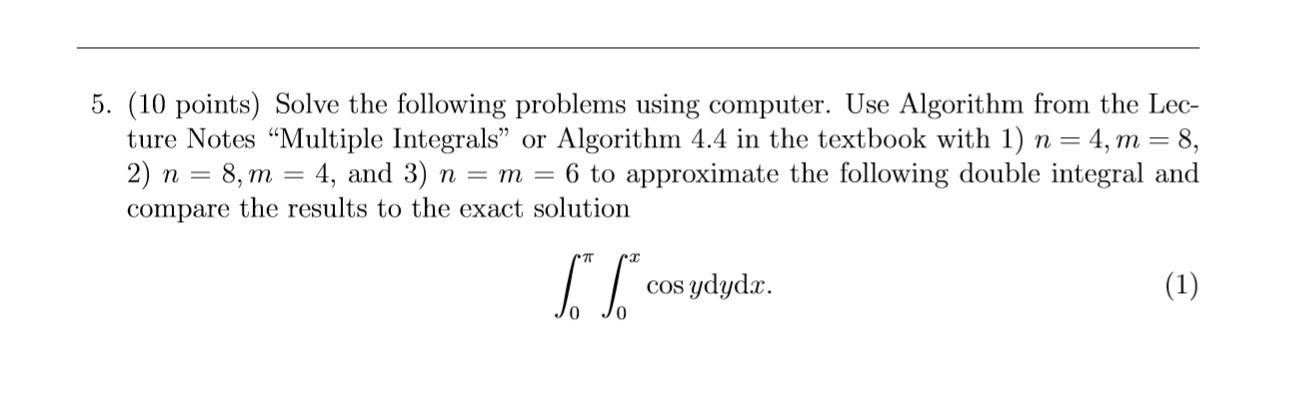
5. (10 points) Solve the following problems using computer. Use Algorithm from the Lec- ture Notes "Multiple Integrals" or Algorithm 4.4 in the textbook with 1) n = 4, m = -8, 2) n = 8, m = 4, and 3) n = m = 6 to approximate the following double integral and compare the results to the exact solution . CL cos ydydx. (1) 5. (10 points) Solve the following problems using computer. Use Algorithm from the Lec- ture Notes "Multiple Integrals" or Algorithm 4.4 in the textbook with 1) n = 4, m = -8, 2) n = 8, m = 4, and 3) n = m = 6 to approximate the following double integral and compare the results to the exact solution . CL cos ydydx. (1)
Step by Step Solution
There are 3 Steps involved in it

Get step-by-step solutions from verified subject matter experts