







Question: please can someone help me to answer the follow Questions for the group project . the questions the group project How does the Group give
please can someone help me to answer the follow Questions for the group project . 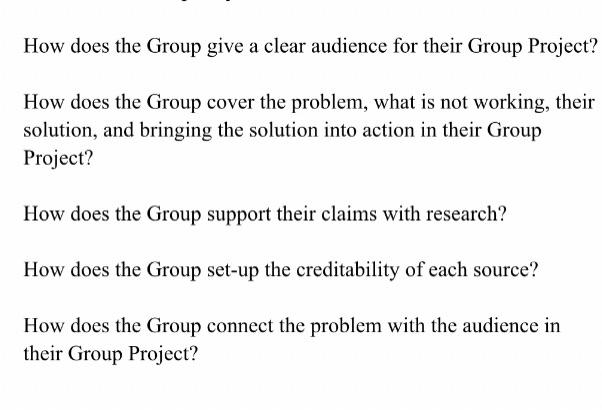
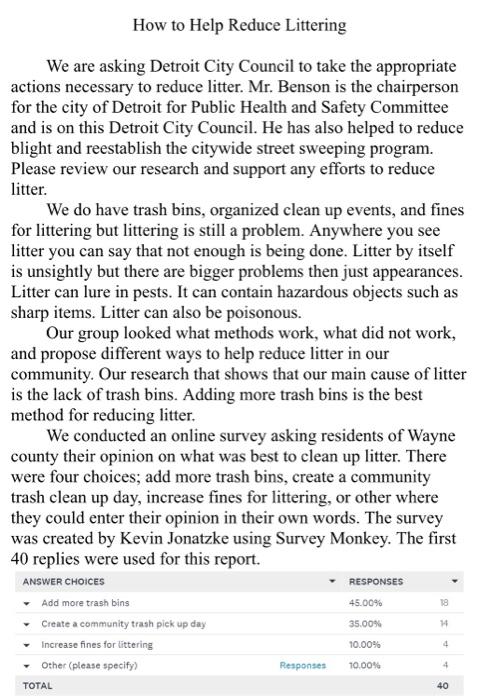
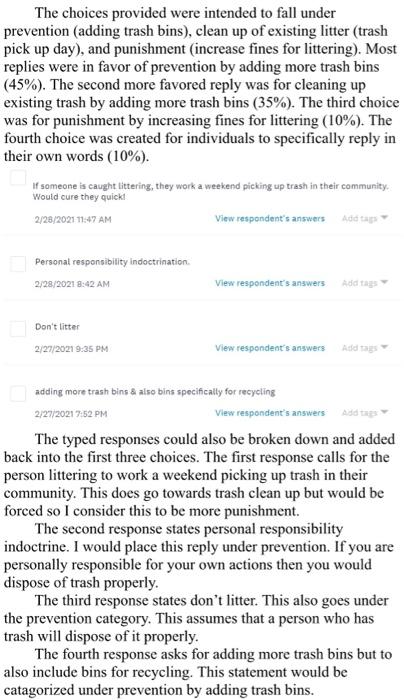
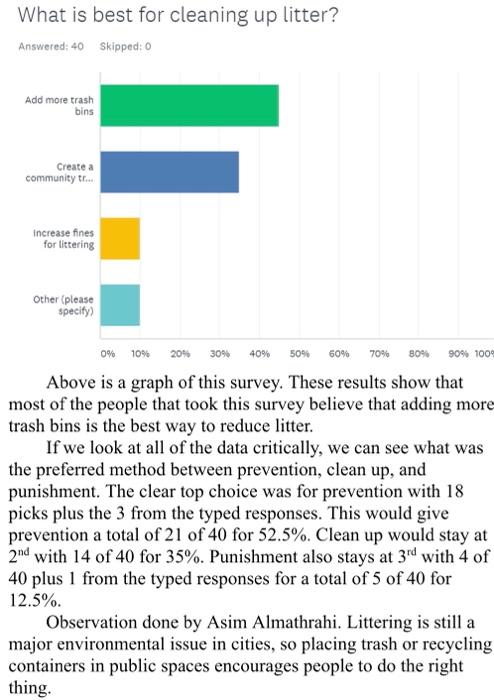
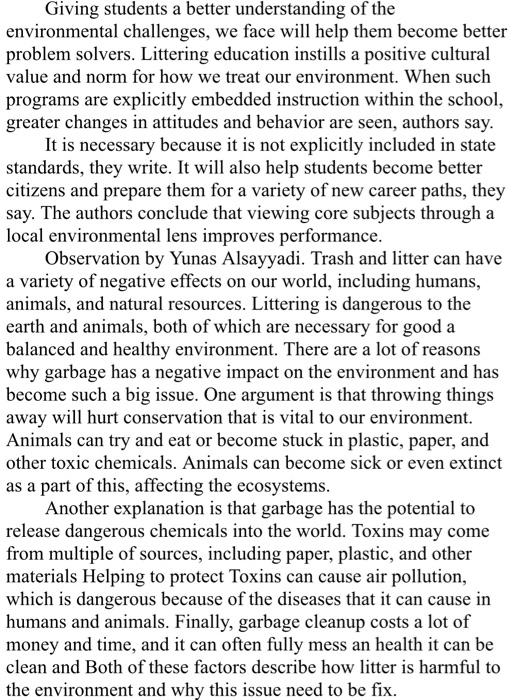
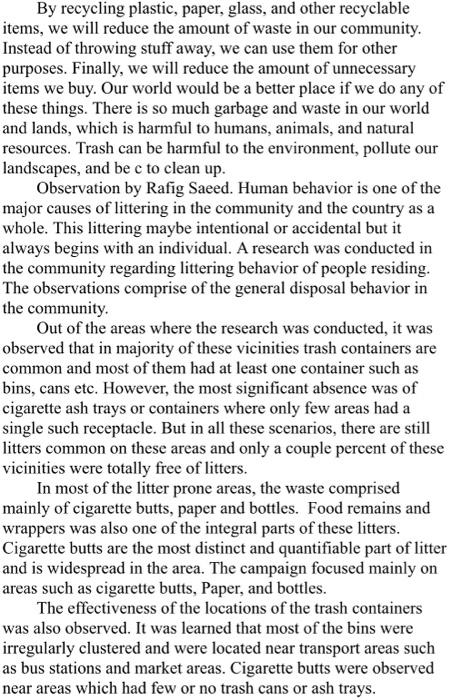
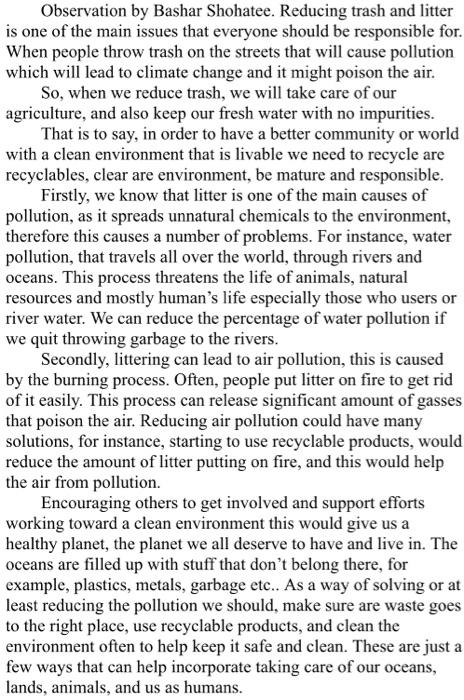
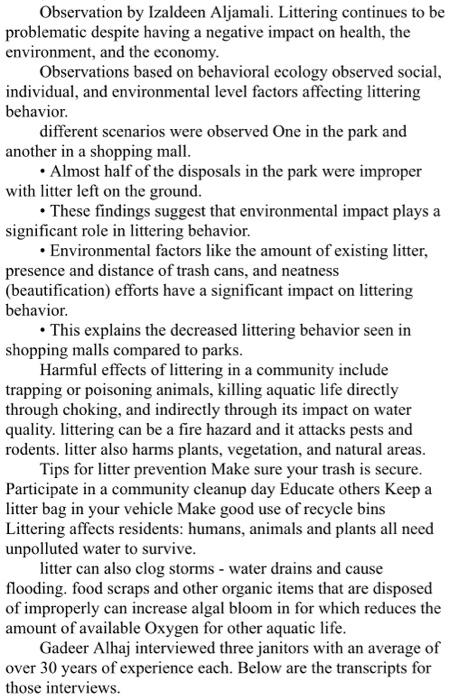
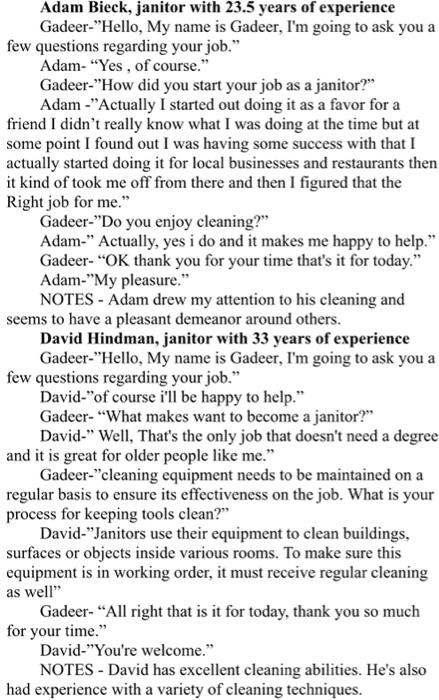
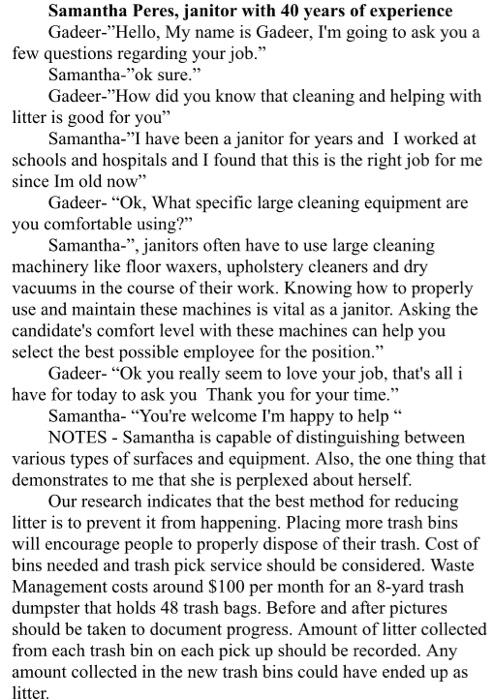
How does the Group give a clear audience for their Group Project? How does the Group cover the problem, what is not working, their solution, and bringing the solution into action in their Group Project? How does the Group support their claims with research? How does the Group set-up the creditability of each source? How does the Group connect the problem with the audience in their Group Project? How to Help Reduce Littering We are asking Detroit City Council to take the appropriate actions necessary to reduce litter. Mr. Benson is the chairperson for the city of Detroit for Public Health and Safety Committee and is on this Detroit City Council. He has also helped to reduce blight and reestablish the citywide street sweeping program. Please review our research and support any efforts to reduce litter. We do have trash bins, organized clean up events, and fines for littering but littering is still a problem. Anywhere you see litter you can say that not enough is being done. Litter by itself is unsightly but there are bigger problems then just appearances. Litter can lure in pests. It can contain hazardous objects such as sharp items. Litter can also be poisonous. Our group looked what methods work, what did not work, and propose different ways to help reduce litter in our community. Our research that shows that our main cause of litter is the lack of trash bins. Adding more trash bins is the best method for reducing litter. We conducted an online survey asking residents of Wayne county their opinion on what was best to clean up litter. There were four choices, add more trash bins, create a community trash clean up day, increase fines for littering, or other where they could enter their opinion in their own words. The survey was created by Kevin Jonatzke using Survey Monkey. The first 40 replies were used for this report. ANSWER CHOICES RESPONSES Add more trash bins 45.00% Create a community trash pick up day Increase fines for littering Other (please specify) 18 35.00% 11 10.00% 4 Responses 10.00% 4 TOTAL 40 The choices provided were intended to fall under prevention (adding trash bins), clean up of existing litter (trash pick up day), and punishment (increase fines for littering). Most replies were in favor of prevention by adding more trash bins (45%). The second more favored reply was for cleaning up existing trash by adding more trash bins (35%). The third choice was for punishment by increasing fines for littering (10%). The fourth choice was created for individuals to specifically reply in their own words (10%). If someone is caught littering, they work a weekend picking up trash in their community Would cure they quickl 2/28/202111:47 AM View respondent's answers Adidas Personal responsibility indoctrination 2/28/2021 8:42 AM View respondent's answers Don't litter 2/27/2021 9:35 PM View respondent's answers adding more trash bins & also bins specifically for recycling 2/27/20212:52 PM View respondent's answers The typed responses could also be broken down and added back into the first three choices. The first response calls for the person littering to work a weekend picking up trash in their community. This does go towards trash clean up but would be forced so I consider this to be more punishment. The second response states personal responsibility indoctrine. I would place this reply under prevention. If you are personally responsible for your own actions then you would dispose of trash properly. The third response states don't litter. This also goes under the prevention category. This assumes that a person who has trash will dispose of it properly. The fourth response asks for adding more trash bins but to also include bins for recycling. This statement would be catagorized under prevention by adding trash bins. What is best for cleaning up litter? Answered: 40 Skipped: 0 Add more trash bins Create a community tr... increase fines for littering Other (please specify) 40% 90% 100% 0% 10% 20% 30% 50% 60% 70% 80% Above is a graph of this survey. These results show that most of the people that took this survey believe that adding more trash bins is the best way to reduce litter. If we look at all of the data critically, we can see what was the preferred method between prevention, clean up, and punishment. The clear top choice was for prevention with 18 picks plus the 3 from the typed responses. This would give prevention a total of 21 of 40 for 52.5%. Clean up would stay at 2nd with 14 of 40 for 35%. Punishment also stays at 3rd with 4 of 40 plus 1 from the typed responses for a total of 5 of 40 for 12.5% Observation done by Asim Almathrahi. Littering is still a major environmental issue in cities, so placing trash or recycling containers in public spaces encourages people to do the right thing. Giving students a better understanding of the environmental challenges, we face will help them become better problem solvers. Littering education instills a positive cultural value and norm for how we treat our environment. When such programs are explicitly embedded instruction within the school, greater changes in attitudes and behavior are seen, authors say. It is necessary because it is not explicitly included in state standards, they write. It will also help students become better citizens and prepare them for a variety of new career paths, they say. The authors conclude that viewing core subjects through a local environmental lens improves performance. Observation by Yunas Alsayyadi. Trash and litter can have a variety of negative effects on our world, including humans, animals, and natural resources. Littering is dangerous to the earth and animals, both of which are necessary for good a balanced and healthy environment. There are a lot of reasons why garbage has a negative impact on the environment and has become such a big issue. One argument is that throwing things away will hurt conservation that is vital to our environment. Animals can try and eat or become stuck in plastic, paper, and other toxic chemicals. Animals can become sick or even extinct as a part of this, affecting the ecosystems. Another explanation is that garbage has the potential to release dangerous chemicals into the world. Toxins may come from multiple of sources, including paper, plastic, and other materials Helping to protect Toxins can cause air pollution, which is dangerous because of the diseases that it can cause in humans and animals. Finally, garbage cleanup costs a lot of money and time, and it can often fully mess an health it can be clean and Both of these factors describe how litter is harmful to the environment and why this issue need to be fix. By recycling plastic, paper, glass, and other recyclable items, we will reduce the amount of waste in our community. Instead of throwing stuff away, we can use them for other purposes. Finally, we will reduce the amount of unnecessary items we buy. Our world would be a better place if we do any of these things. There is so much garbage and waste in our world and lands, which is harmful to humans, animals, and natural resources. Trash can be harmful to the environment, pollute our landscapes, and be c to clean up. Observation by Rafig Saeed. Human behavior is one of the major causes of littering in the community and the country as a whole. This littering maybe intentional or accidental but it always begins with an individual. A research was conducted in the community regarding littering behavior of people residing. The observations comprise of the general disposal behavior in the community Out of the areas where the research was conducted, it was observed that in majority of these vicinities trash containers are common and most of them had at least one container such as bins, cans etc. However, the most significant absence was of cigarette ash trays or containers where only few areas had a single such receptacle. But in all these scenarios, there are still litters common on these areas and only a couple percent of these vicinities were totally free of litters. In most of the litter prone areas, the waste comprised mainly of cigarette butts, paper and bottles. Food remains and wrappers was also one of the integral parts of these litters. Cigarette butts are the most distinct and quantifiable part of litter and is widespread in the area. The campaign focused mainly on areas such as cigarette butts, Paper, and bottles. The effectiveness of the locations of the trash containers was also observed. It was learned that most of the bins were irregularly clustered and were located near transport areas such as bus stations and market areas. Cigarette butts were observed near areas which had few or no trash cans or ash trays. Observation by Bashar Shohatee. Reducing trash and litter is one of the main issues that everyone should be responsible for When people throw trash on the streets that will cause pollution which will lead to climate change and it might poison the air. So, when we reduce trash, we will take care of our agriculture, and also keep our fresh water with no impurities. That is to say, in order to have a better community or world with a clean environment that is livable we need to recycle are recyclables, clear are environment, be mature and responsible. Firstly, we know that litter is one of the main causes of pollution, as it spreads unnatural chemicals to the environment, therefore this causes a number of problems. For instance, water pollution, that travels all over the world, through rivers and oceans. This process threatens the life of animals, natural resources and mostly human's life especially those who users or river water. We can reduce the percentage of water pollution if we quit throwing garbage to the rivers. Secondly, littering can lead to air pollution, this is caused by the burning process. Often, people put litter on fire to get rid of it easily. This process can release significant amount of gasses that poison the air. Reducing air pollution could have many solutions, for instance, starting to use recyclable products, would reduce the amount of litter putting on fire, and this would help the air from pollution Encouraging others to get involved and support efforts working toward a clean environment this would give us a healthy planet, the planet we all deserve to have and live in. The oceans are filled up with stuff that don't belong there, for example, plastics, metals, garbage etc.. As a way of solving or at least reducing the pollution we should make sure are waste goes to the right place, use recyclable products, and clean the environment often to help keep it safe and clean. These are just a few ways that can help incorporate taking care of our oceans, lands, animals, and us as humans. Observation by Izaldeen Aljamali. Littering continues to be problematic despite having a negative impact on health, the environment, and the economy. Observations based on behavioral ecology observed social, individual, and environmental level factors affecting littering behavior. different scenarios were observed One in the park and another in a shopping mall. Almost half of the disposals in the park were improper with litter left on the ground. These findings suggest that environmental impact plays a significant role in littering behavior. Environmental factors like the amount of existing litter, presence and distance of trash cans, and neatness (beautification) efforts have a significant impact on littering behavior. This explains the decreased littering behavior seen in shopping malls compared to parks. Harmful effects of littering in a community include trapping or poisoning animals, killing aquatic life directly through choking, and indirectly through its impact on water quality. littering can be a fire hazard and it attacks pests and rodents. litter also harms plants, vegetation, and natural areas. Tips for litter prevention Make sure your trash is secure. Participate in a community cleanup day Educate others Keep a litter bag in your vehicle Make good use of recycle bins Littering affects residents: humans, animals and plants all need unpolluted water to survive. litter can also clog storms - water drains and cause flooding. food scraps and other organic items that are disposed of improperly can increase algal bloom in for which reduces the amount of available Oxygen for other aquatic life. Gadeer Alhaj interviewed three janitors with an average of over 30 years of experience each. Below are the transcripts for those interviews. Adam Bieck, janitor with 23.5 years of experience Gadeer-"Hello, My name is Gadeer, I'm going to ask you a few questions regarding your job." Adam- "Yes, of course." Gadeer-"How did you start your job as a janitor?" Adam -"Actually I started out doing it as a favor for a friend I didn't really know what I was doing at the time but at some point I found out I was having some success with that I actually started doing it for local businesses and restaurants then it kind of took me off from there and then I figured that the Right job for me." Gadeer-"Do you enjoy cleaning?" Adam-" Actually, yes i do and it makes me happy to help. Gadeer- "OK thank you for your time that's it for today. Adam-"My pleasure." NOTES - Adam drew my attention to his cleaning and seems to have a pleasant demeanor around others. David Hindman, janitor with 33 years of experience Gadeer-"Hello, My name is Gadeer, I'm going to ask you a few questions regarding your job." David-"of course i'll be happy to help." Gadeer- "What makes want to become a janitor?" David-" Well, That's the only job that doesn't need a degree and it is great for older people like me." Gadeer-"cleaning equipment needs to be maintained on a regular basis to ensure its effectiveness on the job. What is your process for keeping tools clean?" David-"Janitors use their equipment to clean buildings, surfaces or objects inside various rooms. To make sure this equipment is in working order, it must receive regular cleaning as well" Gadeer- All right that is it for today, thank you so much for your time." David-"You're welcome." NOTES - David has excellent cleaning abilities. He's also had experience with a variety of cleaning techniques. Samantha Peres, janitor with 40 years of experience Gadeer-"Hello, My name is Gadeer, I'm going to ask you a few questions regarding your job." Samantha-"ok sure. Gadeer-How did you know that cleaning and helping with litter is good for you" Samantha-"I have been a janitor for years and I worked at schools and hospitals and I found that this is the right job for me since Im old now" Gadeer- "Ok, What specific large cleaning equipment are you comfortable using?" Samantha-", janitors often have to use large cleaning machinery like floor waxers, upholstery cleaners and dry vacuums in the course of their work. Knowing how to properly use and maintain these machines is vital as a janitor. Asking the candidate's comfort level with these machines can help you select the best possible employee for the position." Gadeer- "Ok you really seem to love your job, that's all i have for today to ask you Thank you for your time." Samantha-"You're welcome I'm happy to help NOTES - Samantha is capable of distinguishing between various types of surfaces and equipment. Also, the one thing that demonstrates to me that she is perplexed about herself. Our research indicates that the best method for reducing litter is to prevent it from happening. Placing more trash bins will encourage people to properly dispose of their trash. Cost of bins needed and trash pick service should be considered. Waste Management costs around $100 per month for an 8-yard trash dumpster that holds 48 trash bags. Before and after pictures should be taken to document progress. Amount of litter collected from each trash bin on each pick up should be recorded. Any amount collected in the new trash bins could have ended up as litter. How does the Group give a clear audience for their Group Project? How does the Group cover the problem, what is not working, their solution, and bringing the solution into action in their Group Project? How does the Group support their claims with research? How does the Group set-up the creditability of each source? How does the Group connect the problem with the audience in their Group Project? How to Help Reduce Littering We are asking Detroit City Council to take the appropriate actions necessary to reduce litter. Mr. Benson is the chairperson for the city of Detroit for Public Health and Safety Committee and is on this Detroit City Council. He has also helped to reduce blight and reestablish the citywide street sweeping program. Please review our research and support any efforts to reduce litter. We do have trash bins, organized clean up events, and fines for littering but littering is still a problem. Anywhere you see litter you can say that not enough is being done. Litter by itself is unsightly but there are bigger problems then just appearances. Litter can lure in pests. It can contain hazardous objects such as sharp items. Litter can also be poisonous. Our group looked what methods work, what did not work, and propose different ways to help reduce litter in our community. Our research that shows that our main cause of litter is the lack of trash bins. Adding more trash bins is the best method for reducing litter. We conducted an online survey asking residents of Wayne county their opinion on what was best to clean up litter. There were four choices, add more trash bins, create a community trash clean up day, increase fines for littering, or other where they could enter their opinion in their own words. The survey was created by Kevin Jonatzke using Survey Monkey. The first 40 replies were used for this report. ANSWER CHOICES RESPONSES Add more trash bins 45.00% Create a community trash pick up day Increase fines for littering Other (please specify) 18 35.00% 11 10.00% 4 Responses 10.00% 4 TOTAL 40 The choices provided were intended to fall under prevention (adding trash bins), clean up of existing litter (trash pick up day), and punishment (increase fines for littering). Most replies were in favor of prevention by adding more trash bins (45%). The second more favored reply was for cleaning up existing trash by adding more trash bins (35%). The third choice was for punishment by increasing fines for littering (10%). The fourth choice was created for individuals to specifically reply in their own words (10%). If someone is caught littering, they work a weekend picking up trash in their community Would cure they quickl 2/28/202111:47 AM View respondent's answers Adidas Personal responsibility indoctrination 2/28/2021 8:42 AM View respondent's answers Don't litter 2/27/2021 9:35 PM View respondent's answers adding more trash bins & also bins specifically for recycling 2/27/20212:52 PM View respondent's answers The typed responses could also be broken down and added back into the first three choices. The first response calls for the person littering to work a weekend picking up trash in their community. This does go towards trash clean up but would be forced so I consider this to be more punishment. The second response states personal responsibility indoctrine. I would place this reply under prevention. If you are personally responsible for your own actions then you would dispose of trash properly. The third response states don't litter. This also goes under the prevention category. This assumes that a person who has trash will dispose of it properly. The fourth response asks for adding more trash bins but to also include bins for recycling. This statement would be catagorized under prevention by adding trash bins. What is best for cleaning up litter? Answered: 40 Skipped: 0 Add more trash bins Create a community tr... increase fines for littering Other (please specify) 40% 90% 100% 0% 10% 20% 30% 50% 60% 70% 80% Above is a graph of this survey. These results show that most of the people that took this survey believe that adding more trash bins is the best way to reduce litter. If we look at all of the data critically, we can see what was the preferred method between prevention, clean up, and punishment. The clear top choice was for prevention with 18 picks plus the 3 from the typed responses. This would give prevention a total of 21 of 40 for 52.5%. Clean up would stay at 2nd with 14 of 40 for 35%. Punishment also stays at 3rd with 4 of 40 plus 1 from the typed responses for a total of 5 of 40 for 12.5% Observation done by Asim Almathrahi. Littering is still a major environmental issue in cities, so placing trash or recycling containers in public spaces encourages people to do the right thing. Giving students a better understanding of the environmental challenges, we face will help them become better problem solvers. Littering education instills a positive cultural value and norm for how we treat our environment. When such programs are explicitly embedded instruction within the school, greater changes in attitudes and behavior are seen, authors say. It is necessary because it is not explicitly included in state standards, they write. It will also help students become better citizens and prepare them for a variety of new career paths, they say. The authors conclude that viewing core subjects through a local environmental lens improves performance. Observation by Yunas Alsayyadi. Trash and litter can have a variety of negative effects on our world, including humans, animals, and natural resources. Littering is dangerous to the earth and animals, both of which are necessary for good a balanced and healthy environment. There are a lot of reasons why garbage has a negative impact on the environment and has become such a big issue. One argument is that throwing things away will hurt conservation that is vital to our environment. Animals can try and eat or become stuck in plastic, paper, and other toxic chemicals. Animals can become sick or even extinct as a part of this, affecting the ecosystems. Another explanation is that garbage has the potential to release dangerous chemicals into the world. Toxins may come from multiple of sources, including paper, plastic, and other materials Helping to protect Toxins can cause air pollution, which is dangerous because of the diseases that it can cause in humans and animals. Finally, garbage cleanup costs a lot of money and time, and it can often fully mess an health it can be clean and Both of these factors describe how litter is harmful to the environment and why this issue need to be fix. By recycling plastic, paper, glass, and other recyclable items, we will reduce the amount of waste in our community. Instead of throwing stuff away, we can use them for other purposes. Finally, we will reduce the amount of unnecessary items we buy. Our world would be a better place if we do any of these things. There is so much garbage and waste in our world and lands, which is harmful to humans, animals, and natural resources. Trash can be harmful to the environment, pollute our landscapes, and be c to clean up. Observation by Rafig Saeed. Human behavior is one of the major causes of littering in the community and the country as a whole. This littering maybe intentional or accidental but it always begins with an individual. A research was conducted in the community regarding littering behavior of people residing. The observations comprise of the general disposal behavior in the community Out of the areas where the research was conducted, it was observed that in majority of these vicinities trash containers are common and most of them had at least one container such as bins, cans etc. However, the most significant absence was of cigarette ash trays or containers where only few areas had a single such receptacle. But in all these scenarios, there are still litters common on these areas and only a couple percent of these vicinities were totally free of litters. In most of the litter prone areas, the waste comprised mainly of cigarette butts, paper and bottles. Food remains and wrappers was also one of the integral parts of these litters. Cigarette butts are the most distinct and quantifiable part of litter and is widespread in the area. The campaign focused mainly on areas such as cigarette butts, Paper, and bottles. The effectiveness of the locations of the trash containers was also observed. It was learned that most of the bins were irregularly clustered and were located near transport areas such as bus stations and market areas. Cigarette butts were observed near areas which had few or no trash cans or ash trays. Observation by Bashar Shohatee. Reducing trash and litter is one of the main issues that everyone should be responsible for When people throw trash on the streets that will cause pollution which will lead to climate change and it might poison the air. So, when we reduce trash, we will take care of our agriculture, and also keep our fresh water with no impurities. That is to say, in order to have a better community or world with a clean environment that is livable we need to recycle are recyclables, clear are environment, be mature and responsible. Firstly, we know that litter is one of the main causes of pollution, as it spreads unnatural chemicals to the environment, therefore this causes a number of problems. For instance, water pollution, that travels all over the world, through rivers and oceans. This process threatens the life of animals, natural resources and mostly human's life especially those who users or river water. We can reduce the percentage of water pollution if we quit throwing garbage to the rivers. Secondly, littering can lead to air pollution, this is caused by the burning process. Often, people put litter on fire to get rid of it easily. This process can release significant amount of gasses that poison the air. Reducing air pollution could have many solutions, for instance, starting to use recyclable products, would reduce the amount of litter putting on fire, and this would help the air from pollution Encouraging others to get involved and support efforts working toward a clean environment this would give us a healthy planet, the planet we all deserve to have and live in. The oceans are filled up with stuff that don't belong there, for example, plastics, metals, garbage etc.. As a way of solving or at least reducing the pollution we should make sure are waste goes to the right place, use recyclable products, and clean the environment often to help keep it safe and clean. These are just a few ways that can help incorporate taking care of our oceans, lands, animals, and us as humans. Observation by Izaldeen Aljamali. Littering continues to be problematic despite having a negative impact on health, the environment, and the economy. Observations based on behavioral ecology observed social, individual, and environmental level factors affecting littering behavior. different scenarios were observed One in the park and another in a shopping mall. Almost half of the disposals in the park were improper with litter left on the ground. These findings suggest that environmental impact plays a significant role in littering behavior. Environmental factors like the amount of existing litter, presence and distance of trash cans, and neatness (beautification) efforts have a significant impact on littering behavior. This explains the decreased littering behavior seen in shopping malls compared to parks. Harmful effects of littering in a community include trapping or poisoning animals, killing aquatic life directly through choking, and indirectly through its impact on water quality. littering can be a fire hazard and it attacks pests and rodents. litter also harms plants, vegetation, and natural areas. Tips for litter prevention Make sure your trash is secure. Participate in a community cleanup day Educate others Keep a litter bag in your vehicle Make good use of recycle bins Littering affects residents: humans, animals and plants all need unpolluted water to survive. litter can also clog storms - water drains and cause flooding. food scraps and other organic items that are disposed of improperly can increase algal bloom in for which reduces the amount of available Oxygen for other aquatic life. Gadeer Alhaj interviewed three janitors with an average of over 30 years of experience each. Below are the transcripts for those interviews. Adam Bieck, janitor with 23.5 years of experience Gadeer-"Hello, My name is Gadeer, I'm going to ask you a few questions regarding your job." Adam- "Yes, of course." Gadeer-"How did you start your job as a janitor?" Adam -"Actually I started out doing it as a favor for a friend I didn't really know what I was doing at the time but at some point I found out I was having some success with that I actually started doing it for local businesses and restaurants then it kind of took me off from there and then I figured that the Right job for me." Gadeer-"Do you enjoy cleaning?" Adam-" Actually, yes i do and it makes me happy to help. Gadeer- "OK thank you for your time that's it for today. Adam-"My pleasure." NOTES - Adam drew my attention to his cleaning and seems to have a pleasant demeanor around others. David Hindman, janitor with 33 years of experience Gadeer-"Hello, My name is Gadeer, I'm going to ask you a few questions regarding your job." David-"of course i'll be happy to help." Gadeer- "What makes want to become a janitor?" David-" Well, That's the only job that doesn't need a degree and it is great for older people like me." Gadeer-"cleaning equipment needs to be maintained on a regular basis to ensure its effectiveness on the job. What is your process for keeping tools clean?" David-"Janitors use their equipment to clean buildings, surfaces or objects inside various rooms. To make sure this equipment is in working order, it must receive regular cleaning as well" Gadeer- All right that is it for today, thank you so much for your time." David-"You're welcome." NOTES - David has excellent cleaning abilities. He's also had experience with a variety of cleaning techniques. Samantha Peres, janitor with 40 years of experience Gadeer-"Hello, My name is Gadeer, I'm going to ask you a few questions regarding your job." Samantha-"ok sure. Gadeer-How did you know that cleaning and helping with litter is good for you" Samantha-"I have been a janitor for years and I worked at schools and hospitals and I found that this is the right job for me since Im old now" Gadeer- "Ok, What specific large cleaning equipment are you comfortable using?" Samantha-", janitors often have to use large cleaning machinery like floor waxers, upholstery cleaners and dry vacuums in the course of their work. Knowing how to properly use and maintain these machines is vital as a janitor. Asking the candidate's comfort level with these machines can help you select the best possible employee for the position." Gadeer- "Ok you really seem to love your job, that's all i have for today to ask you Thank you for your time." Samantha-"You're welcome I'm happy to help NOTES - Samantha is capable of distinguishing between various types of surfaces and equipment. Also, the one thing that demonstrates to me that she is perplexed about herself. Our research indicates that the best method for reducing litter is to prevent it from happening. Placing more trash bins will encourage people to properly dispose of their trash. Cost of bins needed and trash pick service should be considered. Waste Management costs around $100 per month for an 8-yard trash dumpster that holds 48 trash bags. Before and after pictures should be taken to document progress. Amount of litter collected from each trash bin on each pick up should be recorded. Any amount collected in the new trash bins could have ended up as litter the questions
the group project
Step by Step Solution
There are 3 Steps involved in it
1 Expert Approved Answer
Step: 1 Unlock

Question Has Been Solved by an Expert!
Get step-by-step solutions from verified subject matter experts
Step: 2 Unlock
Step: 3 Unlock
 Study Help