







Question: Please can you solve using EXCEL M/M/1 Queue with Feedback: consider a standard first-in-first-out M/M/1 queue with the following modification: the server quality is unreliable
Please can you solve using EXCEL
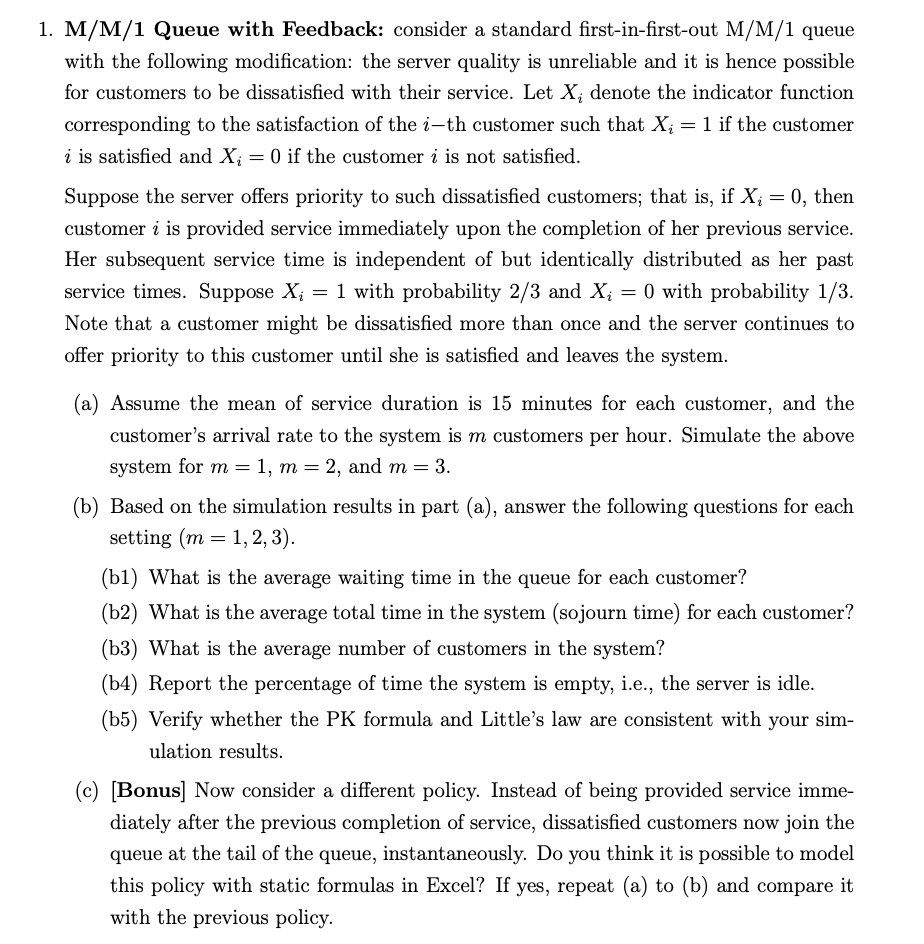
M/M/1 Queue with Feedback: consider a standard first-in-first-out M/M/1 queue with the following modification: the server quality is unreliable and it is hence possible for customers to be dissatisfied with their service. Let Xi denote the indicator function corresponding to the satisfaction of the i-th customer such that Xi=1 if the customer i is satisfied and Xi=0 if the customer i is not satisfied. Suppose the server offers priority to such dissatisfied customers; that is, if Xi=0, then customer i is provided service immediately upon the completion of her previous service. Her subsequent service time is independent of but identically distributed as her past service times. Suppose Xi=1 with probability 2/3 and Xi=0 with probability 1/3. Note that a customer might be dissatisfied more than once and the server continues to offer priority to this customer until she is satisfied and leaves the system. (a) Assume the mean of service duration is 15 minutes for each customer, and the customer's arrival rate to the system is m customers per hour. Simulate the above system for m=1,m=2, and m=3. (b) Based on the simulation results in part (a), answer the following questions for each setting (m=1,2,3). (b1) What is the average waiting time in the queue for each customer? (b2) What is the average total time in the system (sojourn time) for each customer? (b3) What is the average number of customers in the system? (b4) Report the percentage of time the system is empty, i.e., the server is idle. (b5) Verify whether the PK formula and Little's law are consistent with your simulation results. (c) [Bonus] Now consider a different policy. Instead of being provided service immediately after the previous completion of service, dissatisfied customers now join the queue at the tail of the queue, instantaneously. Do you think it is possible to model this policy with static formulas in Excel? If yes, repeat (a) to (b) and compare it with the previous policy
Step by Step Solution
There are 3 Steps involved in it

Get step-by-step solutions from verified subject matter experts
 Study Help