







Question: please case study all questions CASE STUDY Objective: To understand the role of leadership within organisations. Sam Magubane - Sun Sporting Goods The Sun Sporting
please case study all questions 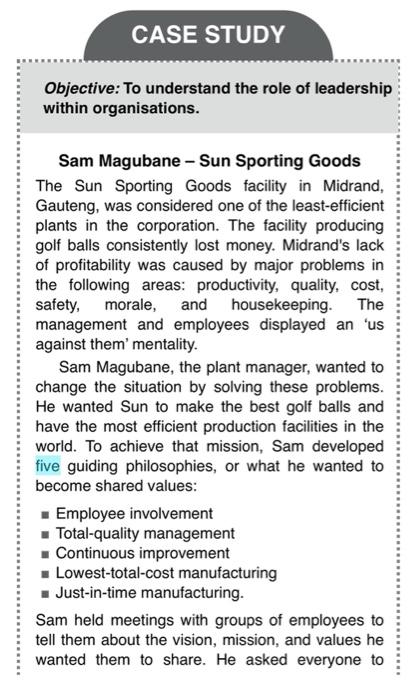
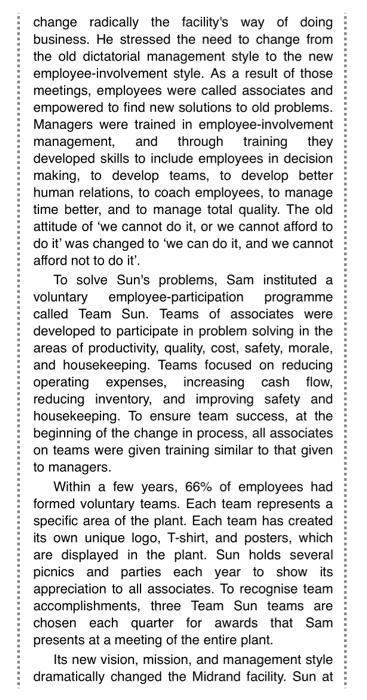
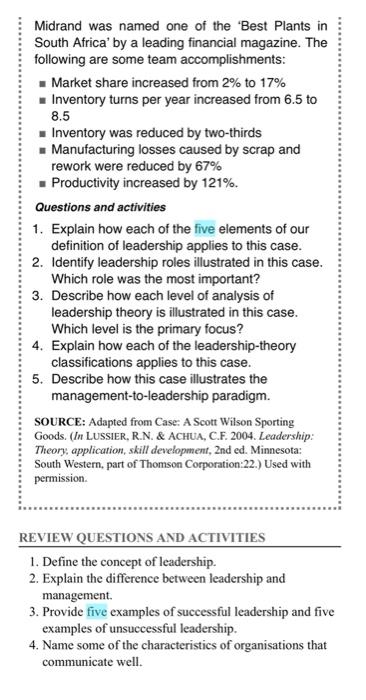
CASE STUDY Objective: To understand the role of leadership within organisations. Sam Magubane - Sun Sporting Goods The Sun Sporting Goods facility in Midrand, Gauteng, was considered one of the least-efficient plants in the corporation. The facility producing golf balls consistently lost money. Midrand's lack of profitability was caused by major problems in the following areas: productivity, quality, cost, safety, morale, and housekeeping. The management and employees displayed an 'us against them' mentality. Sam Magubane, the plant manager, wanted to change the situation by solving these problems. He wanted Sun to make the best golf balls and have the most efficient production facilities in the world. To achieve that mission, Sam developed five guiding philosophies, or what he wanted to become shared values: . Employee involvement Total-quality management Continuous improvement Lowest-total-cost manufacturing Just-in-time manufacturing. Sam held meetings with groups of employees to tell them about the vision, mission, and values he wanted them to share. He asked everyone to change radically the facility's way of doing business. He stressed the need to change from the old dictatorial management style to the new employee-involvement style. As a result of those meetings, employees were called associates and empowered to find new solutions to old problems. Managers were trained in employee-involvement management, and through training they developed skills to include employees in decision making, to develop teams, to develop better human relations, to coach employees, to manage time better, and to manage total quality. The old attitude of 'we cannot do it, or we cannot afford to do it' was changed to 'we can do it, and we cannot afford not to do it' To solve Sun's problems, Sam instituted a voluntary employee-participation programme called Team Sun. Teams of associates were developed to participate in problem solving in the areas of productivity, quality, cost, safety, morale, and housekeeping. Teams focused on reducing operating expenses, increasing cash flow, reducing inventory, and improving safety and housekeeping. To ensure team success, at the beginning of the change in process, all associates on teams were given training similar to that given to managers. Within a few years, 66% of employees had formed voluntary teams. Each team represents a specific area of the plant. Each team has created its own unique logo, T-shirt, and posters, which are displayed in the plant. Sun holds several picnics and parties each year to show its appreciation to all associates. To recognise team accomplishments, three Team Sun teams are chosen each quarter for awards that Sam presents at a meeting of the entire plant. Its new vision, mission, and management style dramatically changed the Midrand facility. Sun at Midrand was named one of the Best Plants in South Africa' by a leading financial magazine. The following are some team accomplishments: Market share increased from 2% to 17% Inventory turns per year increased from 6.5 to 8.5 Inventory was reduced by two-thirds Manufacturing losses caused by scrap and rework were reduced by 67% Productivity increased by 121%. Questions and activities 1. Explain how each of the five elements of our definition of leadership applies to this case. 2. Identify leadership roles illustrated in this case. Which role was the most important? 3. Describe how each level of analysis of leadership theory is illustrated in this case. Which level is the primary focus? 4. Explain how each of the leadership-theory classifications applies to this case. 5. Describe how this case illustrates the management-to-leadership paradigm. SOURCE: Adapted from Case: A Scott Wilson Sporting Goods. (In LUSSIER, R.N. & ACHUA, C.F. 2004. Leadership: Theory, application, skill development, 2nd ed. Minnesota: South Western, part of Thomson Corporation:22.) Used with permission REVIEW QUESTIONS AND ACTIVITIES 1. Define the concept of leadership 2. Explain the difference between leadership and management 3. Provide five examples of successful leadership and five examples of unsuccessful leadership. 4. Name some of the characteristics of organisations that communicate well Step by Step Solution
There are 3 Steps involved in it
1 Expert Approved Answer
Step: 1 Unlock

Question Has Been Solved by an Expert!
Get step-by-step solutions from verified subject matter experts
Step: 2 Unlock
Step: 3 Unlock
 Study Help