



Question: Please check the attached file for the instructions and details. Complete Stock Index Fair Value Analysis. Stock Index Fair Value Analysis Many of topics in
Please check the attached file for the instructions and details.
Complete Stock Index Fair Value Analysis.
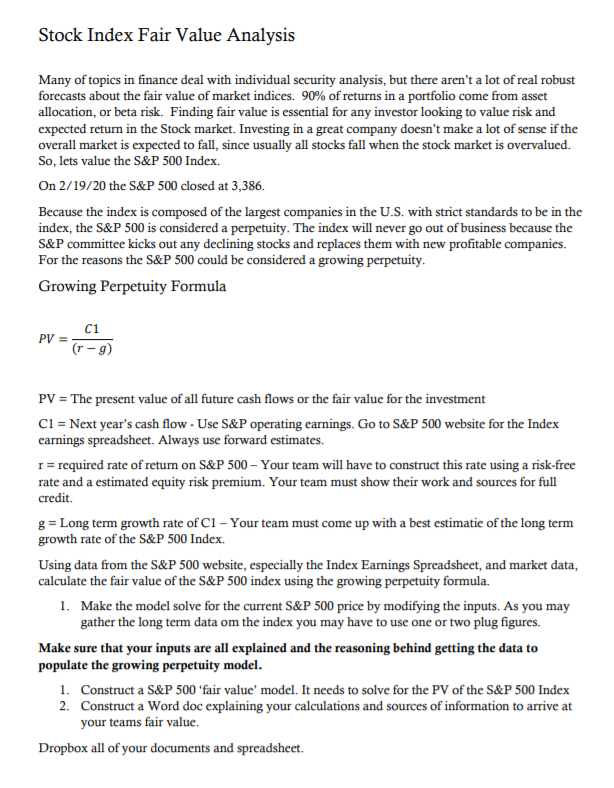
Stock Index Fair Value Analysis Many of topics in finance deal with individual security analysis, but there aren't a lot of real robust forecasts about the fair value of market indices. 90% of returns in a portfolio come from asset allocation, or beta risk. Finding fair value is essential for any investor looking to value risk and expected return in the Stock market. Investing in a great company doesn't make a lot of sense if the overall market is expected to fall, since usually all stocks fall when the stock market is overvalued. So, lets value the S&P 500 Index. On 2/19/20 the S&P 500 closed at 3,386. Because the index is composed of the largest companies in the U.S. with strict standards to be in the index, the S&P 500 is considered a perpetuity. The index will never go out of business because the S&P committee kicks out any declining stocks and replaces them with new profitable companies. For the reasons the S&P 500 could be considered a growing perpetuity. Growing Perpetuity Formula PV = (20 PV = The present value of all future cash flows or the fair value for the investment CI = Next year's cash flow - Use S&P operating earnings. Go to S&P 500 website for the Index earnings spreadsheet. Always use forward estimates. r = required rate of return on S&P 500 - Your team will have to construct this rate using a risk-free rate and a estimated equity risk premium. Your team must show their work and sources for full credit. g= Long term growth rate of CI-Your team must come up with a best estimatie of the long term growth rate of the S&P 500 Index. Using data from the S&P 500 website, especially the Index Earnings Spreadsheet, and market data, calculate the fair value of the S&P 500 index using the growing perpetuity formula. 1. Make the model solve for the current S&P 500 price by modifying the inputs. As you may gather the long term data om the index you may have to use one or two plug figures. Make sure that your inputs are all explained and the reasoning behind getting the data to populate the growing perpetuity model. 1. Construct a S&P 500 'fair value' model. It needs to solve for the PV of the S&P 500 Index 2. Construct a Word doc explaining your calculations and sources of information to arrive at your teams fair value. Dropbox all of your documents and spreadsheet. Stock Index Fair Value Analysis Many of topics in finance deal with individual security analysis, but there aren't a lot of real robust forecasts about the fair value of market indices. 90% of returns in a portfolio come from asset allocation, or beta risk. Finding fair value is essential for any investor looking to value risk and expected return in the Stock market. Investing in a great company doesn't make a lot of sense if the overall market is expected to fall, since usually all stocks fall when the stock market is overvalued. So, lets value the S&P 500 Index. On 2/19/20 the S&P 500 closed at 3,386. Because the index is composed of the largest companies in the U.S. with strict standards to be in the index, the S&P 500 is considered a perpetuity. The index will never go out of business because the S&P committee kicks out any declining stocks and replaces them with new profitable companies. For the reasons the S&P 500 could be considered a growing perpetuity. Growing Perpetuity Formula PV = (20 PV = The present value of all future cash flows or the fair value for the investment CI = Next year's cash flow - Use S&P operating earnings. Go to S&P 500 website for the Index earnings spreadsheet. Always use forward estimates. r = required rate of return on S&P 500 - Your team will have to construct this rate using a risk-free rate and a estimated equity risk premium. Your team must show their work and sources for full credit. g= Long term growth rate of CI-Your team must come up with a best estimatie of the long term growth rate of the S&P 500 Index. Using data from the S&P 500 website, especially the Index Earnings Spreadsheet, and market data, calculate the fair value of the S&P 500 index using the growing perpetuity formula. 1. Make the model solve for the current S&P 500 price by modifying the inputs. As you may gather the long term data om the index you may have to use one or two plug figures. Make sure that your inputs are all explained and the reasoning behind getting the data to populate the growing perpetuity model. 1. Construct a S&P 500 'fair value' model. It needs to solve for the PV of the S&P 500 Index 2. Construct a Word doc explaining your calculations and sources of information to arrive at your teams fair value. Dropbox all of your documents and spreadsheet
Step by Step Solution
There are 3 Steps involved in it

Get step-by-step solutions from verified subject matter experts