Question: Please choose one topic and write a paper. I will give you the best feedbacks. Creative Writing Papers 1) A Missing Chapter: write a missing
Please choose one topic and write a paper. I will give you the best feedbacks.
Creative Writing Papers
1) A Missing Chapter: write a missing chapter to one of the works in class-either a missing ending, beginning, or something in the middle. This chapter should deal with characters and themes in the book, but should add its own "twist" that helps interpret the work from a modern perspective. For example, what might Elizabeth have said to the Creature?
2) Gothic Letters/Diary: a set of "discovered" letters that either start in the middle or break off before the end. Experiment with the epistolary form and the voice of a single narrator, and consider what we see and what falls between the letters (or letters that the writer responds to but that we don't get to see). Be sure that crucial information/elements are missing, and don't create a complete narrative-have it seem incomplete and mysterious (and thus Gothic!).
3) Write a Ghost Story in the spirit of Dickens or Victorian writers we've read in class.
The paper should be 5-7 pages.
Victorian Gothic
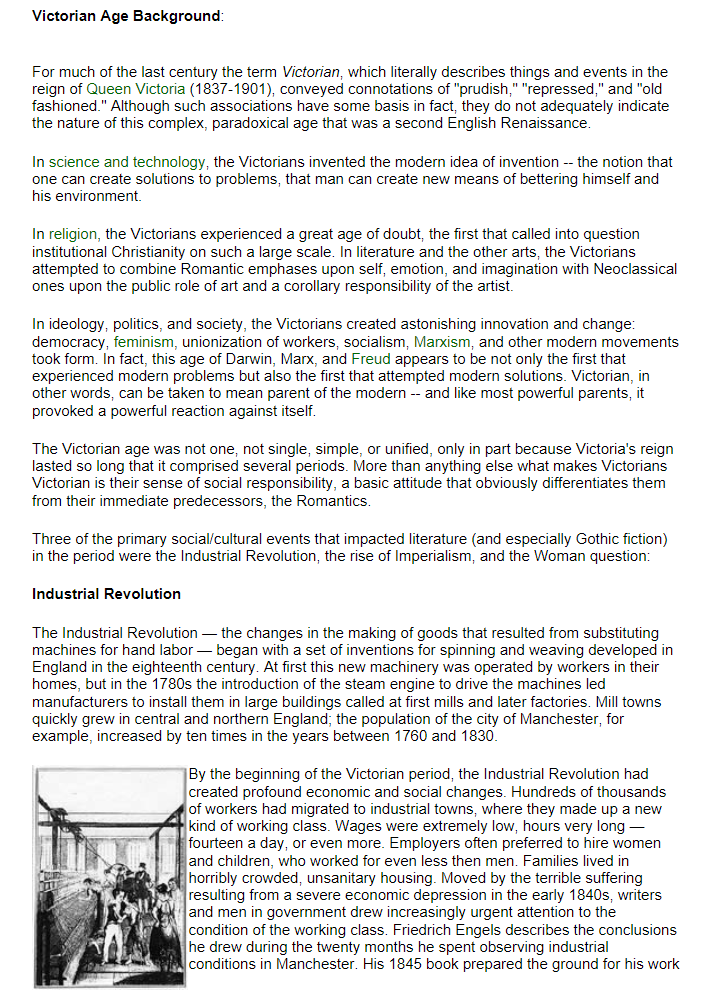
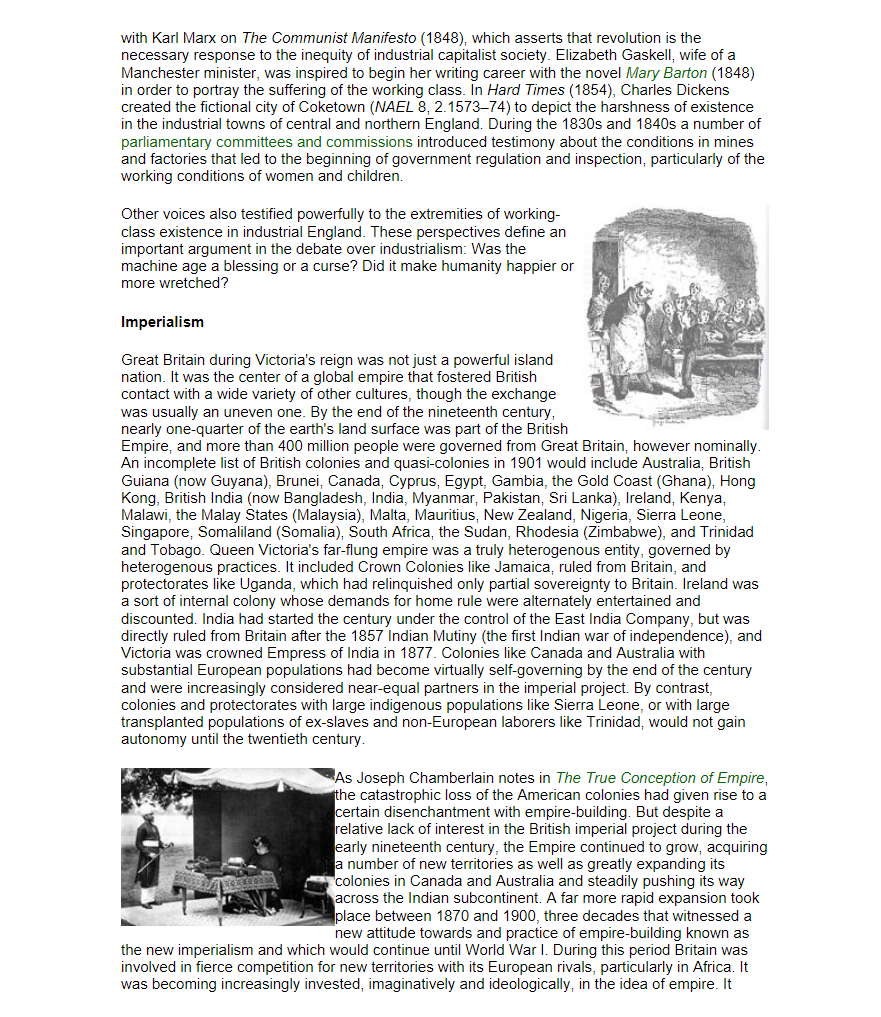
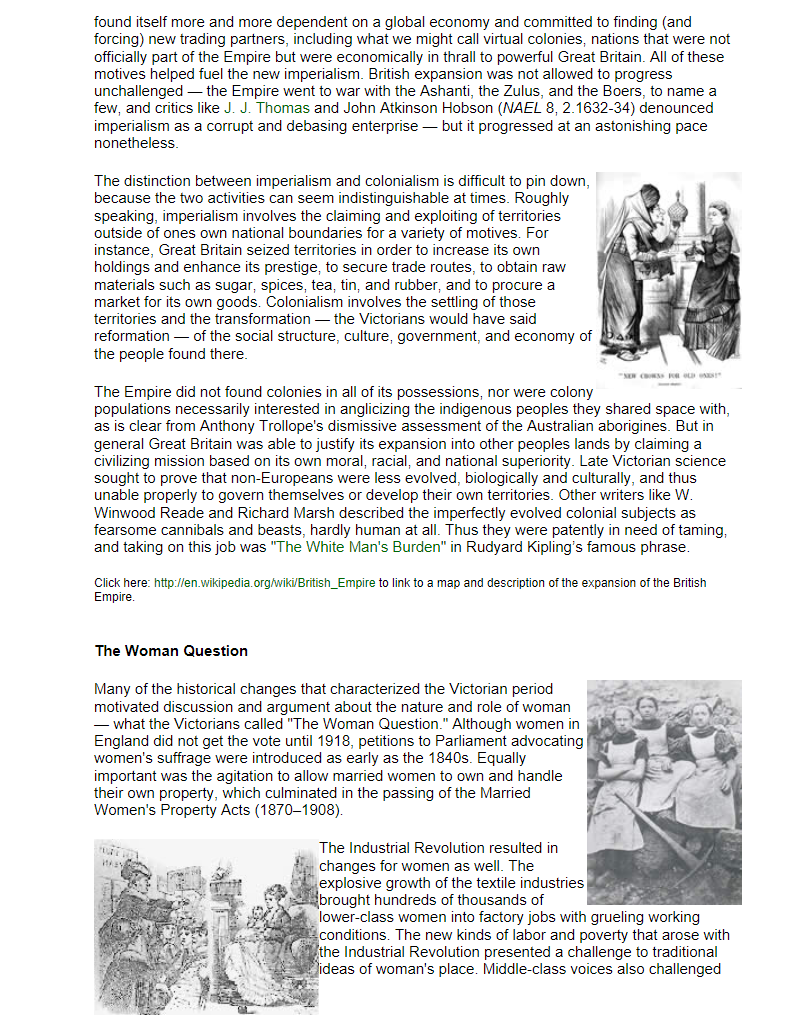
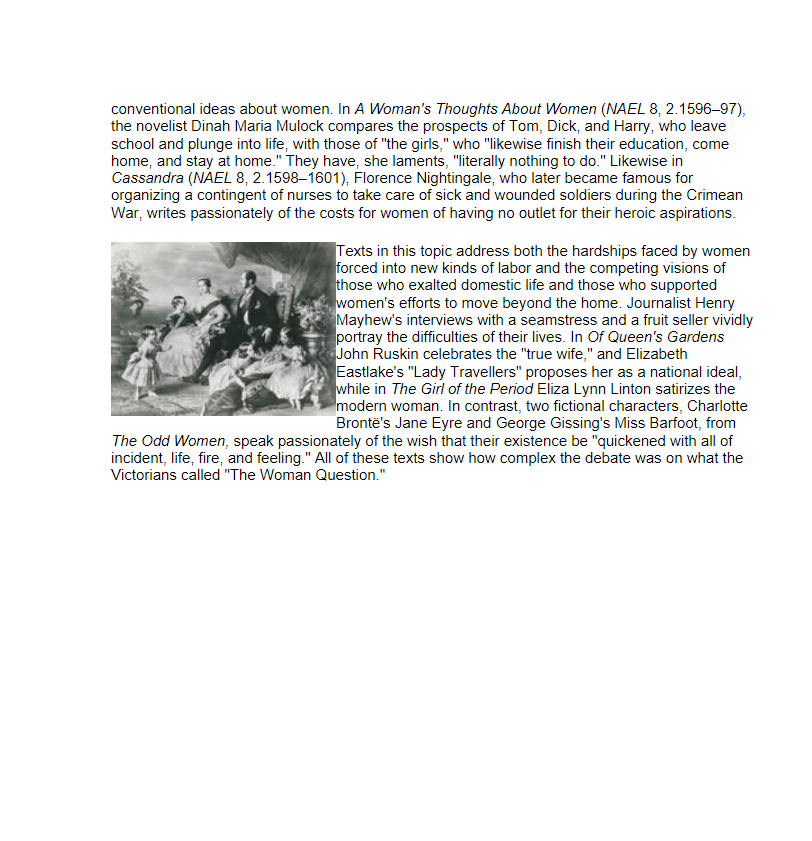
Victorian Age Background: For much of the last century the term Victorian, which literally describes things and events in the reign of Queen Victaria (1837-1901), conveyed connotations of "prudish " "repressed " and "old fashioned." Although such associations have some basis in fact, they do not adequately indicate the nature of this complex, paradoxical age that was a second English Renaissance. In science and technology, the Victorians invented the modern idea of invention -- the notion that one can create solutions to problems, that man can create new means of bettering himself and his environment. In religion, the Victorians experienced a great age of doubt, the first that called into question institutional Christianity on such a large scale. In literature and the other arts, the Victorians attempted to combine Romantic emphases upon self, emotion, and imagination with Neoclassical ones upon the public role of art and a corollary responsibility of the artist. In ideclogy, politics, and society, the Victorians created astonishing innovation and change: democracy, feminism, unionization of workers, socialism, Marxism, and other modern movements took form. In fact, this age of Darwin, Marx, and Freud appears 1o be not only the first that experienced madern problems but also the first that attempted modern solutions. Victorian, in other words, can be taken to mean parent of the modern -- and like most powerful parents, it provoked a powerful reaction against itself. The Victorian age was not one, not single, simple, or unified, only in part because Victoria's reign lasted so long that it comprised several periods. More than anything else what makes Victorians Victorian is their sense of social responsibility, a basic attitude that obviously differentiates them from their immediate predecessors, the Romantics. Three of the primary social/cultural events that impacted literature (and especially Gothic fiction) in the period were the Industrial Revolution, the rise of Imperialism, and the Woman guestion: Industrial Revolution The Industrial Revolution the changes in the making of goods that resulted from substituting machines for hand labor began with a set of inventions for spinning and weaving developed in England in the eighteenth century. At first this new machinery was operated by workers in their homes, but in the 1780s the introduction of the steam engine fo drive the machines led manufacturers to install them in large buildings called at first mills and later factories. Mill towns quickly grew in central and northern England; the population of the city of Manchester, for example, increased by ten times in the years between 1760 and 1830. | By the beginning of the Victorian period, the Industrial Revolution had created profound economic and social changes. Hundreds of thousands | of workers had migrated to industrial towns, where they made up a new \\kind of working class. Wages were extremely low, hours very long i fourteen a day, or even more. Employers often preferred to hire waomen :I and children, who worked for even less then men. Families lived in horribly crowded, unsanitary housing. Moved by the terrible suffering [ |resulting from a severe economic depression in the early 1840s, writers and men in government drew increasingly urgent attention to the condition of the working class. Friedrich Engels describes the conclusions he drew during the twenty months he spent abserving industrial R conditions in Manchester. His 1845 book prepared the ground for his work 1 \ffound itself more and maore dependent on a global economy and committed to finding (and forcing) new trading partners, including what we might call virtual cclonies, nations that were not officially part of the Empire but were economically in thrall to powerful Great Britain. All of these motives helped fuel the new imperialism. British expansion was not allowed to progress unchallenged the Empire went to war with the Ashanti, the Zulus, and the Boers, to name a few, and critics like J. J. Thomas and John Atkinson Hobson (MAEL 8, 2 1632-34) denounced imperialism as a corrupt and debasing enterprise but it progressed at an astonishing pace nonetheless. The distinction between imperialism and colonialism is difficult to pin down, because the two activities can seem indistinguishable at times. Roughly speaking, imperialism involves the claiming and exploiting of territories outside of ones own national boundaries for a variety of motives. For instance, Great Britain seized territories in order to increase its own holdings and enhance its prestige, to secure trade routes, to cbtain raw materials such as sugar, spices, tea, tin, and rubber, and to procure a market for its own goods. Colonialism involves the settling of those territories and the transformation the Victorians would have said \\ reformation of the social structure, culture, government, and economy of B the people found there. The Empire did not found colonies in all of its possessions, nor were colony populations necessarily interested in anglicizing the indigenous peoples they shared space with, as is clear from Anthony Trollope's dismissive assessment of the Australian aborigines. But in general Great Britain was able to justify its expansion intc other peoples lands by claiming a2 civilizing mission based on its own moral, racial, and national superiority. Late Victorian science sought to prove that non-Europeans were less evolved, biclogically and culturally, and thus unable properly to govern themselves or develop their own territories. Other writers like W. Winwood Reade and Richard Marsh described the imperfectly evolved colonial subjects as fearsome cannibals and beasts. hardly human at all. Thus they were patently in need of taming, and taking on this job was "The White Man's Burden" in Rudyard Kipling's famous phrase. Click here: http://fen wikipedia. org/wikiVBritish_Empire to link to 8 map and description of the expansion of the British Empire. The Woman Question IMany of the historical changes that characterized the Victorian pericd maotivated discussion and argument about the nature and role of woman what the Victorians called "The Woman Question.\" Although women in England did not get the vote until 1918, petitions to Parliament advocating women's suffrage were introduced as early as the 1840s. Equally important was the agitation to allow married women to own and handle their own property, which culminated in the passing of the Married Women's Property Acts (1870-1908). _ The Industrial Revolution resulted in '?_'II changes for women as well. The & explosive growth of the textile industries brought hundreds of thousands of i lower-class women into factory jobs with grueling working =52 conditions. The new kinds of labor and poverty that arose with 'the Industrial Revolution presented a challenge to traditional \"lideas of woman's place. IMiddle-class voices also challenged \f\f\f\f\f\f
Step by Step Solution
There are 3 Steps involved in it
1 Expert Approved Answer
Step: 1 Unlock
Question Has Been Solved by an Expert!
Get step-by-step solutions from verified subject matter experts
Step: 2 Unlock
Step: 3 Unlock
Students Have Also Explored These Related Business Writing Questions!









 Study Help