







Question: please clearly label! will thumbs up! this is all the information needed and given in general. it is telling you about some paying annually, semiannually,
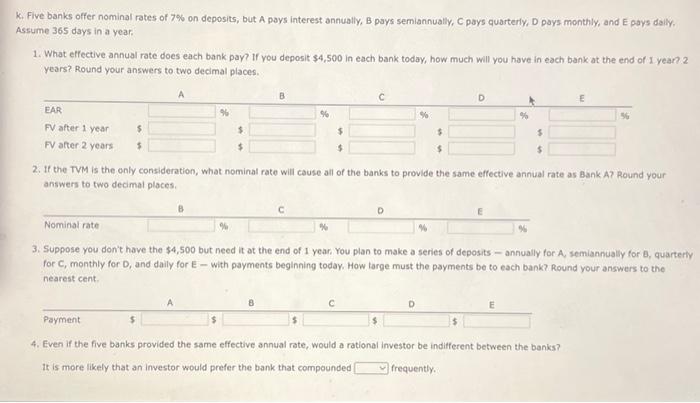
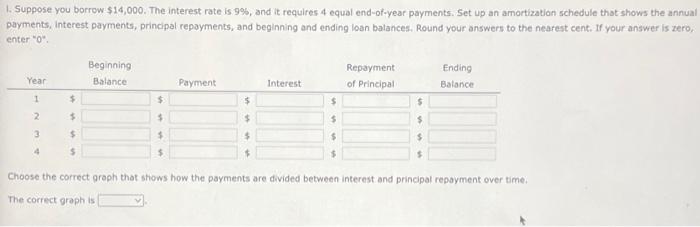
k. Five banks offer nominal rates of 7% on deposits, but A pays interest annually, B pays semiannually, C pays quarterly, D pays monthly, and E pays dally, Assume 365 days in a year: 1. What effective annual rate does each bank pay? If you deposit $4,500 in each bank today, how much will you have in each bank at the end of 1 year? 2 years? Round your answers to two decimal places. 2. If the TVM is the only consideration, what nominal rate will cause all of the banks to provide the same effective annual rate as Bank A? Round your answers to two decimal ploces. 3. Suppose you don't have the \$4,500 but need it at the end of 1 year. You plan to make a series of deposits - annually for A, semiannually for 8, quarterly for C, monthly for D, and daily for E - with payments beginning today. How large must the payments be to each bank? Round your answers to the nearest cent. 4. Even if the five banks provided the same effective annual rate, would a rational investor be indifferent between the banks? It is more likely that an investor would prefer the bank that compounded frequently. 1. Suppose you borrow $14,000. The interest rate is 9%, and it requires 4 equal end-of-year payments. Set up an amortization schedule that shows the annual payments, interest payments, principal repayments, and beginning and ending loan balances. Round your answers to the nearest cent. If your answer is zero, enter " 0 ". Choose the correct greph that shows how the payments are divided between interest and principal repayment over time. The correct groph is k. Five banks offer nominal rates of 7% on deposits, but A pays interest annually, B pays semiannually, C pays quarterly, D pays monthly, and E pays dally, Assume 365 days in a year: 1. What effective annual rate does each bank pay? If you deposit $4,500 in each bank today, how much will you have in each bank at the end of 1 year? 2 years? Round your answers to two decimal places. 2. If the TVM is the only consideration, what nominal rate will cause all of the banks to provide the same effective annual rate as Bank A? Round your answers to two decimal ploces. 3. Suppose you don't have the \$4,500 but need it at the end of 1 year. You plan to make a series of deposits - annually for A, semiannually for 8, quarterly for C, monthly for D, and daily for E - with payments beginning today. How large must the payments be to each bank? Round your answers to the nearest cent. 4. Even if the five banks provided the same effective annual rate, would a rational investor be indifferent between the banks? It is more likely that an investor would prefer the bank that compounded frequently. 1. Suppose you borrow $14,000. The interest rate is 9%, and it requires 4 equal end-of-year payments. Set up an amortization schedule that shows the annual payments, interest payments, principal repayments, and beginning and ending loan balances. Round your answers to the nearest cent. If your answer is zero, enter " 0 ". Choose the correct greph that shows how the payments are divided between interest and principal repayment over time. The correct groph is
Step by Step Solution
There are 3 Steps involved in it

Get step-by-step solutions from verified subject matter experts
 Study Help