







Question: Please code in Java and add comments for my understanding. A start-up code is given to implement the Kruskal function (feel free to change the
Please code in Java and add comments for my understanding. A start-up code is given to implement the Kruskal function (feel free to change the two prim's algorithm functions in Graph.Java to kruskal's). Please test out the Kruskal implementation in Main.Java (test 1 and test 2), and don't copy-paste old answers. Thanks!

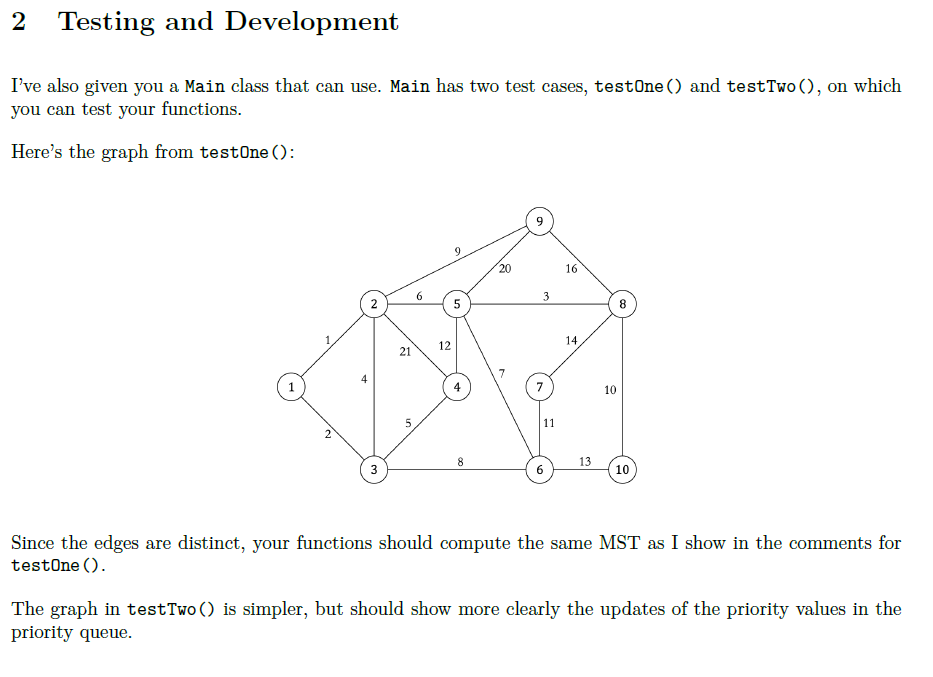
1) Graph.Java ******************************************************************************************************************************
import java.util.List; import java.util.ArrayList; import java.util.PriorityQueue; public class Graph { List nodes; //--------------------------------------------------- public Graph() { nodes = new ArrayList(); } //--------------------------------------------------- public void addNode(Node node) { for (Node n: this.nodes) { if (n == node) { System.out.println("ERROR: graph already has a node " + n.name); assert false; } } this.nodes.add(node); } //--------------------------------------------------- public void addEdge(Node n1, Node n2, int weight) { // outgoing edge int idx1 = this.nodes.indexOf(n1); if (idx1 prim(Node s) { // implement this } // prim() //----------------------------------------------- public List primPQ(Node s) { // implement this } // primPQ() } // class Graph 2) Node.Java ******************************************************************************************************************************
import java.util.List; import java.util.ArrayList; import java.lang.Comparable; public class Node implements Comparable { List adjlist; int name; int priority; // needed for PQ implementation public Node(int name) { this.name = name; this.adjlist = new ArrayList(); this.priority = 0; } public void add(Edge edge) { this.adjlist.add(edge); } // this is needed for PQ implementation public int compareTo(Object o) { Node otherNode = (Node) o; if (this.priority otherNode.priority) return 1; else return 0; } @Override public String toString() { String s = "N" + this.name; return s; } } // class Node 3) Edge.Java ******************************************************************************************************************************
public class Edge { int weight; Node n1; Node n2; public Edge(Node n1, Node n2, int weight) { this.n1 = n1; this.n2 = n2; this.weight = weight; } @Override public String toString() { String s = "(" + this.n1.name + ", " + this.n2.name + "); wt = " + this.weight; return s; } // needed only for grad assignment public int compareTo(Object o) { Edge otherEdge = (Edge) o; if (this.weight otherEdge.weight) return 1; else return 0; } } // class Edge 4) Main.Java ******************************************************************************************************************************
import java.util.List; public class Main { public static void main(String args[]) { testOne(); testTwo(); } // From the lecture slides. // Starting at node 10, here are the edges that form an MST: // (10, 8), (8, 5), (5, 2), (2, 1), (1, 3), (3, 4), (5, 6), // (2, 9), (6, 7); the total weight is 54 // Your function should select nodes in this order: // 10, 8, 5, 2, 1, 3, 4, 6, 9, 7 public static void testOne() { System.out.println("this is testOne()"); Node n1 = new Node(1); Node n2 = new Node(2); Node n3 = new Node(3); Node n4 = new Node(4); Node n5 = new Node(5); Node n6 = new Node(6); Node n7 = new Node(7); Node n8 = new Node(8); Node n9 = new Node(9); Node n10 = new Node(10); Graph G = new Graph(); G.addNode(n1); G.addNode(n2); G.addNode(n3); G.addNode(n4); G.addNode(n5); G.addNode(n6); G.addNode(n7); G.addNode(n8); G.addNode(n9); G.addNode(n10); G.addEdge(n1, n2, 1); G.addEdge(n1, n3, 2); G.addEdge(n2, n3, 4); G.addEdge(n2, n4, 21); G.addEdge(n2, n5, 6); G.addEdge(n2, n9, 9); G.addEdge(n3, n4, 5); G.addEdge(n3, n6, 8); G.addEdge(n4, n5, 12); G.addEdge(n5, n6, 7); G.addEdge(n5, n8, 3); G.addEdge(n5, n9, 20); G.addEdge(n6, n7, 11); G.addEdge(n6, n10, 13); G.addEdge(n7, n8, 14); G.addEdge(n8, n9, 16); G.addEdge(n8, n10, 10); System.out.println("first call prim()"); List edges = G.prim(n10); for (Edge e: edges) System.out.println(e); System.out.println(); System.out.println("now call primPQ()"); edges = G.primPQ(n10); for (Edge e: edges) System.out.println(e); // // grad assignment // System.out.println(); // System.out.println("now call kruskal()"); // edges = G.kruskal(); // for (Edge e: edges) // System.out.println(e); } // testOne() public static void testTwo() { System.out.println("this is testTwo()"); Node n1 = new Node(1); Node n2 = new Node(2); Node n3 = new Node(3); Node n4 = new Node(4); Node n5 = new Node(5); Graph G = new Graph(); G.addNode(n1); G.addNode(n2); G.addNode(n3); G.addNode(n4); G.addNode(n5); G.addEdge(n1, n2, 4); G.addEdge(n1, n4, 6); G.addEdge(n1, n5, 9); G.addEdge(n2, n3, 12); G.addEdge(n2, n4, 11); G.addEdge(n3, n4, 5); G.addEdge(n3, n5, 10); G.addEdge(n4, n5, 2); System.out.println("first call prim()"); List edges = G.prim(n5); for (Edge e: edges) System.out.println(e); System.out.println(); System.out.println("now call primPQ()"); edges = G.primPQ(n5); for (Edge e: edges) System.out.println(e); } // testTwo() } Students taking the course for graduate credit, and undergraduates for a little bit of extra credit: implement Kruskal's Algorithm, using the union-find data structure. Implement this in a function called public List kruskal () . To determine whether the addition of an edge e from ni to nj to (V,T) would create a cycle, check to see whether ni and nj are in the same connected component, using the union-find data structure. Ask me for help with the implementation of the union-find data structure. I've also given you a Main class that can use. Main has two test cases, testOne() and testTwo(), on which you can test your functions. Here's the graph from testOne(): Since the edges are distinct, your functions should compute the same MST as I show in the comments for testOne(). The graph in testTwo () is simpler, but should show more clearly the updates of the priority values in the priority queue
Step by Step Solution
There are 3 Steps involved in it

Get step-by-step solutions from verified subject matter experts
 Study Help