







Question: Please code in Java Your program should use the bit string representation of sets to perform union, intersection, and complement operations. This representation is described
Please code in Java
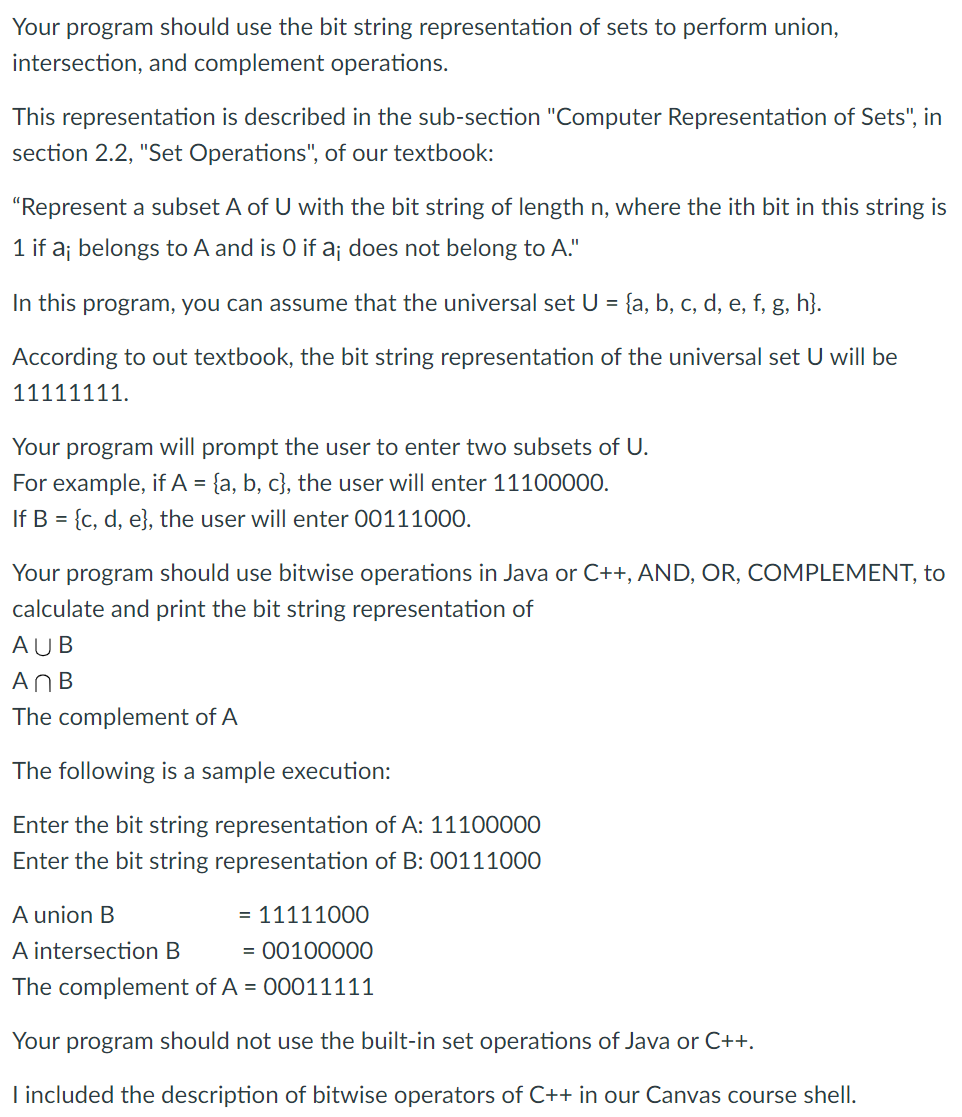
Your program should use the bit string representation of sets to perform union, intersection, and complement operations. This representation is described in the sub-section "Computer Representation of Sets", in section 2.2, "Set Operations", of our textbook: Represent a subset A of U with the bit string of length n, where the ith bit in this string is 1 if a; belongs to A and is O if a; does not belong to A." In this program, you can assume that the universal set U = {a, b, c, d, e, f, g, h}. According to out textbook, the bit string representation of the universal set U will be 11111111. Your program will prompt the user to enter two subsets of U. For example, if A = {a, b, c}, the user will enter 11100000. If B = {c, d, e), the user will enter 00111000. Your program should use bitwise operations in Java or C++, AND, OR, COMPLEMENT, to calculate and print the bit string representation of AUB AnB The complement of A The following is a sample execution: Enter the bit string representation of A: 11100000 Enter the bit string representation of B: 00111000 A union B = 11111000 A intersection B = 00100000 The complement of A = 00011111 Your program should not use the built-in set operations of Java or C++. I included the description of bitwise operators of C++ in our Canvas course shell. Your program should use the bit string representation of sets to perform union, intersection, and complement operations. This representation is described in the sub-section "Computer Representation of Sets", in section 2.2, "Set Operations", of our textbook: Represent a subset A of U with the bit string of length n, where the ith bit in this string is 1 if a; belongs to A and is O if a; does not belong to A." In this program, you can assume that the universal set U = {a, b, c, d, e, f, g, h}. According to out textbook, the bit string representation of the universal set U will be 11111111. Your program will prompt the user to enter two subsets of U. For example, if A = {a, b, c}, the user will enter 11100000. If B = {c, d, e), the user will enter 00111000. Your program should use bitwise operations in Java or C++, AND, OR, COMPLEMENT, to calculate and print the bit string representation of AUB AnB The complement of A The following is a sample execution: Enter the bit string representation of A: 11100000 Enter the bit string representation of B: 00111000 A union B = 11111000 A intersection B = 00100000 The complement of A = 00011111 Your program should not use the built-in set operations of Java or C++. I included the description of bitwise operators of C++ in our Canvas course shell
Step by Step Solution
There are 3 Steps involved in it

Get step-by-step solutions from verified subject matter experts
 Study Help