







Question: Please comment if not visible properly. Question One Total 20 marks Assets Cash (0%) OECD interbank deposits (20%) Mortgage loans (50%) Consumer loans (100%) Reserve
 Please comment if not visible properly.
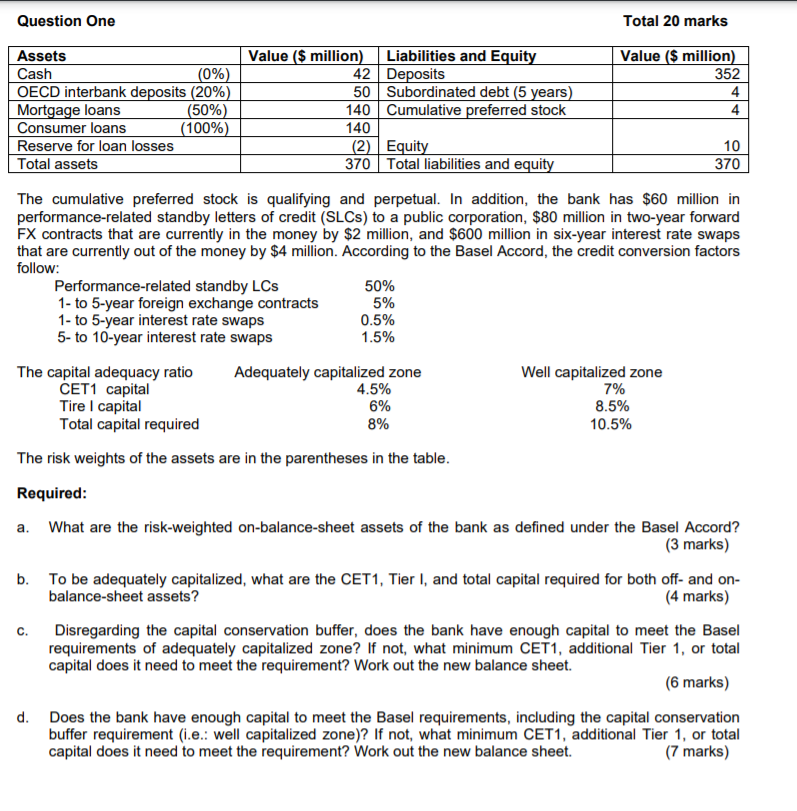
Question One Total 20 marks Assets Cash (0%) OECD interbank deposits (20%) Mortgage loans (50%) Consumer loans (100%) Reserve for loan losses Total assets Value ($ million) Liabilities and Equity 42 Deposits 50 Subordinated debt (5 years) 140 Cumulative preferred stock 140 (2) Equity 370 Total liabilities and equity Value ($ million) 352 4 4 10 370 The cumulative preferred stock is qualifying and perpetual. In addition, the bank has $60 million in performance-related standby letters of credit (SLCs) to a public corporation, $80 million in two-year forward FX contracts that are currently in the money by $2 million, and $600 million in six-year interest rate swaps that are currently out of the money by $4 million. According to the Basel Accord, the credit conversion factors follow: Performance-related standby LCs 50% 1- to 5-year foreign exchange contracts 5% 1- to 5-year interest rate swaps 0.5% 5- to 10-year interest rate swaps 1.5% The capital adequacy ratio Adequately capitalized zone Well capitalized zone CET1 capital 4.5% 7% Tire I capital 6% 8.5% Total capital required 8% 10.5% The risk weights of the assets are in the parentheses in the table. Required: a. What are the risk-weighted on-balance-sheet assets of the bank as defined under the Basel Accord? (3 marks) C. b. To be adequately capitalized, what are the CET1, Tier I, and total capital required for both off- and on- balance sheet assets? (4 marks) Disregarding the capital conservation buffer, does the bank have enough capital to meet the Basel requirements of adequately capitalized zone? If not, what minimum CET1, additional Tier 1, or total capital does it need to meet the requirement? Work out the new balance sheet. (6 marks) d. Does the bank have enough capital to meet the Basel requirements, including the capital conservation buffer requirement (.e.: well capitalized zone)? If not, what minimum CET1, additional Tier 1, or total capital does it need to meet the requirement? Work out the new balance sheet. (7 marks) Question One Total 20 marks Assets Cash (0%) OECD interbank deposits (20%) Mortgage loans (50%) Consumer loans (100%) Reserve for loan losses Total assets Value ($ million) Liabilities and Equity 42 Deposits 50 Subordinated debt (5 years) 140 Cumulative preferred stock 140 (2) Equity 370 Total liabilities and equity Value ($ million) 352 4 4 10 370 The cumulative preferred stock is qualifying and perpetual. In addition, the bank has $60 million in performance-related standby letters of credit (SLCs) to a public corporation, $80 million in two-year forward FX contracts that are currently in the money by $2 million, and $600 million in six-year interest rate swaps that are currently out of the money by $4 million. According to the Basel Accord, the credit conversion factors follow: Performance-related standby LCs 50% 1- to 5-year foreign exchange contracts 5% 1- to 5-year interest rate swaps 0.5% 5- to 10-year interest rate swaps 1.5% The capital adequacy ratio Adequately capitalized zone Well capitalized zone CET1 capital 4.5% 7% Tire I capital 6% 8.5% Total capital required 8% 10.5% The risk weights of the assets are in the parentheses in the table. Required: a. What are the risk-weighted on-balance-sheet assets of the bank as defined under the Basel Accord? (3 marks) C. b. To be adequately capitalized, what are the CET1, Tier I, and total capital required for both off- and on- balance sheet assets? (4 marks) Disregarding the capital conservation buffer, does the bank have enough capital to meet the Basel requirements of adequately capitalized zone? If not, what minimum CET1, additional Tier 1, or total capital does it need to meet the requirement? Work out the new balance sheet. (6 marks) d. Does the bank have enough capital to meet the Basel requirements, including the capital conservation buffer requirement (.e.: well capitalized zone)? If not, what minimum CET1, additional Tier 1, or total capital does it need to meet the requirement? Work out the new balance sheet. (7 marks)
Step by Step Solution
There are 3 Steps involved in it

Get step-by-step solutions from verified subject matter experts
 Study Help