







Question: please complete 1 2 and 3. ( there is no additional information). thanks Chapter 6 1. What is the auditors' opinion on the company's internal
please complete 1 2 and 3. ( there is no additional information). thanks

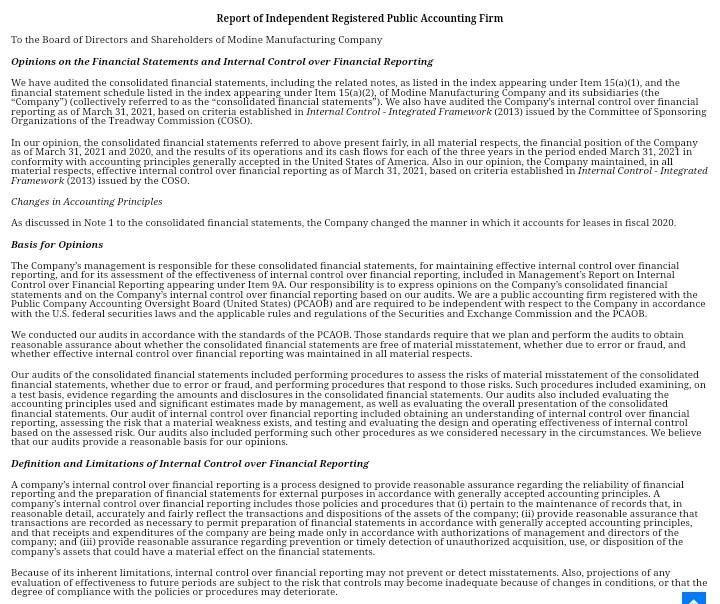
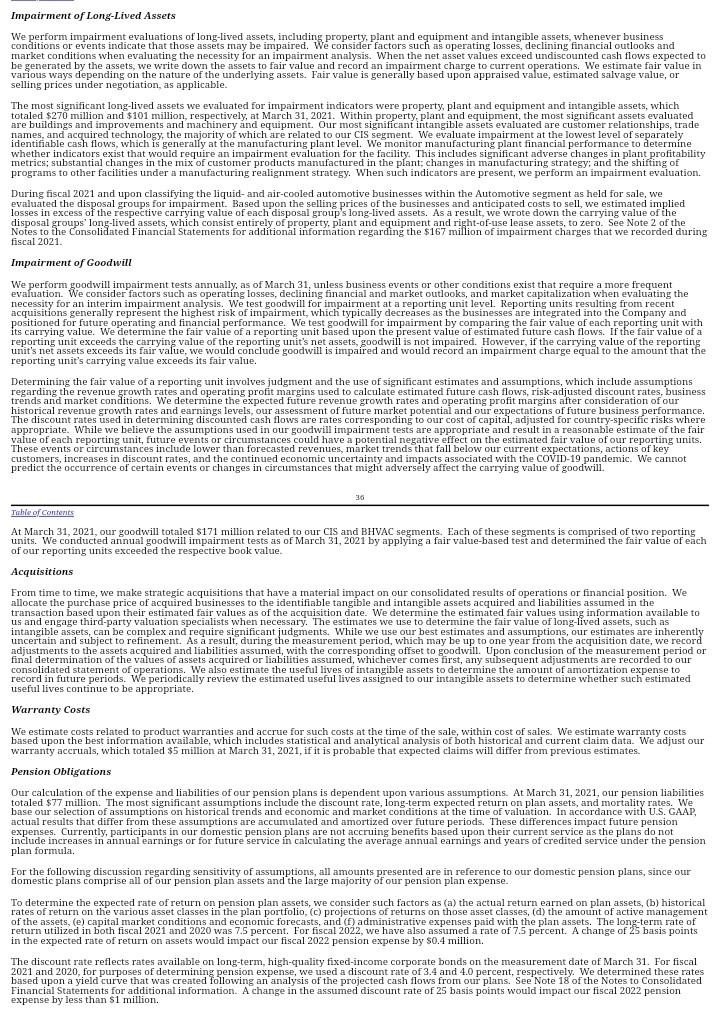
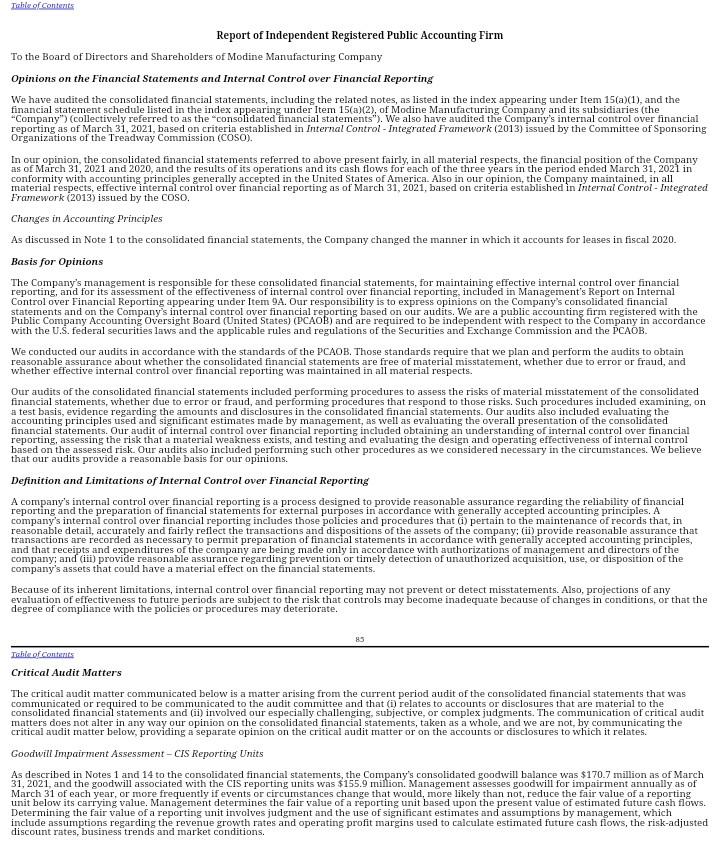
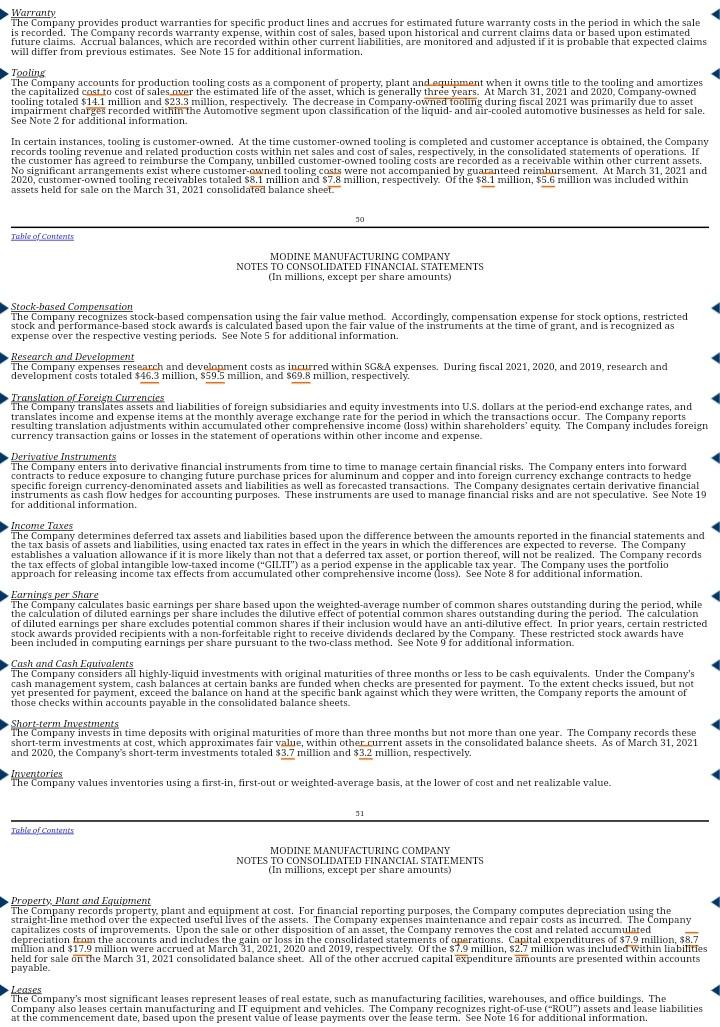
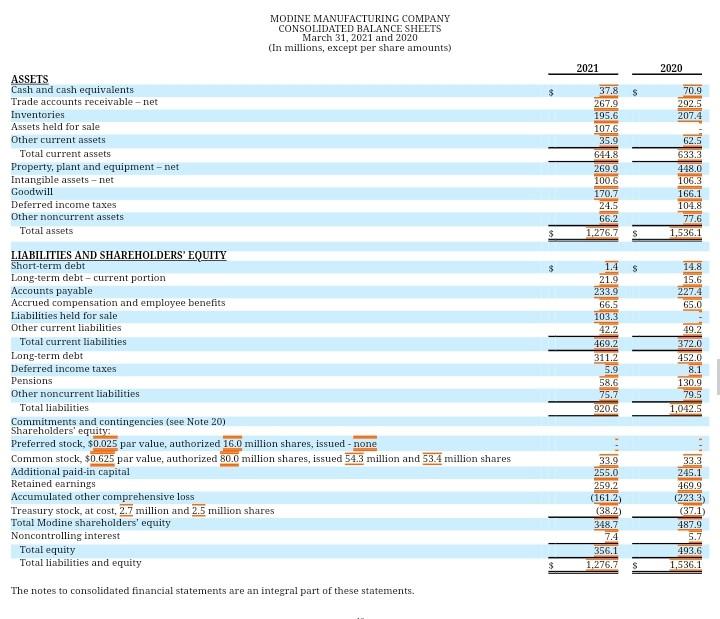
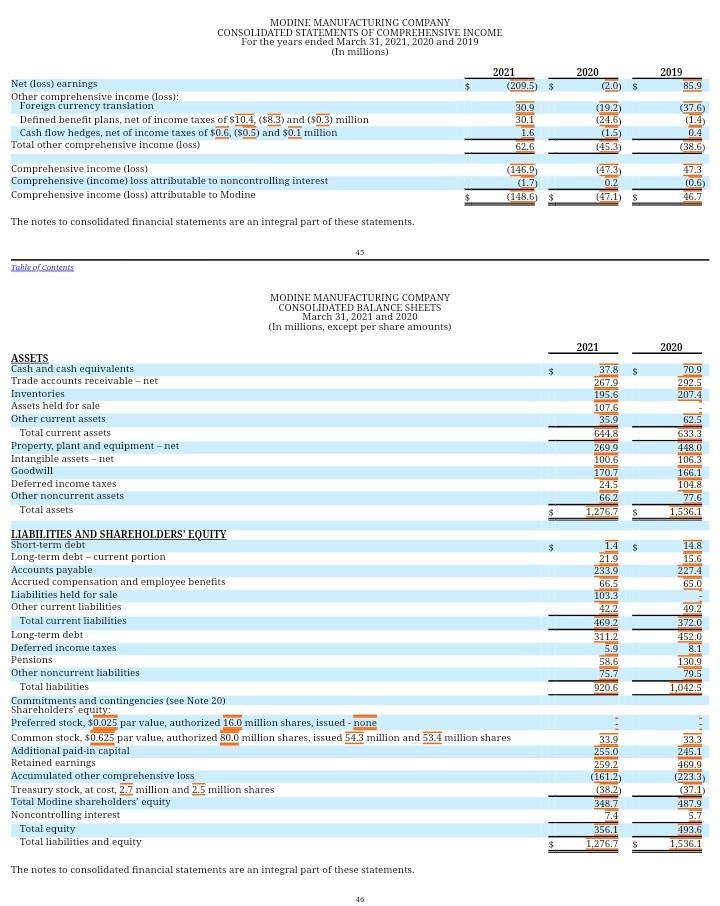
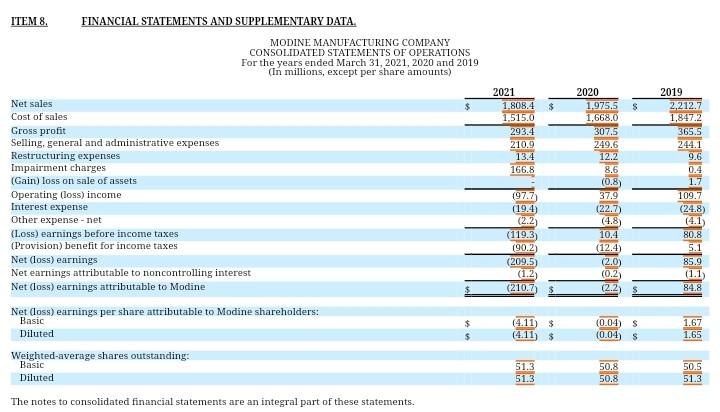
Chapter 6 1. What is the auditors' opinion on the company's internal controls? 2. Does the management mention anything about cash management? 3. What assets does the company list as current assets? Report of Independent Registered Public Accounting Firm To the Board of Directors and Shareholders of Modine Manufacturing Company Opinions on the Financial Statements and Internal Control over Financial Reporting We have audited the consolidated financial statements, including the related notes, as listed in the index appearing under Item 15(a)(1), and the financial statement schedule listed in the index appearing under Item 15(a)(2), of Modine Manufacturing Company and its subsidiaries (the "Company") (collectively referred to as the consolidated financial statements"). We also have audited the Company's internal control over financial reporting as of March 31, 2021, based on criteria established in internal Control - Integrated Framework (2013) issued by the Committee of Sponsoring Organizations of the Treadway Commission (COSO). In our opinion, the consolidated financial statements referred to above present fairly, in all material respects, the financial position of the Company as of March 31, 2021 and 2020, and the results of its operations and its cash flows for each of the three years in the period ended March 31, 2021 in conformity with accounting principles generally accepted in the United States of America. Also in our opinion, the Company maintained in all material respects, effective internal control over financial reporting as of March 31, 2021, based on criteria established in Internal Control - Integrated Framework (2013) issued by the coso. Changes in Accounting Principles As discussed in Note 1 to the consolidated financial statements, the Company changed the manner in which it accounts for leases in fiscal 2020. Basis for Opinions The Company's management is responsible for these consolidated financial statements, for maintaining effective internal control over financial reporting, and for its assessment of the effectiveness of internal control over financial reporting, included in Management's Report on Internal Control over Financial Reporting appearing under Item 9A. Our responsibility is to express opinions on the Company's consolidated financial statements and on the Company's internal control over financial reporting based on our audits. We are a public accounting firm registered with the Public Company Accounting Oversight Board (United States) (PCAOB) and are required to be independent with respect to the Company in accordance with the U.S. federal securities laws and the applicable rules and regulations of the Securities and Exchange Commission and the PCAOB. We conducted our audits in accordance with the standards of the PCAOB. Those standards require that we plan and perform the audits to obtain reasonable assurance about whether the consolidated financial statements are free of material misstatement, whether due to error or fraud, and whether effective internal control over financial reporting was maintained in all material respects. Our audits of the consolidated financial statements included performing procedures to assess the risks of material misstatement of the consolidated financial statements, whether due to error or fraud, and performing procedures that respond to those risks. Such procedures included examining, on a test basis, evidence regarding the amounts and disclosures in the consolidated financial statements. Our audits also included evaluating the accounting principles used and significant estimates made by management, as well as evaluating the overall presentation of the consolidated financial statements. Our audit of internal control over financial reporting included obtaining an understanding of internal control over financial reporting, assessing the risk that a material weakness exists, and testing and evaluating the design and operating effectiveness of internal control based on the assessed risk. Our audits also included performing such other procedures as we considered necessary in the circumstances. We believe that our audits provide a reasonable basis for our opinions. Definition and Limitations of Internal Control over Financial Reporting A company's internal control over financial reporting is a process designed to provide reasonable assurance regarding the reliability of financial reporting and the preparation of financial statements for external purposes in accordance with generally accepted accounting principles. A company's internal control over financial reporting includes those policies and procedures that (i) pertain to the maintenance of records that, in reasonable detail, accurately and fairly reflect the transactions and dispositions of the assets of the company: (ii) provide reasonable assurance that transactions are recorded as necessary to permit preparation of financial statements in accordance with generally accepted accounting principles, and that receipts and expenditures of the company are being made only in accordance with authorizations of management and directors of the company and (iii) provide reasonable assurance regarding prevention or timely detection of unauthorized acquisition, use, or disposition of the company's assets that could have a material effect on the financial statements. Because of its inherent limitations, internal control over financial reporting may not prevent or detect misstatements. Also, projections of any evaluation of effectiveness to future periods are subject to the risk that controls may become inadequate because of changes in conditions, or that the degree of compliance with the policies or procedures may deteriorate. Impairment of Long-Lived Assets We perform impairment evaluations of long-lived assets, including property, plant and equipment and intangible assets, whenever business conditions or events indicate that those assets may be impaired. We consider factors such as operating losses, declining financial outlooks and market conditions when evaluating the necessity for an impairment analysis. When the net asset values exceed undiscounted cash flows expected to be generated by the assets, we write down the assets to fair value and record an impairment charge to current operations. We estimate fair value in various ways depending on the nature of the underlying assets. Fair value is generally based upon appraised value, estimated salvage value, or selling prices under negotiation, as applicable. The most significant long-lived assets we evaluated for impairment indicators were property, plant and equipment and intangible assets, which totaled $270 million and $101 million, respectively, at March 31, 2021. Within property, plant and equipment, the most significant assets evaluated are buildings and improvements and machinery and equipment. Our most significant intangible assets evaluated are customer relationships, trade names, and acquired technology, the majority of which are related to our CIS segment. We evaluate impairment at the lowest level of separately 1. whether indicators exist that would require an impairment evaluation for the facility. This includes significant adverse changes in plant profitability metrics; substantial changes in the mix of customer products manufactured in the plant: changes in manufacturing strategy, and the shifting of programs to other facilities under a manufacturing realignment strategy. When such indicators are present, we perform an impairment evaluation. During fiscal 2021 and upon classifying the liquid- and air-cooled automotive businesses within the Automotive segment as held for sale, we evaluated the disposal groups for impairment. Based upon the selling prices of the businesses and anticipated costs to sell, we estimated implied losses in excess of the respective carrying value of each disposal group's long-lived assets. As a result, we wrote down the carrying value of the disposal groups' long-lived assets, which consist entirely of property, plant and equipment and right-of-use lease assets, to zero. See Note 2 of the Notes to the Consolidated Financial Statements for additional information regarding the $167 million of impairment charges that we recorded during fiscal 20211 Impairment of Goodwill We perform goodwill impairment tests annually, as of March 31, unless business events or other conditions exist that require a more frequent evaluation. We consider factors such as operating losses, declining financial and market outlooks, and market capitalization when evaluating the for all interim impalli the highest risk of i . We test goodwill for i necesarions generally represent t which wirawat ar units resulting from recent decreases as the reporting unit level. Reportinerated i are d into the Company a y and positioned for future operating and financial performance. We test goodwill for impairment by comparing the fair value of each reporting unit with its carrying value. We determine the fair value of a reporting unit based upon the present value of estimated future cash flows. If the fair value of a reporting unit exceeds the carrying value of the reporting unit's net assets, goodwill is not impaired. However, if the carrying value of the reporting unit's net assets exceeds its fair value, we would conclude goodwill is impaired and would record an impairment charge equal to the amount that the reporting unit's carrying value exceeds its fair value, regarding the arket Determining the fair value of a reporting unit involves judgment and the use of significant estimates and assumptions, which include assumptions e cash Chesties and op the pected neure revenue growth rates and operating the laten risiko ditet e do disidenticates it margins historical revenue growth rates and earnings levels, our assessment of future market potential and our expectations of future business performance. The discount rates used in determining discounted cash flows are rates corresponding to our cost of capital, adjusted for country-specific risks where appropriate. While we believe the assumptions used in our goodwill impairment tests are appropriate and result in a reasonable estimate of the fair value of each reporting unit, future events or creur SC forecasted revenues, marential neede effect on the estimated fair These events or circumstances include lower than could have a key customers, increases in discount rates, and the continued economic uncertainty and impacts associated with the COVID-19 pandemic. We cannot it fall below our current expectations, act reporting units. predict the occurrence of certain events or changes in circumstances that might adversely affect the carrying value of goodwill. consideration of business 36 Csegmentfair value-based Table of Contents At March 31, 2021, our goodwill totaled $171 million related to our CIS and Bapplying a Each of these sestanda and determine the fair valorting as of March 31, 2021 by of each of our reporting units exceeded the respective book value. Acquisitions From time to time, we make strategic acquisitions that have a material impact on our consolidated results of operations or financial position. We allocate the purchase price of acquired businesses to the identifiable tangible and intangible assets acquired and liabilities assumed in the transaction based upon their estimated fair values as of the acquisition date. We determine the estimated fair values using information available to us and engage third-party valuation specialists when necessary. The estimates we use to determine the fair value of long-lived assets, such as intangible assets, can be complex and require significant judgments. While we use our best estimates and assumptions, our estimates are inherently uncertain and subject to refinement. As a result, during the measurement period, which may be up to one year from the acquisition date, we record adjustments to the assets acquired and liabilities assumed, with the corresponding offset to goodwill. Upon conclusion of the measurement period or final fassets acquired determination of the values of d or liabilities assumed, whichever comes first, any subsequent adjustments are recorded to our consolidated statement of operations. We also estimate the useful lives of intangible assets to determine the amount of amortization expense to record in future periods. We periodically review the estimated useful lives assigned to our intangible assets to determine whether such estimated useful lives continue to be appropriate. Warranty Costs We estimate costs related to and accrue for such costs at the time of the sale, within cost of sales. We estimate warranty current nt claim data. We adjust our warranty accruals, which totaled $5 million at March 31, 2021, if it is probable that expected claims will differ from previous estimates. Pension Obligations Our calculation of the expense and liabilities of our pension plans is dependent upon various assumptions. At March 31, 2021, our pension liabilities totaled $77 million. The most significant assumptions include the discount rate, long-term expected return on plan assets, and mortality rates. We base our selection of assumptions on historical trends and economic and market conditions at the time of valuation. In accordance with U.S. GA actual results that differ from these assumptions are accumulated and amortized over future periods. These differences impact future pension expenses. Currently, participants in our domestic pension plans are not accruing benefits based upon their current service as the plans do not include increases in annual earnings or for future service in calculating the average annual earnings and years of credited service under the pension plan formula. sensitivity assumptions all amounts are in reterore to our domestic pension plans, since our To determine the expected rate of return on pension plan assets, we consider such factors as (a) the actual return earned on plan assets, (b) historical rates of return on the various asset classes in the plan portfolio, (c) projections of returns on those asset classes, (d) the amount of active management of the assets, (e) capital market conditions and economic forecasts, and (f) administrative expenses paid with the plan assets. The long-term rate of return utilized in both fiscal 2021 and 2020 was 7.5 percent. For fiscal 2022, we have also assumed a rate of 7.5 percent. A change of 25 basis points in the expected rate of return on assets would impact our fiscal 2022 pension expense by S0.4 million. The discount rate reflects rates available on long-term, high-quality fixed-income corporate bonds on the measurement date of March 31. For fiscal 2021 and 2020, for purposes of determining pension expense, we used a discount rate of 3.4 and 4.0 percent, respectively. We determined these rates based upon a yield curve that was created following an analysis of the projected cash flows from our plans. See Note 18 of the Notes to Consolidated Financial Statements for additional information. A change in the assumed discount rate of 25 basis points would impact our fiscal 2022 pension expense by less than $1 million. For the following diperussion regardin sem piwity of Scienarge majority of our pension plane Tohle of contents Report of Independent Registered Public Accounting Firm To the Board of Directors and Shareholders of Modine Manufacturing Company Opinions on the Financial Statements and Internal Control over Financial Reporting We have audited the consolidated financial statements, including the related notes, as listed in the index appearing under Item 15(a)(1), and the financial statement schedule listed in the index appearing under Item 15(a) (2), of Modine Manufacturing Company and its subsidiaries (the "Company") (collectively referred to as the consolidated financial statements"). We also have audited the Company's internal control over financial reporting as of March 31, 2021, based on criteria established in Internal Control - Integrated Framework (2013) issued by the Committee of Sponsoring Organizations of the Treadway Commission (COSO). In our opinion, the consolidated financial statements referred to above present fairly, in all material respects, the financial position of the Company as of March 31, 2021 and 2020, and the results of its operations and its cash flows for each of the three years in the period ended March 31, 2021 in conformity with accounting principles generally accepted in the United States of America. Also in our opinion, the Company maintained in all material respects, effective internal control over financial reporting as of March 31, 2021, based on criteria established in Internal Control - Integrated Framework (2013) issued by the COSO. Changes in Accounting Principles As discussed in Note 1 to the consolidated financial statements, the Company changed the manner in which it accounts for leases in fiscal 2020. Basis for Opinions The Company's management is responsible for these consolidated financial statements, for maintaining effective internal control over financial reporting, and for its assessment of the effectiveness of internal control over financial reporting, included in Management's Report on Internal Control over Financial Reporting appearing under Item 9A. Our responsibility is to express opinions on the Company's consolidated financial statements and on the Company's internal control over financial reporting based on our audits. We are a public accounting firm registered with the Public Company Accounting Oversight Board (United States) (PCAOB) and are required to be independent with respect to the Company in accordance with the U.S. federal securities laws and the applicable rules and regulations of the Securities and Exchange Commission and the DCAOB. We conducted our audits in accordance with the standards of the PCAOB. Those standards require that we plan and perform the audits to obtain reasonable assurance about whether the consolidated financial statements are free of material misstatement, whether due to error or fraud, and whether effective internal control over financial reporting was maintained in all material respects. Our audits of the consolidated financial statements included performing procedures to assess the risks of material misstatement of the consolidated financial statements, whether due to error or fraud, and performing procedures that respond to those risks. Such procedures included examining, on a test basis, evidence regarding the amounts and disclosures in the consolidated financial statements. Our audits also included evaluating the accounting principles used and significant estimates made by management, as well as evaluating the overall presentation of the consolidated financial statements. Our audit of internal control over financial reporting included obtaining an understanding of internal control over financial reporting, assessing the risk that a material weakness exists, and testing and evaluating the design and operating effectiveness of internal control based on the assessed risk. Our audits also included performing such other procedures as we considered necessary in the circumstances. We believe that our audits provide a reasonable basis for our opinions. Definition and Limitations of Internal Control over Financial Reporting A company's internal control over financial reporting is a process designed to provide reasonable assurance regarding the reliability of financial reporting and the preparation of financial statements for external purposes in accordance with generally accepted accounting principles. A company's internal control over financial reporting includes those policies and procedures that ) pertain to the maintenance of records that, in reasonable detail, accurately and fairly reflect the transactions and dispositions of the assets of the company: (ii) provide reasonable assurance that transactions are recorded as necessary to permit preparation of financial statements in accordance with generally accepted accounting principles, and that receipts and expenditures of the company are being made only in accordance with authorizations of management and directors of the company; and (iii) provide reasonable assurance regarding prevention or timely detection of unauthorized acquisition, use, or disposition of the company's assets that could have a material effect on the financial statements. Because of its inherent limitations, internal control over financial reporting may not prevent or detect misstatements. Also, projections of any evaluation of effectiveness to future periods are subject to the risk that controls may become inadequate because of changes in conditions, or that the degree of compliance with the policies or procedures may deteriorate. 85 Tohle of Contents Critical Audit Matters The critical audit matter communicated below is a matter arising from the current period audit of the consolidated financial statements that was communicated or required to be communicated to the audit committee and that (1) relates to accounts or disclosures that are material to the consolidated financial statements and (ii) involved our especially challenging, subjective, or complex judgments. The communication of critical audit matters does not alter in any way our opinion on the consolidated financial statements, taken as a whole, and we are not, by communicating the critical audit matter below, providing a separate opinion on the critical audit matter or on the accounts or disclosures to which it relates. Goodwill impairment Assessment - CIS Reporting Units As described in Notes 1 and 14 to the consolidated financial statements, the Company's consolidated goodwill balance was $170.7 million as of March 31, 2021, and the goodwill associated with the CIS reporting units was $155.9 million Management assesses goodwill for impairment annually as of March 31 of each year, or more frequently if events or circumstances change that would, more likely than not, reduce the fair value of a reporting unit below its carrying value. Management determines the fair value of a reporting unit based upon the present value of estimated future cash flows. Determining the fair value of a reporting unit involves judgment and the use of significant estimates and assumptions by management, which include assumptions regarding the revenue growth rates and operating profit margins used to calculate estimated future cash flows, the risk-adjusted discount rates, business trends and market conditions. Warranty The Company provides product warranties for specific product lines and accrues for estimated future warranty costs in the period in which the sale is recorded. The Company records warranty expense, within cost of sales, based upon historical and current claims data or based upon estimated future claims. Accrual balances, which are recorded within other current liabilities, are monitored and adjusted if it is probable that expected claims will differ from previous estimates. See Note 15 for additional information. Tooling The Company accounts for production tooling costs as a component of property, plant and equipment when it owns title to the tooling and amortizes the capitalized cost to cost of sales over the estimated life of the asset, which is generally three years. At March 31, 2021 and 2020, Company-owned tooling totaled $14.1 million and $23.3 million, respectively. The decrease in Company-owned fooling during fiscal 2021 was primarily due to asset impairment charges recorded within the Automotive segment upon classification of the liquid and air-cooled automotive businesses as held for sale. See Note 2 for additional information. In certain instances, tooling is customer-owned. At the time customer-owned tooling is completed and customer acceptance is obtained, the Company records tooling revenue and related production costs within net sales and cost of sales, respectively, in the consolidated statements of operations. If the customer has agreed to reimburse the Company, unbilled customer-owned tooling costs are recorded as a receivable within other current assets. No significant arrangements exist where customer-owned tooling costs were not accompanied by guaranteed reimbursement. At March 31, 2021 and 2020, customer-owned tooling receivables totaled $8.1 million and $7.8 million, respectively. Of the $8.1 million, $5.6 million was included within assets held for sale on the March 31, 2021 consolidated balance sheet 30 Table of Contents MODINE MANUFACTURING COMPANY NOTES TO CONSOLIDATED FINANCIAL STATEMENTS (In millions, except per share amounts) Stock-based Compensation The Company recognizes stock-based compensation using the fair value method. Accordingly, compensation expense for stock options, restricted stock and performance-based stock awards is calculated based upon the fair value of the instruments at the time of grant, and is recognized as expense over the respective vesting periods. See Note 5 for additional information. Research and Development The Company expenses research and development costs as incurred within SG&A A development costs totaled $46.3 million, $59.5 million, and $69.5 million, respectively enses. During fiscal 2021, 2020, and 2019, research and , . The Company translates assets and liabilities of foreign subsidiaries and equity investments into U.S. dollars at the period-end exchange rates, and Translation of Foreign Currencies translates income and expense items at the monthly average exchange rate for the period in which the transactions occur. The Company reports resulting translation adjustments within accumulated other comprehensive income (loss) within shareholders' equity. The Company includes foreign currency transaction gains or losses in the statement of operations within other income and expense. Derivative Instruments The Company enters into derivative financial instruments from time to time to manage certain financial risks. The Company enters into forward contracts to reduce exposure to changing future purchase prices for aluminum and copper and into foreign currency exchange contracts to hedge specific foreign currency-denominated assets and liabilities as well as forecasted transactions. The Company designates certain derivative financial instruments as cash flow hedges for accounting purposes. These instruments are used to manage financial risks and are not speculative. See Note 19 for additional information Income Taxes The Company determines deferred tax assets and liabilities based upon the difference between the amounts reported in the financial statements and the tax basis of assets and liabilities, using enacted tax rates in effect in the years in which the differences are expected to reverse. The Company establishes a valuation allowance if it is more likely than not that a deferred tax asset, or portion thereof, will not be realized. The Company records the tax effects of global intangible low-taxed income ("GILTI") as a period expense in the applicable tax year. The Company uses the portfolio approach for releasing income tax effects from accumulated other comprehensive income (loss). See Note 8 for additional information. Earnings per Share The Company calculates basic earnings per share based upon the weighted average number of common shares outstanding during the period, while the calculation of diluted earnings per share includes the dilutive effect of potential common shares outstanding during the period. The calculation of diluted earnings per share excludes potential common shares if their inclusion would have an anti-dilutive effect. In prior years, certain restricted stock awards provided recipients with a non-forfeitable right to receive dividends declared by the Company. These restricted stock awards have been included in computing earnings per share pursuant to the two-class method. See Note 9 for additional information. Cash and Cash Equivalents The Company considers all highly-liquid investments with original maturities of three months or less to be cash equivalents. Under the Company's cash management system, cash balances at certain banks are funded when checks are presented for payment. To the extent checks issued, but not yet presented for payment, exceed the balance on hand at the specific bank against which they were written, the Company reports the amount of those checks within accounts payable in the consolidated balance sheets Short-term Investments The Company invests in time deposits with original maturities of more than three months but not more than one year. The Company records these short-term investments at cost, which approximates fair value, within other current assets in the consolidated balance sheets. As of March 31, 2021 and 2020, the Company's short-term investments totaled $3.7 million and $3.2 million, respectively. Inventories The Company values inventories using a first-in, first-out or weighted average basis, at the lower of cost and net realizable value. 31 Table of contents MODINE MANUFACTURING COMPANY NOTES TO CONSOLIDATED FINANCIAL STATEMENTS (In millions, except per share amounts) Property. Plant and Equipment The Company records property, plant and equipment at cost. For financial reporting purposes, the Company computes depreciation using the straight-line method over the expected useful lives of the assets. The Companiy expenses maintenance and repair costs as incurred. The Company capitalizes costs of improvements. Upon the sale or other disposition of an asset, the Company removes the cost and related accumulated depreciation from the accounts and includes the gain or loss in the consolidated statements of operations. Capital expenditures of $7.9 million, 58.7 $, million and $17.9 million were accrued at March 31, 2021, 2020 and 2019, respectively. Of the $7.9 million, $2.7 million was included within liabilities held for sale on the March 31, 2021 consolidated balance sheet. All of the other accrued capital expenditure amounts are presented within accounts payable Leases The Company's most significant leases represent leases of real estate, such as manufacturing facilities, warehouses, and office buildings. The Company also leases certain manufacturing and IT equipment and vehicles. The Company recognizes right-of-use ("ROU") assets and lease liabilities at the commencement date, based upon the present value of lease payments over the lease term. See Note 16 for additional information. MODINE MANUFACTURING COMPANY CONSOLIDATED BALANCE SHEETS March 31, 2021 and 2020 (In millions, except per share amounts) 2021 2020 S 70.9 292.5 207.4 625 ASSETS Cash and cash equivalents Trade accounts receivable -net Inventories Assets held for sale Other current assets Total current assets Property, plant and equipment -net Intangible assets - net Goodwill Deferred income taxes Other noncurrent assets Total assets 37.8 267.9 195.6 107.6 35.9 644.8 269.9 100.6 170.7 24.5 66.2 1,276,7 633.3 448.0 106.3 166.1 104.8 77.6 1,536.1 S S 14.8 15.6 227.4 65.0 LIABILITIES AND SHAREHOLDERS' EQUITY Short-term debt Long-term debt-current portion Accounts payable Accrued compensation and employee benefits Liabilities held for sale Other current liabilities Total current liabilities Long-term debt Deferred income taxes Pensions Other noncurrent liabilities Total liabilities Commitments and contingencies (see Note 20) Shareholders' equity Preferred stock. $0.025 par value, authorized 16.0 million shares, issued - none Common stock, $0.625 par value, authorized 80.0 million shares, issued 54.3 million and 53.4 million shares Additional paid-in capital Retained earnings Accumulated other comprehensive loss Treasury stock, at cost, 2.7 million and 2.5 million shares Total Modine shareholders' equity Noncontrolling interest Total equity Total liabilities and equity 1.4 21.9 233.9 66.5 103.3 42.2 469.2 311.2 5.9 58.6 75.7 920.6 49.2 372.0 452.0 8.1 130.9 79.5 1,042.5 33.9 255.0 259.2 (161.2 (38.2 348.7 7.4 356.1 1,276,7 33.3 245.1 469.9 (223.3 (37.1 487.9 5.7 493.6 1.536.1 $ $ The notes to consolidated financial statements are an integral part of these statements. MODINE MANUFACTURING COMPANY CONSOLIDATED STATEMENTS OF COMPREHENSIVE INCOME For the years ended March 31, 2021, 2020 and 2019 (In millions) 2020 2021 (209.5) 2019 85.9 $ (2.0) S (37.6 (1.4 Net (loss) earnings Other comprehensive income (loss): Foreign currency translation Defined benefit plans, net of income taxes of $10.4, ($8.3) and ($0.3) million Cash flow hedges, net of income taxes of $0.6, (80.5) and $0.1 million Total other comprehensive income (loss) Comprehensive income (loss) Comprehensive (income) loss attributable to noncontrolling interest Comprehensive income (loss) attributable to Modine 30.9 30.1 1.6 62.6 (19.2) (24.6) (1.5) (45.3 0.4 (38.6 (146.9 (1.7) (148,6) (473 0.2 (47.1) 47.3 (0.6 $ S 46.7 The notes to consolidated financial statements are an integral part of these statements. 45 Thef. Contents MODINE MANUFACTURING COMPANY CONSOLIDATED BALANCE SHEETS March 31, 2021 and 2020 (In millions, except per share amounts) 2021 2020 $ 70.9 292.5 207.4 62.5 ASSETS Cash and cash equivalents Trade accounts receivable -net Inventories Assets held for sale Other current assets Total current assets Property, plant and equipment-net Intangible assets - net Goodwill Deferred income taxes Other noncurrent assets Total assets 37.8 267.9 195.6 107.6 35.9 644.8 269.9 100.6 170,7 24.5 66.2 1,276,7 633.3 448.0 106.3 166.1 104.8 77.6 1,536.1 S $ 14.8 15.6 227.4 65.0 LIABILITIES AND SHAREHOLDERS' EQUITY Short-term debt Long-term debt - current portion Accounts payable Accrued compensation and employee benefits Liabilities held for sale Other current liabilities Total current liabilities Long-term debt Deferred income taxes Pensions Other noncurrent liabilities Total liabilities Commitments and contingencies (see Note 20) Shareholders' equity: Preferred stock. $0.025 par value, authorized 16.0 million shares, issued - none Common stock, $0.625 par value, authorized 80.0 million shares, issued 54.3 million and 53.4 million shares Additional paid-in capital Retained earnings Accumulated other comprehensive loss Treasury stock, at cost, 27 million and 2.5 million shares Total Modine shareholders' equity Noncontrolling interest Total equity Total liabilities and equity 1.4 21.9 233.9 66.5 103.3 42.2 469.2 311.2 5.9 58.6 75.7 920,6 49.2 372.0 452.0 8.1 130.9 79.5 1,042.5 33.9 255.0 259,2 (161.25 (38.2) 348.7 7.4 356,1 1.276.7 33.3 245.1 469.9 (223.3 (37.1 487.9 5.7 493.6 1,536.1 $ The notes to consolidated financial statements are an integral part of these statements. 46 ITEM 8 FINANCIAL STATEMENTS AND SUPPLEMENTARY DATA MODINE MANUFACTURING COMPANY CONSOLIDATED STATEMENTS OF OPERATIONS For the years ended March 31, 2021, 2020 and 2019 (In millions, except per share amounts) $ S 2021 1.808.4 1.515.0 293.4 210.9 13.4 166.8 2019 2,212.7 1,847.2 365.5 244.1 9.6 0.4 1.7 Net sales Cost of sales Gross profit Selling, general and administrative expenses Restructuring expenses Impairment charges (Gain) loss on sale of assets Operating (loss) income Interest expense Other expense - net (Loss) earnings before income taxes (Provision) benefit for income taxes Net (loss) earnings Net earnings attributable to noncontrolling interest Net (loss) earnings attributable to Modine Net (loss) earnings per share attributable to Modine shareholders: Basic Diluted Weighted average shares outstanding: Basic Diluted 2020 1.975.5 1,668,0 307.5 249.6 12.2 8.6 (0.8) 37.9 (22.7) (4.8) 10.4 (12.4) (2.0) (0.2 (2.2 1977 (19.4) (2.2) (119.3) (90.2 (209.5) (1.2) (210.7) $ 109.7 (24.8 (4.1 80.8 5.1 85.9 (1.1 84.8 $ $ $ 1.67 (4.11) (4.11) (0.04) (0.04) $ $ S 1.65 51.3 51.3 50.8 50.8 50.5 51.3 The notes to consolidated financial statements are an integral part of these statements
Step by Step Solution
There are 3 Steps involved in it

Get step-by-step solutions from verified subject matter experts
 Study Help