







Question: Please complete all the questions, otherwise do not answer. Instructions: A. You have the entire class time to answer these questions B. This is a
Please complete all the questions, otherwise do not answer.
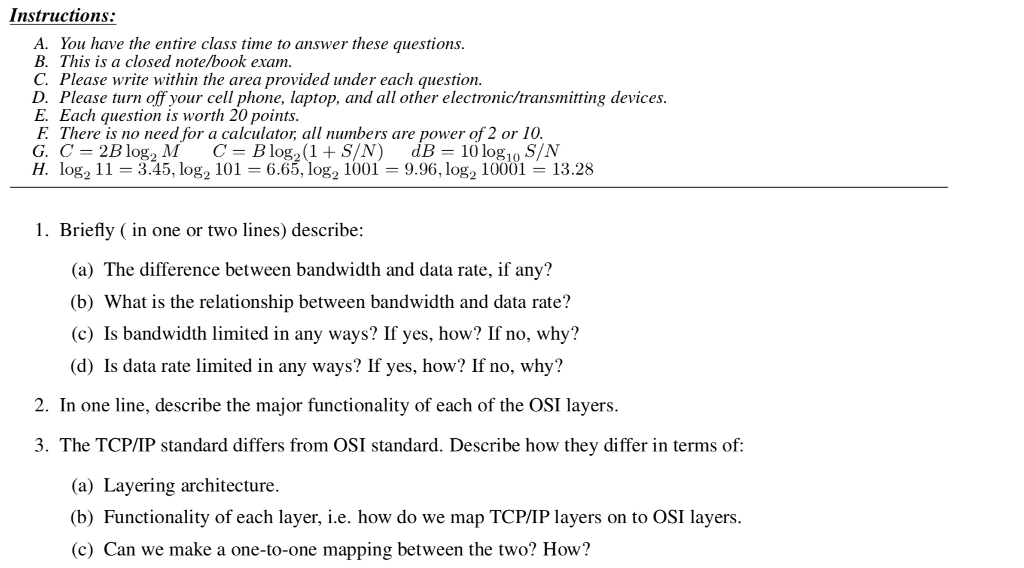
Instructions: A. You have the entire class time to answer these questions B. This is a closed note/book exam C. Please write within the area provided under each question. D. Please turn off your cell phone, laptop, and all other electronic/transmitting devices E. Each question is worth 20 points. F There is no need for a calculator, all numbers are power of 2 or 10. G. C-2Blog2M C= Blog2(1+S/N) dB-10log10 S/ H. log2 = 345,1082 101-655,10821001-9.96, lo8210001 -13.28 1. Briefly (in one or two lines) describe: (a) The difference between bandwidth and data rate, if any? (b) What is the relationship between bandwidth and data rate? (c) Is bandwidth limited in any ways? If yes, how? If no, why? (d) Is data rate limited in any ways? If yes, how? If no, why? 2. In one line, describe the major functionality of each of the OSI layers. 3. The TCP/IP standard differs from OSI standard. Describe how they differ in terms of: (a) Layering architecture. (b) Functionality of each layer, i.e. how do we map TCP/IP layers on to OSI layers. c) Can we make a one-to-one mapping between the two? How? Instructions: A. You have the entire class time to answer these questions B. This is a closed note/book exam C. Please write within the area provided under each question. D. Please turn off your cell phone, laptop, and all other electronic/transmitting devices E. Each question is worth 20 points. F There is no need for a calculator, all numbers are power of 2 or 10. G. C-2Blog2M C= Blog2(1+S/N) dB-10log10 S/ H. log2 = 345,1082 101-655,10821001-9.96, lo8210001 -13.28 1. Briefly (in one or two lines) describe: (a) The difference between bandwidth and data rate, if any? (b) What is the relationship between bandwidth and data rate? (c) Is bandwidth limited in any ways? If yes, how? If no, why? (d) Is data rate limited in any ways? If yes, how? If no, why? 2. In one line, describe the major functionality of each of the OSI layers. 3. The TCP/IP standard differs from OSI standard. Describe how they differ in terms of: (a) Layering architecture. (b) Functionality of each layer, i.e. how do we map TCP/IP layers on to OSI layers. c) Can we make a one-to-one mapping between the two? How
Step by Step Solution
There are 3 Steps involved in it

Get step-by-step solutions from verified subject matter experts
 Study Help