







Question: Please complete and post all simulated matlab code to prove it works, also if necessary I can reupload to be completed in 2 parts Discrete
Please complete and post all simulated matlab code to prove it works, also if necessary I can reupload to be completed in 2 parts
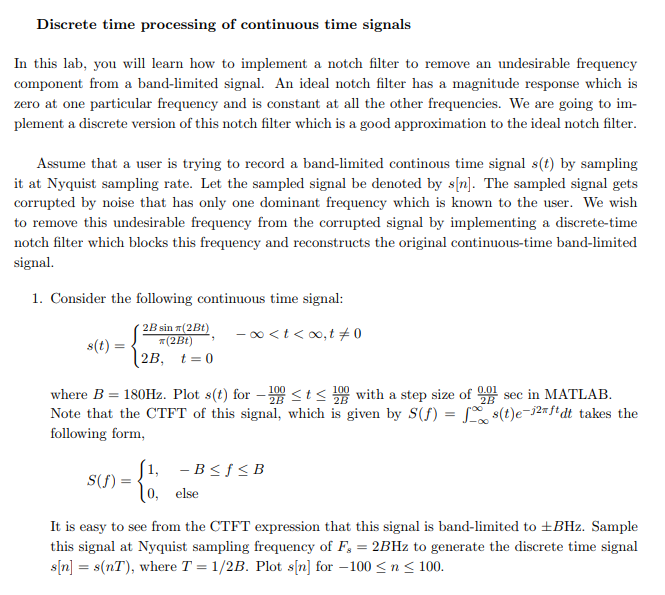
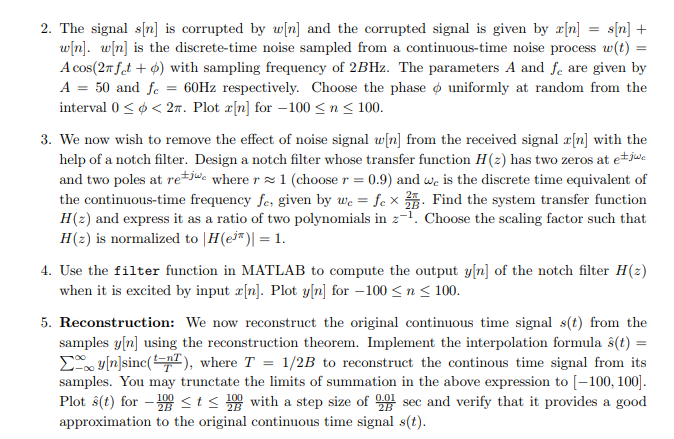
Discrete time processing of continuous time signals In this lab, you will learn how to implement a notch filter to remove an undesirable frequency component from a band-limited signal. An ideal notch filter has a magnitude response which is zero at one particular frequency and is constant at all the other frequencies. We are going to im- plement a discrete version of this notch filter which is a good approximation to the ideal notch filter Assume that a user is trying to record a band-limited continous time signal s(t by sampling it at Nyquist sampling rate. Let the sampled signal be denoted by s[n]. The sampled signal gets corrupted by noise that has only one dominant frequency which is known to the user. We wish to remove this undesirable frequency from the corrupted signal by implementing a discrete-time notch filter which blocks this frequency and reconstructs the original continuous-time band-limited signal. 1. Consider the following continuous time signal: 2B sin (2Bt) s(t) 2B, t=0 where B = 180Hz. Plot s(t) for- t ?with a step size of sec in MATLAB Note that the CTFT of this signal, whih is given by S(f)-?s(t)e-j2nftdt takes the following form, S(f)- 0, else It is easy to see from the CTFT expression that this signal is band-limited to tBHz. Sample this signal at Nyquist sampling frequency of Fs2BHz to generate the discrete time signal s[n] = s(nT), where T 1/2B. Plot 8[n] for-100
Step by Step Solution
There are 3 Steps involved in it

Get step-by-step solutions from verified subject matter experts
 Study Help