







Question: Please complete and show work for the cash flows from this case study. Dear Mr. Fitzgerald, After our meeting last week, I have developed the
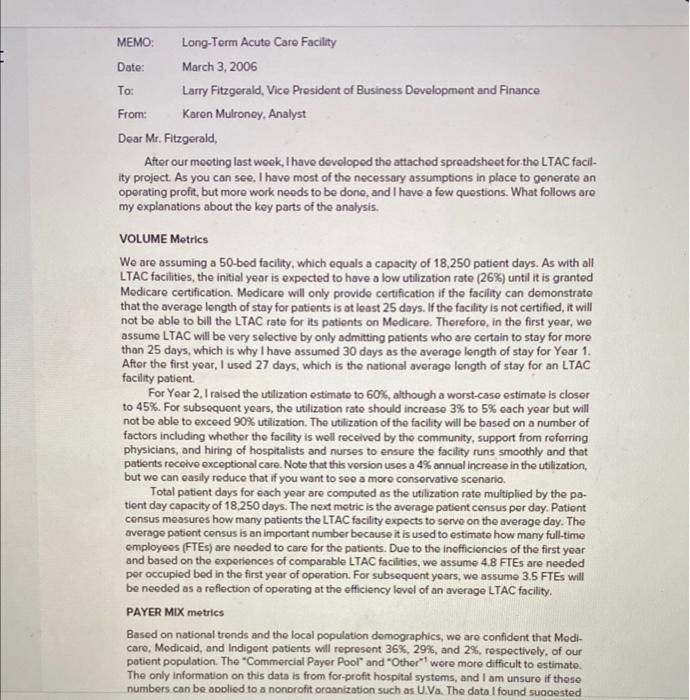
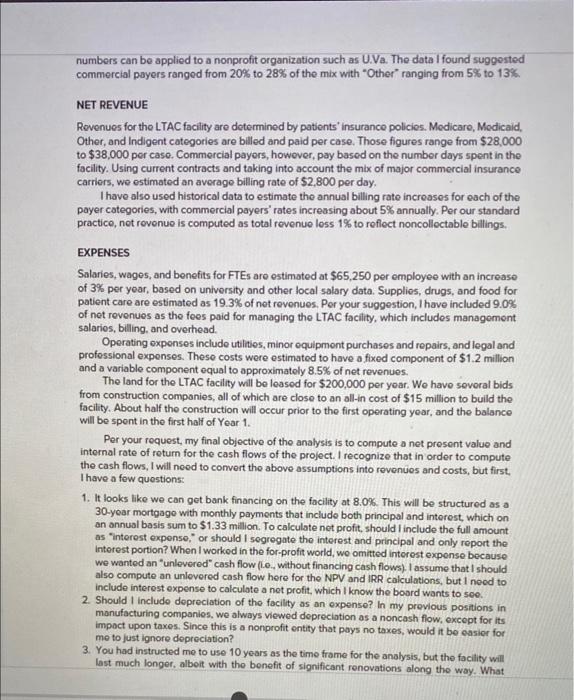
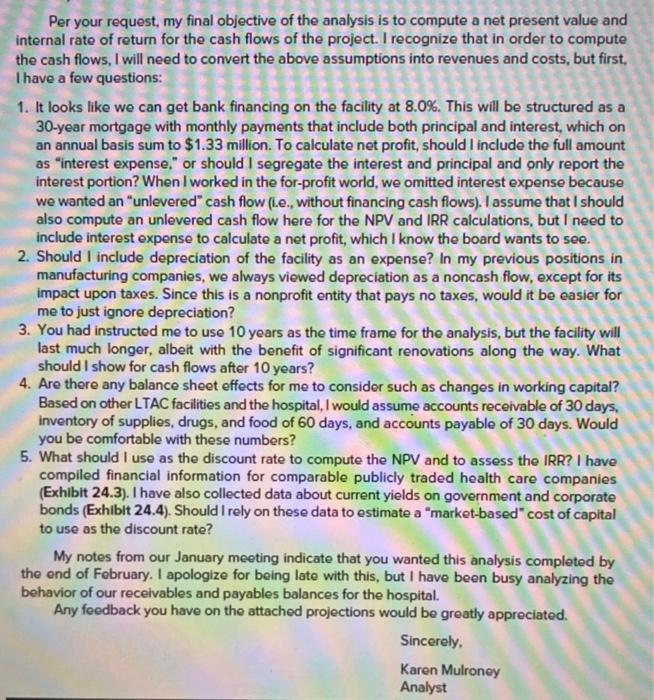
Dear Mr. Fitzgerald, After our meeting last week, I have developed the attached spreadsheet for the LTAC faciity project. As you can see, I have most of the necessary assumptions in place to generate an operating profit, but more work needs to be done, and I have a few questions. What follows are my explanations about the key parts of the analysis. VOLUME Metrics We are assuming a 50-bed facility, which equals a capacity of 18,250 patient days. As with all LTAC facilities, the initial year is expected to have a low utilization rate (26\%) until it is granted Medicare certification. Medicare will only provide certification if the facility can demonstrate that the average length of stay for patients is at least 25 days. If the facility is not certified, it will not be able to bill the LTAC rate for its pationts on Medicare. Therefore, in the first yoar, we assume LTAC will be very selective by only admitting patients who are certain to stay for more than 25 days, which is why I have assumed 30 days as the average length of stay for Year 1. After the first year, I used 27 days, which is the national average length of stay for an LTAC facility patient. For Year 2 , I raised the utilization estimate to 60%, although a worst-case estimate is closer to 45%. For subsequont years, the utilization rate should increase 3% to 5% each year but will not be able to exceed 90% utilization. The utilization of the facility will be based on a number of factors including whether the facility is well recelved by the community, support from reforring physicians, and hiring of hospitalists and nurses to ensure the facility runs smoothly and that patients recelve exceptional care. Note that this version uses a 4% annual increase in the utilization, but we can easily reduce that if you want to see a more conservative scenario. Total patient days for each year are computed as the utilization rate multiplied by the potient day capacity of 18,250 days. The next metric is the average patient census per day. Pationt census measures how many patients the LTAC facility expects to serve on the average day. The average patient census is an important number because it is used to estimate how many full-time employees (FTEs) are needed to care for the patients. Due to the inefficiencies of the first yoar and based on the experiences of comparable LTAC facilties, we assume 4.8 FTEs are needed per occupied bed in the first year of operation. For subsequent years, we assume 3.5 FTEs will be needed as a reflection of operating at the efficiency lovel of an average LTAC facility. PAYER MIX metrics Based on national trends and the local population demographics, we are confident that Medicare, Medicaid, and Indigent patients will represent 36%,29%, and 2%, respectively, of our patient population. The "Commercial Payer Pool" and "Other" were more difficult to estimate. The only information on this data is from for-profit hospital systems, and I am unsure if these numbers can be apolied to a nonorofit oraanization such as U.Va. The data I found suagested numbers can be applied to a nonprofit organization such as U.Va. The data I found suggested commercial payers ranged from 20% to 28% of the mix with "Other" ranging from 5% to 13%. NET REVENUE Revenues for the LTAC facility are determined by patients' insurance policies. Medicare, Medicaid, Other, and Indigent categories are billed and paid per case. Those figures range from $28,000 to $38,000 per case. Commercial payors, however, pay based on the number days spent in the facility. Using current contracts and taking into account the mix of major commercial insurance carriers, we estimated an average billing rate of $2,800 per day. I have also used historical data to estimate the annual billing rate increases for each of the payer categories, with commercial payers' rates increasing about 5% annually. Per our standard practice, not rovenue is computed as total revenue loss 1% to reflect noncollectable billings. EXPENSES Salaries, wages, and benefits for FTEs are estimated at $65,250 per employee with an increase of 3% per yoar, based on university and other local salary data. Supplies, drugs, and food for patient care are estimated as 19.3% of net revenues. Per your suggestion, I have included 9.0% of net revenues as the fees paid for managing the LTAC facility, which includes management salarios, billing, and overhead. Operating expenses include utilites, minor equipment purchases and repairs, and legal and profossional expenses. These costs were estimated to have a fixed component of $1.2 million and a variable component equal to approximately 8.5% of net revenues. The land for the LTAC facility will be leased for $200,000 per year. We have sovoral bids from construction companies, all of which are close to an all-in cost of $15 million to build the facility. About half the construction will occur prior to the first operating year, and the balance will be spent in the first half of Year 1. Per your request, my final objective of the analysis is to compute a net present value and internal rate of return for the cash flows of the project. I recognize that in order to compute the cash flows, I will need to convert the above assumptions into revenues and costs, but first, I have a few questions: 1. It looks like we can get bank financing on the facility at 8.0%. This will be structured as a 30 -year mortgage with monthly payments that include both principal and intorest, which on an annual basis sum to $1.33 million. To calculate net profit, should I include the full amount as "interest expense," or should I segregate the interest and principal and only report the interest portion? When I worked in the for-profit world, wo omitted interest expense because we wanted an "unlevered" cash flow (L.e., without financing cash flows), l assume that I should also compute an unlevered cash flow here for the NPV and IRR calculations, but 1 need to include interest expense to calculate a net profit, which I know the board wants to see. 2. Should I include depreciation of the facility as an expense? in my provious positions in manufacturing companies, we always viewed depreciation as a noncash flow, except for its impoct upon taxes. Since this is a nonprofit entity that pays no taxes, would it be easier for me to just ignore dopreciation? 3. You had instructed me to use 10 years as the time frame for the analysis, but the facility will last much longer, albeit with the benefit of significant renovations along the way. What Per your request, my final objective of the analysis is to compute a net present value and internal rate of return for the cash flows of the project. I recognize that in order to compute the cash flows, I will need to convert the above assumptions into revenues and costs, but first, I have a fow questions: 1. It looks like we can get bank financing on the facility at 8.0%. This will be structured as a 30-year mortgage with monthly payments that include both principal and interest, which on an annual basis sum to $1.33 million. To calculate net profit, should I include the full amount as "interest expense," or should I segregate the interest and principal and only report the interest portion? When I worked in the for-profit world, we omitted interest expense because we wanted an "unlevered" cash flow (i.e., without financing cash flows). I assume that I should also compute an unlevered cash flow here for the NPV and IRR calculations, but I need to include interest expense to calculate a net profit, which I know the board wants to see. 2. Should I include depreciation of the facility as an expense? In my previous positions in manufacturing companies, we always viewed depreciation as a noncash flow, except for its impact upon taxes. Since this is a nonprofit entity that pays no taxes, would it be easier for me to just ignore depreciation? 3. You had instructed me to use 10 years as the time frame for the analysis, but the facility will last much longer, albeit with the benefit of significant renovations along the way. What should I show for cash flows after 10 years? 4. Are there any balance sheet effects for me to consider such as changes in working capital? Based on other LTAC facilities and the hospital, I would assume accounts receivable of 30 days, inventory of supplies, drugs, and food of 60 days, and accounts payable of 30 days. Would you be comfortable with these numbers? 5. What should I use as the discount rate to compute the NPV and to assess the IRR? I have compiled financial information for comparable publicly traded health care companies (Exhibit 24.3). I have also collected data about current yields on government and corporate bonds (Exhibit 24.4). Should I rely on these data to estimate a "market-based" cost of capital to use as the discount rate? My notes from our January meeting indicate that you wanted this analysis completed by the end of February. I apologize for being late with this, but I have been busy analyzing the behavior of our receivables and payables balances for the hospital. Any feedback you have on the attached projections would be greatly appreciated. Sincerely. Dear Mr. Fitzgerald, After our meeting last week, I have developed the attached spreadsheet for the LTAC faciity project. As you can see, I have most of the necessary assumptions in place to generate an operating profit, but more work needs to be done, and I have a few questions. What follows are my explanations about the key parts of the analysis. VOLUME Metrics We are assuming a 50-bed facility, which equals a capacity of 18,250 patient days. As with all LTAC facilities, the initial year is expected to have a low utilization rate (26\%) until it is granted Medicare certification. Medicare will only provide certification if the facility can demonstrate that the average length of stay for patients is at least 25 days. If the facility is not certified, it will not be able to bill the LTAC rate for its pationts on Medicare. Therefore, in the first yoar, we assume LTAC will be very selective by only admitting patients who are certain to stay for more than 25 days, which is why I have assumed 30 days as the average length of stay for Year 1. After the first year, I used 27 days, which is the national average length of stay for an LTAC facility patient. For Year 2 , I raised the utilization estimate to 60%, although a worst-case estimate is closer to 45%. For subsequont years, the utilization rate should increase 3% to 5% each year but will not be able to exceed 90% utilization. The utilization of the facility will be based on a number of factors including whether the facility is well recelved by the community, support from reforring physicians, and hiring of hospitalists and nurses to ensure the facility runs smoothly and that patients recelve exceptional care. Note that this version uses a 4% annual increase in the utilization, but we can easily reduce that if you want to see a more conservative scenario. Total patient days for each year are computed as the utilization rate multiplied by the potient day capacity of 18,250 days. The next metric is the average patient census per day. Pationt census measures how many patients the LTAC facility expects to serve on the average day. The average patient census is an important number because it is used to estimate how many full-time employees (FTEs) are needed to care for the patients. Due to the inefficiencies of the first yoar and based on the experiences of comparable LTAC facilties, we assume 4.8 FTEs are needed per occupied bed in the first year of operation. For subsequent years, we assume 3.5 FTEs will be needed as a reflection of operating at the efficiency lovel of an average LTAC facility. PAYER MIX metrics Based on national trends and the local population demographics, we are confident that Medicare, Medicaid, and Indigent patients will represent 36%,29%, and 2%, respectively, of our patient population. The "Commercial Payer Pool" and "Other" were more difficult to estimate. The only information on this data is from for-profit hospital systems, and I am unsure if these numbers can be apolied to a nonorofit oraanization such as U.Va. The data I found suagested numbers can be applied to a nonprofit organization such as U.Va. The data I found suggested commercial payers ranged from 20% to 28% of the mix with "Other" ranging from 5% to 13%. NET REVENUE Revenues for the LTAC facility are determined by patients' insurance policies. Medicare, Medicaid, Other, and Indigent categories are billed and paid per case. Those figures range from $28,000 to $38,000 per case. Commercial payors, however, pay based on the number days spent in the facility. Using current contracts and taking into account the mix of major commercial insurance carriers, we estimated an average billing rate of $2,800 per day. I have also used historical data to estimate the annual billing rate increases for each of the payer categories, with commercial payers' rates increasing about 5% annually. Per our standard practice, not rovenue is computed as total revenue loss 1% to reflect noncollectable billings. EXPENSES Salaries, wages, and benefits for FTEs are estimated at $65,250 per employee with an increase of 3% per yoar, based on university and other local salary data. Supplies, drugs, and food for patient care are estimated as 19.3% of net revenues. Per your suggestion, I have included 9.0% of net revenues as the fees paid for managing the LTAC facility, which includes management salarios, billing, and overhead. Operating expenses include utilites, minor equipment purchases and repairs, and legal and profossional expenses. These costs were estimated to have a fixed component of $1.2 million and a variable component equal to approximately 8.5% of net revenues. The land for the LTAC facility will be leased for $200,000 per year. We have sovoral bids from construction companies, all of which are close to an all-in cost of $15 million to build the facility. About half the construction will occur prior to the first operating year, and the balance will be spent in the first half of Year 1. Per your request, my final objective of the analysis is to compute a net present value and internal rate of return for the cash flows of the project. I recognize that in order to compute the cash flows, I will need to convert the above assumptions into revenues and costs, but first, I have a few questions: 1. It looks like we can get bank financing on the facility at 8.0%. This will be structured as a 30 -year mortgage with monthly payments that include both principal and intorest, which on an annual basis sum to $1.33 million. To calculate net profit, should I include the full amount as "interest expense," or should I segregate the interest and principal and only report the interest portion? When I worked in the for-profit world, wo omitted interest expense because we wanted an "unlevered" cash flow (L.e., without financing cash flows), l assume that I should also compute an unlevered cash flow here for the NPV and IRR calculations, but 1 need to include interest expense to calculate a net profit, which I know the board wants to see. 2. Should I include depreciation of the facility as an expense? in my provious positions in manufacturing companies, we always viewed depreciation as a noncash flow, except for its impoct upon taxes. Since this is a nonprofit entity that pays no taxes, would it be easier for me to just ignore dopreciation? 3. You had instructed me to use 10 years as the time frame for the analysis, but the facility will last much longer, albeit with the benefit of significant renovations along the way. What Per your request, my final objective of the analysis is to compute a net present value and internal rate of return for the cash flows of the project. I recognize that in order to compute the cash flows, I will need to convert the above assumptions into revenues and costs, but first, I have a fow questions: 1. It looks like we can get bank financing on the facility at 8.0%. This will be structured as a 30-year mortgage with monthly payments that include both principal and interest, which on an annual basis sum to $1.33 million. To calculate net profit, should I include the full amount as "interest expense," or should I segregate the interest and principal and only report the interest portion? When I worked in the for-profit world, we omitted interest expense because we wanted an "unlevered" cash flow (i.e., without financing cash flows). I assume that I should also compute an unlevered cash flow here for the NPV and IRR calculations, but I need to include interest expense to calculate a net profit, which I know the board wants to see. 2. Should I include depreciation of the facility as an expense? In my previous positions in manufacturing companies, we always viewed depreciation as a noncash flow, except for its impact upon taxes. Since this is a nonprofit entity that pays no taxes, would it be easier for me to just ignore depreciation? 3. You had instructed me to use 10 years as the time frame for the analysis, but the facility will last much longer, albeit with the benefit of significant renovations along the way. What should I show for cash flows after 10 years? 4. Are there any balance sheet effects for me to consider such as changes in working capital? Based on other LTAC facilities and the hospital, I would assume accounts receivable of 30 days, inventory of supplies, drugs, and food of 60 days, and accounts payable of 30 days. Would you be comfortable with these numbers? 5. What should I use as the discount rate to compute the NPV and to assess the IRR? I have compiled financial information for comparable publicly traded health care companies (Exhibit 24.3). I have also collected data about current yields on government and corporate bonds (Exhibit 24.4). Should I rely on these data to estimate a "market-based" cost of capital to use as the discount rate? My notes from our January meeting indicate that you wanted this analysis completed by the end of February. I apologize for being late with this, but I have been busy analyzing the behavior of our receivables and payables balances for the hospital. Any feedback you have on the attached projections would be greatly appreciated. Sincerely
Step by Step Solution
There are 3 Steps involved in it

Get step-by-step solutions from verified subject matter experts
 Study Help