







Question: PLEASE COMPLETE PROBLEMS 5, 6, & 7. THANK YOU. Part I. Consider, as we did a few weeks back, a formal language with a one-place
PLEASE COMPLETE PROBLEMS 5, 6, & 7. THANK YOU.
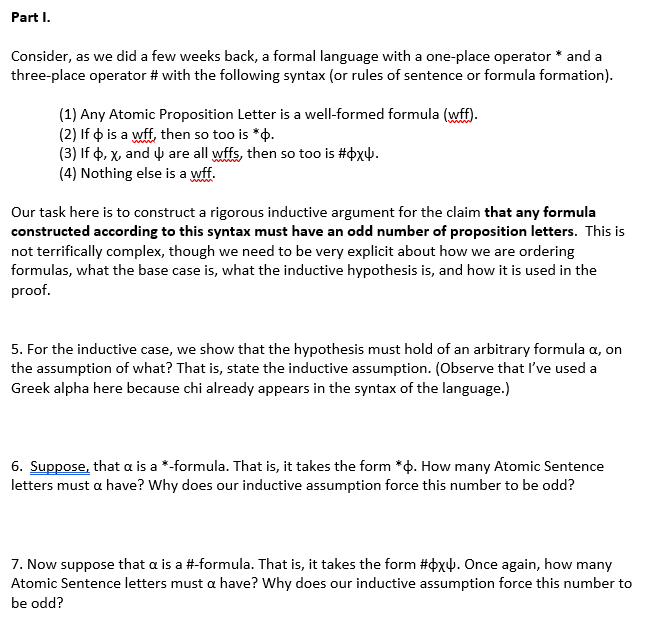
Part I. Consider, as we did a few weeks back, a formal language with a one-place operator * and a three-place operator # with the following syntax (or rules of sentence or formula formation). (1) Any Atomic Proposition Letter is a well-formed formula (wff). (2) If is a wff, then so too is *. (3) If , X, and y are all wffs, then so too is #ox4. (4) Nothing else is a wff. Our task here is to construct a rigorous inductive argument for the claim that any formula constructed according to this syntax must have an odd number of proposition letters. This is not terrifically complex, though we need to be very explicit about how we are ordering formulas, what the base case is, what the inductive hypothesis is, and how it is used in the proof. 5. For the inductive case, we show that the hypothesis must hold of an arbitrary formula a, on the assumption of what? That is, state the inductive assumption. (Observe that I've used a Greek alpha here because chi already appears in the syntax of the language.) 6. Suppose, that a is a *-formula. That is, it takes the form **. How many Atomic Sentence letters must a have? Why does our inductive assumption force this number to be odd? 7. Now suppose that a is a #-formula. That is, it takes the form #oxy. Once again, how many Atomic Sentence letters must a have? Why does our inductive assumption force this number to be odd? Part I. Consider, as we did a few weeks back, a formal language with a one-place operator * and a three-place operator # with the following syntax (or rules of sentence or formula formation). (1) Any Atomic Proposition Letter is a well-formed formula (wff). (2) If is a wff, then so too is *. (3) If , X, and y are all wffs, then so too is #ox4. (4) Nothing else is a wff. Our task here is to construct a rigorous inductive argument for the claim that any formula constructed according to this syntax must have an odd number of proposition letters. This is not terrifically complex, though we need to be very explicit about how we are ordering formulas, what the base case is, what the inductive hypothesis is, and how it is used in the proof. 5. For the inductive case, we show that the hypothesis must hold of an arbitrary formula a, on the assumption of what? That is, state the inductive assumption. (Observe that I've used a Greek alpha here because chi already appears in the syntax of the language.) 6. Suppose, that a is a *-formula. That is, it takes the form **. How many Atomic Sentence letters must a have? Why does our inductive assumption force this number to be odd? 7. Now suppose that a is a #-formula. That is, it takes the form #oxy. Once again, how many Atomic Sentence letters must a have? Why does our inductive assumption force this number to be odd
Step by Step Solution
There are 3 Steps involved in it

Get step-by-step solutions from verified subject matter experts
 Study Help