



Question: Please complete the following questions based on the abstract, tables, figures and options provided: Abstract Background: Obesity is a major risk factor for venous thromboembolism
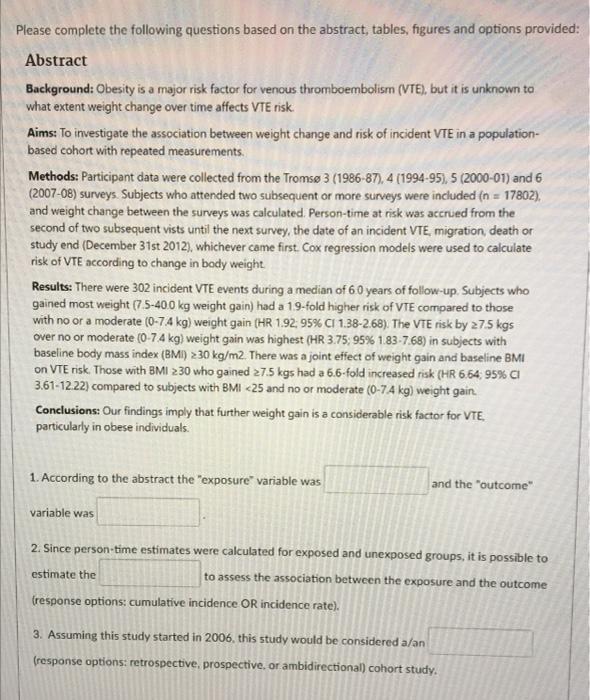
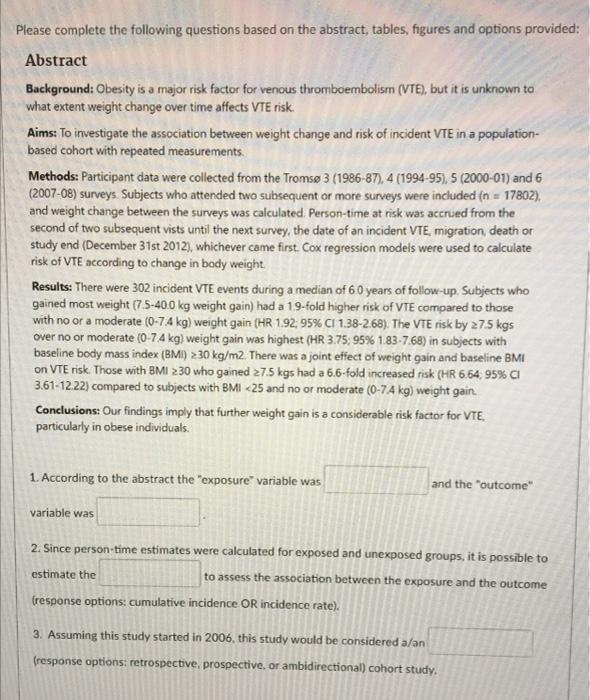
Please complete the following questions based on the abstract, tables, figures and options provided: Abstract Background: Obesity is a major risk factor for venous thromboembolism (VTE), but it is unknown to what extent weight change over time affects VTE risk Aims: To investigate the association between weight change and risk of incident VTE in a population- based cohort with repeated measurements. Methods: Participant data were collected from the Tromso 3 (1986-87), 4 (1994-95), 5 (2000-01) and 6 (2007-08) surveys. Subjects who attended two subsequent or more surveys were included (n = 17802) and weight change between the surveys was calculated. Person-time at risk was accrued from the second of two subsequent vists until the next survey, the date of an incident VTE, migration, death or study end (December 31st 2012), whichever came first. Cox regression models were used to calculate risk of VTE according to change in body weight Results: There were 302 incident VTE events during a median of 6 0 years of follow-up. Subjects who gained most weight (7.5-40 0 kg weight gain) had a 1.9-fold higher risk of VTE compared to those with no or a moderate (0-74 kg) weight gain (HR 1.92: 95% CI 1.38-2.68) The VTE risk by 27.5 kgs over no or moderate (0-7.4 kg) weight gain was highest (HR 3.75; 95% 1.83-7.68) in subjects with baseline body mass index (BMI) >30 kg/m2. There was a joint effect of weight gain and baseline BMI on VTE risk. Those with BMI 230 who gained 27.5 kgs had a 6.6-fold increased risk (HR 6.64; 95% C] 3.61-12.22) compared to subjects with BMI
Step by Step Solution
There are 3 Steps involved in it

Get step-by-step solutions from verified subject matter experts