







Question: please complete the table ? Impulse Response Worksheet Now let's see how this all fits together! Lets consider ar+bx' +cr = f(t) with r(0) =
please complete the table ?
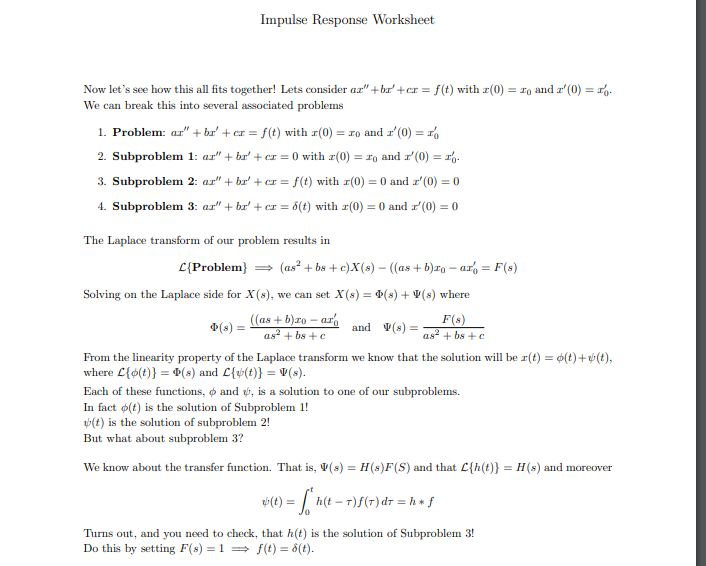
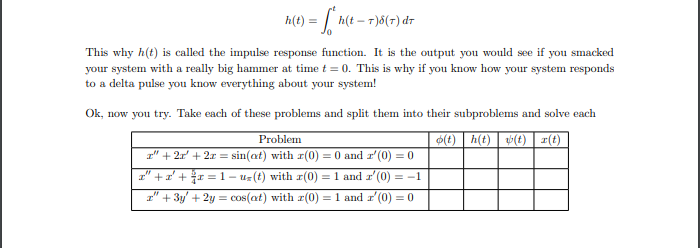
Impulse Response Worksheet Now let's see how this all fits together! Lets consider ar"+bx' +cr = f(t) with r(0) = 1, and x'(O) = 16- We can break this into several associated problems 1. Problem: ar" + bx' + er = f(t) with r(0) = ro and x'(0) = 16 2. Subproblem 1: ar" + br' + cr=0 with r(0) = 19 and 20) = 36. 3. Subproblem 2: ar" +br'+er = f(t) with r(0) = 0 and x'(0) = 0 4. Subproblem 3: ar" + bar' + cr= 8(t) with r(0) = 0 and 10) = 0 $(s) = as? + bs + c The Laplace transform of our problem results in C{Problem} (as + bs + c)X(8) - ((as +b)xo - ax = F(s) Solving on the Laplace side for X(s), we can set X (s) = f(s) + (s) where ((as+b)xo -ax F(s) and (8) = as + b + c From the linearity property of the Laplace transform we know that the solution will be r(t) = $(t)+v(t), where C{$(t)} = (8) and C{X(t)} = (s). Each of these functions, and y, is a solution to one of our subproblems. In fact o(t) is the solution of Subproblem 1! v(t) is the solution of subproblem 2! But what about subproblem 3? We know about the transfer function. That is, (s) = H(s)F(S) and that c{h(t)} = H(s) and moreover v (t) = n(t = 1)F()dt = has Turns out, and you need to check, that h(t) is the solution of Subproblem 3! Do this by setting F(x) = 1 = f(t) = 8(t). H(E) = *m4 )b(7) dr This why h(t) is called the impulse response function. It is the output you would see if you smacked your system with a really big hammer at time t = 0. This is why if you know how your system responds to a delta pulse you know everything about your system! Ok, now you try. Take each of these problems and split them into their subproblems and solve each Problem (t) h(t) v(t) =(t) 2" +22' + 2x = sin(at) with r(0) = 0 and r'(0) = 0 = 1 - uz(t) with r(0) = 1 and x'(0) = -1 2" + 3y' + 2y = cos(at) with x(0) = 1 and 2'0) = 0 " + + Impulse Response Worksheet Now let's see how this all fits together! Lets consider ar"+bx' +cr = f(t) with r(0) = 1, and x'(O) = 16- We can break this into several associated problems 1. Problem: ar" + bx' + er = f(t) with r(0) = ro and x'(0) = 16 2. Subproblem 1: ar" + br' + cr=0 with r(0) = 19 and 20) = 36. 3. Subproblem 2: ar" +br'+er = f(t) with r(0) = 0 and x'(0) = 0 4. Subproblem 3: ar" + bar' + cr= 8(t) with r(0) = 0 and 10) = 0 $(s) = as? + bs + c The Laplace transform of our problem results in C{Problem} (as + bs + c)X(8) - ((as +b)xo - ax = F(s) Solving on the Laplace side for X(s), we can set X (s) = f(s) + (s) where ((as+b)xo -ax F(s) and (8) = as + b + c From the linearity property of the Laplace transform we know that the solution will be r(t) = $(t)+v(t), where C{$(t)} = (8) and C{X(t)} = (s). Each of these functions, and y, is a solution to one of our subproblems. In fact o(t) is the solution of Subproblem 1! v(t) is the solution of subproblem 2! But what about subproblem 3? We know about the transfer function. That is, (s) = H(s)F(S) and that c{h(t)} = H(s) and moreover v (t) = n(t = 1)F()dt = has Turns out, and you need to check, that h(t) is the solution of Subproblem 3! Do this by setting F(x) = 1 = f(t) = 8(t). H(E) = *m4 )b(7) dr This why h(t) is called the impulse response function. It is the output you would see if you smacked your system with a really big hammer at time t = 0. This is why if you know how your system responds to a delta pulse you know everything about your system! Ok, now you try. Take each of these problems and split them into their subproblems and solve each Problem (t) h(t) v(t) =(t) 2" +22' + 2x = sin(at) with r(0) = 0 and r'(0) = 0 = 1 - uz(t) with r(0) = 1 and x'(0) = -1 2" + 3y' + 2y = cos(at) with x(0) = 1 and 2'0) = 0 " + +
Step by Step Solution
There are 3 Steps involved in it

Get step-by-step solutions from verified subject matter experts
 Study Help