



Question: please complete with python3! (next-to-the-last-digit of my id is 7) Write a program that reads in two integers, helght and width. Then generates output that
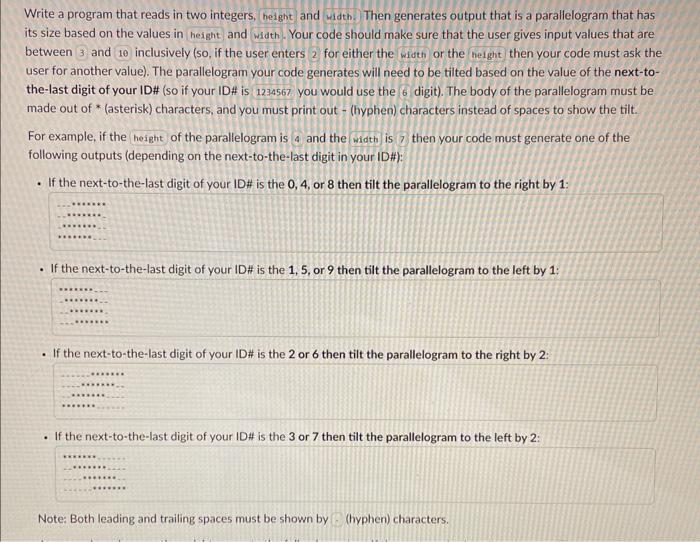

Write a program that reads in two integers, helght and width. Then generates output that is a parallelogram that has its size based on the values in and width. Your code should make sure that the user gives input values that are between 3 and 10 inclusively (so, if the user enters 2 for either the wioth or the height then your code must ask the user for another value). The parallelogram your code generates will need to be tilted based on the value of the next-tothe-last digit of your ID\# (so if your ID\# is 1234567 you would use the 6 digit). The body of the parallelogram must be made out of * (asterisk) characters, and you must print out - (hyphen) characters instead of spaces to show the tilt. For example, if the height of the parallelogram is 4 and the is 7 then your code must generate one of the following outputs (depending on the next-to-the-last digit in your ID\#): - If the next-to-the-last digit of your ID\# is the 0,4, or 8 then tilt the parallelogram to the right by 1 : - If the next-to-the-last digit of your ID\# is the 1,5 , or 9 then tilt the parallelogram to the left by 1 : - If the next-to-the-last digit of your ID\# is the 2 or 6 then tilt the parallelogram to the right by 2 : - If the next-to-the-last digit of your ID\# is the 3 or 7 then tilt the parallelogram to the left by 2 : Note: Both leading and trailing spaces must be shown by (hyphen) characters. Submit a copy of your code. Also submit the output generated by your code running for parallelograms of the following dimensions: - Heights and width - Height of 10 and width 3 - Height 7 and width of (4)
Step by Step Solution
There are 3 Steps involved in it

Get step-by-step solutions from verified subject matter experts