







Question: Please Construct a 10 Period Binomial Lattice Please use the excel template to complete this by showing the formulas and steps to plug in to
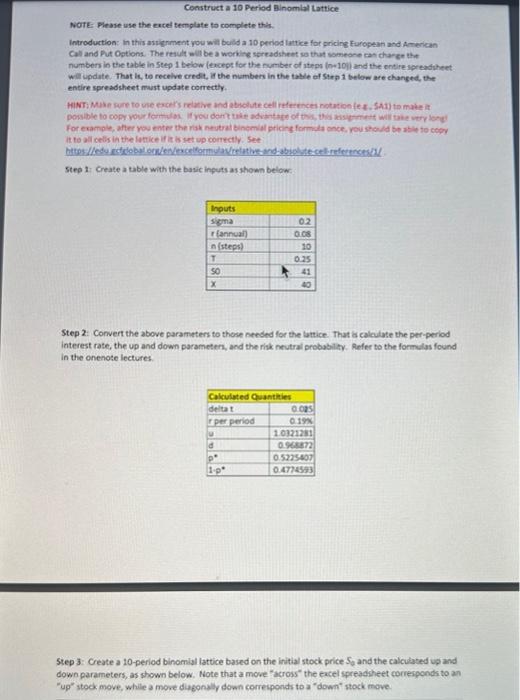
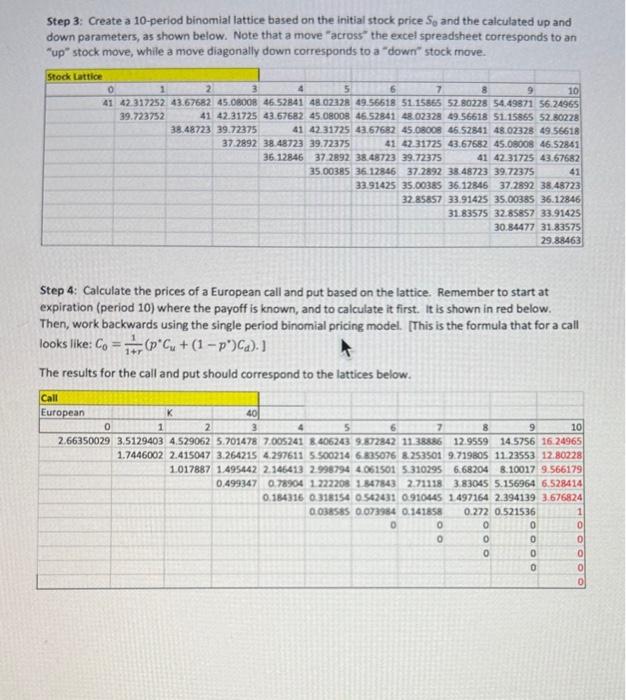
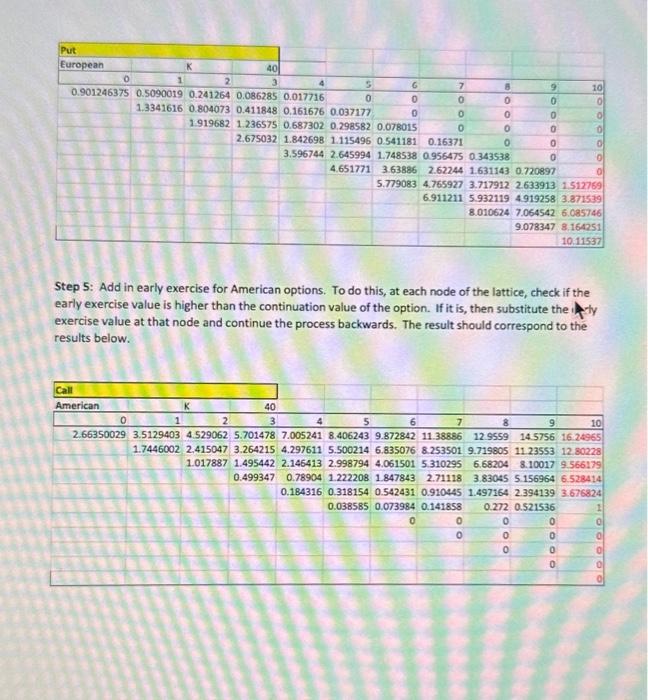
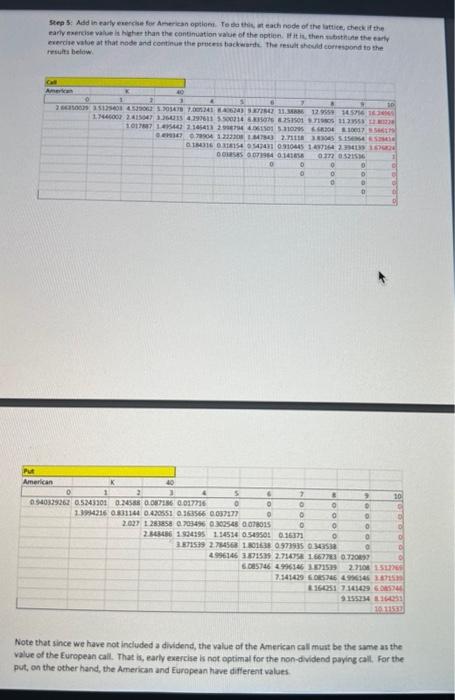
Step 5: Add in early exercise for American options. To do this, at each node of the lattice, check if the early exercise value is higher than the continuation value of the option. If it is, then substitute the ify exercise value at that node and continue the process backwards. The result should correspond to the results below. Construct a 10 Period Binomial Lattice. NOTE: Please use the excel template to complete this. Introduction: in this assienment you wal beild a 10 period lantice for pricing Furopean and American Cal and hut Options. The result will be a workire sereadshet so that someone can charce the numbers in the table in Step 1 below (except for the number of ateps (bw10) and the entirespreadiphet enclire spreadsheet must update correcthy. it to af cells th the frefice if it is ter up correctly. See Step it Create a table with the basic inputs as shown below: Step 2: Convert the above paramaters to those needed for the lumice. That is calculate the perf-period interest rate, the up and down parameter, and the rikk neutral probablity. Aefer to the formulas found in the onenote lectures. Step 3: Create a 10-period binomial lattice based on the initial stock price S0 and the calculated up and down parameters, as shown below. Note that a move "across" the eacel spreadiheet corresponds to an "up" stock move, while a more diagonally down corresponds to a "down" stock move Step 3: Create a 10-period binomial lattice based on the initial stock price S0 and the calculated up and down parameters, as shown below. Note that a move "across" the excel spreadsheet corresponds to an "up" stock move, while a move diagonally down corresponds to a "down" stock move. Step 4: Calculate the prices of a European call and put based on the lattice. Remember to start at expiration (period 10) where the payoff is known, and to calculate it first. it is shown in red below. Then, work backwards using the single period binomial pricing model. IThis is the formula that for a call looks like: C0=1+r1(pCu+(1p)Cd).] The results for the call and put should correspond to the lattices below. Sep 5: Add in earfy enercise fer American optiom. To ba thic it each node of the lattice, check if the rraiti below. Note that since we have not included a dividend, the value of the American cal mutt be the sume as the value of the European call. That is, early exercise is not optimal for the non-dividend paying call. For the put, on the other hand, the American and European have different values Step 5: Add in early exercise for American options. To do this, at each node of the lattice, check if the early exercise value is higher than the continuation value of the option. If it is, then substitute the ify exercise value at that node and continue the process backwards. The result should correspond to the results below. Construct a 10 Period Binomial Lattice. NOTE: Please use the excel template to complete this. Introduction: in this assienment you wal beild a 10 period lantice for pricing Furopean and American Cal and hut Options. The result will be a workire sereadshet so that someone can charce the numbers in the table in Step 1 below (except for the number of ateps (bw10) and the entirespreadiphet enclire spreadsheet must update correcthy. it to af cells th the frefice if it is ter up correctly. See Step it Create a table with the basic inputs as shown below: Step 2: Convert the above paramaters to those needed for the lumice. That is calculate the perf-period interest rate, the up and down parameter, and the rikk neutral probablity. Aefer to the formulas found in the onenote lectures. Step 3: Create a 10-period binomial lattice based on the initial stock price S0 and the calculated up and down parameters, as shown below. Note that a move "across" the eacel spreadiheet corresponds to an "up" stock move, while a more diagonally down corresponds to a "down" stock move Step 3: Create a 10-period binomial lattice based on the initial stock price S0 and the calculated up and down parameters, as shown below. Note that a move "across" the excel spreadsheet corresponds to an "up" stock move, while a move diagonally down corresponds to a "down" stock move. Step 4: Calculate the prices of a European call and put based on the lattice. Remember to start at expiration (period 10) where the payoff is known, and to calculate it first. it is shown in red below. Then, work backwards using the single period binomial pricing model. IThis is the formula that for a call looks like: C0=1+r1(pCu+(1p)Cd).] The results for the call and put should correspond to the lattices below. Sep 5: Add in earfy enercise fer American optiom. To ba thic it each node of the lattice, check if the rraiti below. Note that since we have not included a dividend, the value of the American cal mutt be the sume as the value of the European call. That is, early exercise is not optimal for the non-dividend paying call. For the put, on the other hand, the American and European have different values
Step by Step Solution
There are 3 Steps involved in it

Get step-by-step solutions from verified subject matter experts
 Study Help