







Question: please, could you help with (a), (b), and (c) 2. Consider a car industry that produces differentiated varieties of cars. The demand faced by each
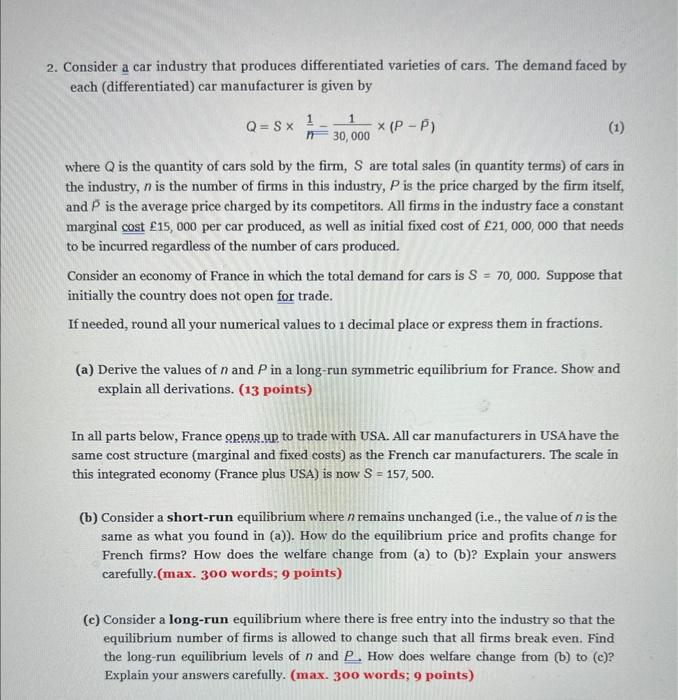
2. Consider a car industry that produces differentiated varieties of cars. The demand faced by each (differentiated) car manufacturer is given by Q=Sn130,0001(PP) where Q is the quantity of cars sold by the firm, S are total sales (in quantity terms) of cars in the industry, n is the number of firms in this industry, P is the price charged by the firm itself, and P is the average price charged by its competitors. All firms in the industry face a constant marginal cost 15,000 per car produced, as well as initial fixed cost of 21,000,000 that needs to be incurred regardless of the number of cars produced. Consider an economy of France in which the total demand for cars is S=70,000. Suppose that initially the country does not open for trade. If needed, round all your numerical values to 1 decimal place or express them in fractions. (a) Derive the values of n and P in a long-run symmetric equilibrium for France. Show and explain all derivations. (13 points) In all parts below, France opens up to trade with USA. All car manufacturers in USA have the same cost structure (marginal and fixed costs) as the French car manufacturers. The scale in this integrated economy (France plus USA) is now S=157,500. (b) Consider a short-run equilibrium where n remains unchanged (i.e., the value of n is the same as what you found in (a)). How do the equilibrium price and profits change for French firms? How does the welfare change from (a) to (b)? Explain your answers carefully.(max. 300 words; 9 points) (c) Consider a long-run equilibrium where there is free entry into the industry so that the equilibrium number of firms is allowed to change such that all firms break even. Find the long-run equilibrium levels of n and P How does welfare change from (b) to (c)? Explain your answers carefully. (max. 300 words; 9 points) 2. Consider a car industry that produces differentiated varieties of cars. The demand faced by each (differentiated) car manufacturer is given by Q=Sn130,0001(PP) where Q is the quantity of cars sold by the firm, S are total sales (in quantity terms) of cars in the industry, n is the number of firms in this industry, P is the price charged by the firm itself, and P is the average price charged by its competitors. All firms in the industry face a constant marginal cost 15,000 per car produced, as well as initial fixed cost of 21,000,000 that needs to be incurred regardless of the number of cars produced. Consider an economy of France in which the total demand for cars is S=70,000. Suppose that initially the country does not open for trade. If needed, round all your numerical values to 1 decimal place or express them in fractions. (a) Derive the values of n and P in a long-run symmetric equilibrium for France. Show and explain all derivations. (13 points) In all parts below, France opens up to trade with USA. All car manufacturers in USA have the same cost structure (marginal and fixed costs) as the French car manufacturers. The scale in this integrated economy (France plus USA) is now S=157,500. (b) Consider a short-run equilibrium where n remains unchanged (i.e., the value of n is the same as what you found in (a)). How do the equilibrium price and profits change for French firms? How does the welfare change from (a) to (b)? Explain your answers carefully.(max. 300 words; 9 points) (c) Consider a long-run equilibrium where there is free entry into the industry so that the equilibrium number of firms is allowed to change such that all firms break even. Find the long-run equilibrium levels of n and P How does welfare change from (b) to (c)? Explain your answers carefully. (max. 300 words; 9 points)
Step by Step Solution
There are 3 Steps involved in it

Get step-by-step solutions from verified subject matter experts
 Study Help