







Question: Please create 4 discussion questions based on the article. When the State Bilingual Advisory Committee (SBAC) was formed in I970, its members were as new
Please create 4 discussion questions based on the article.
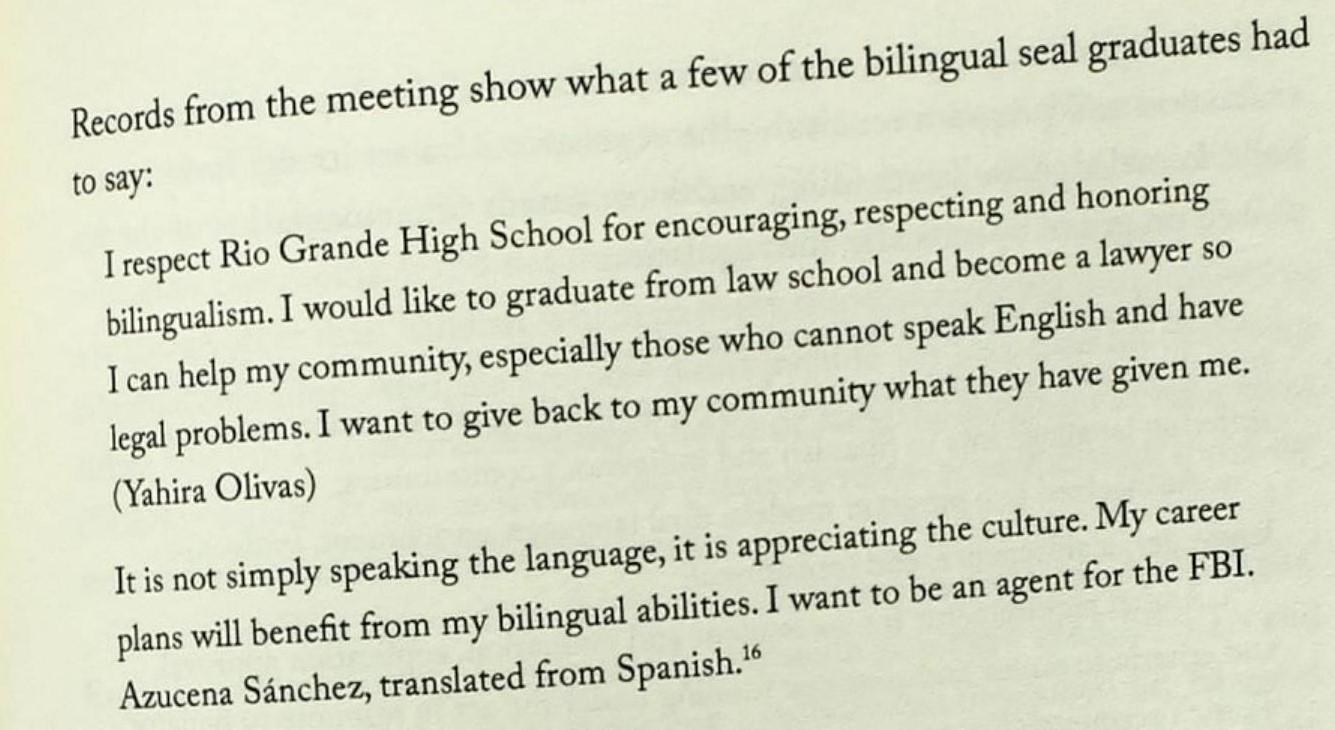
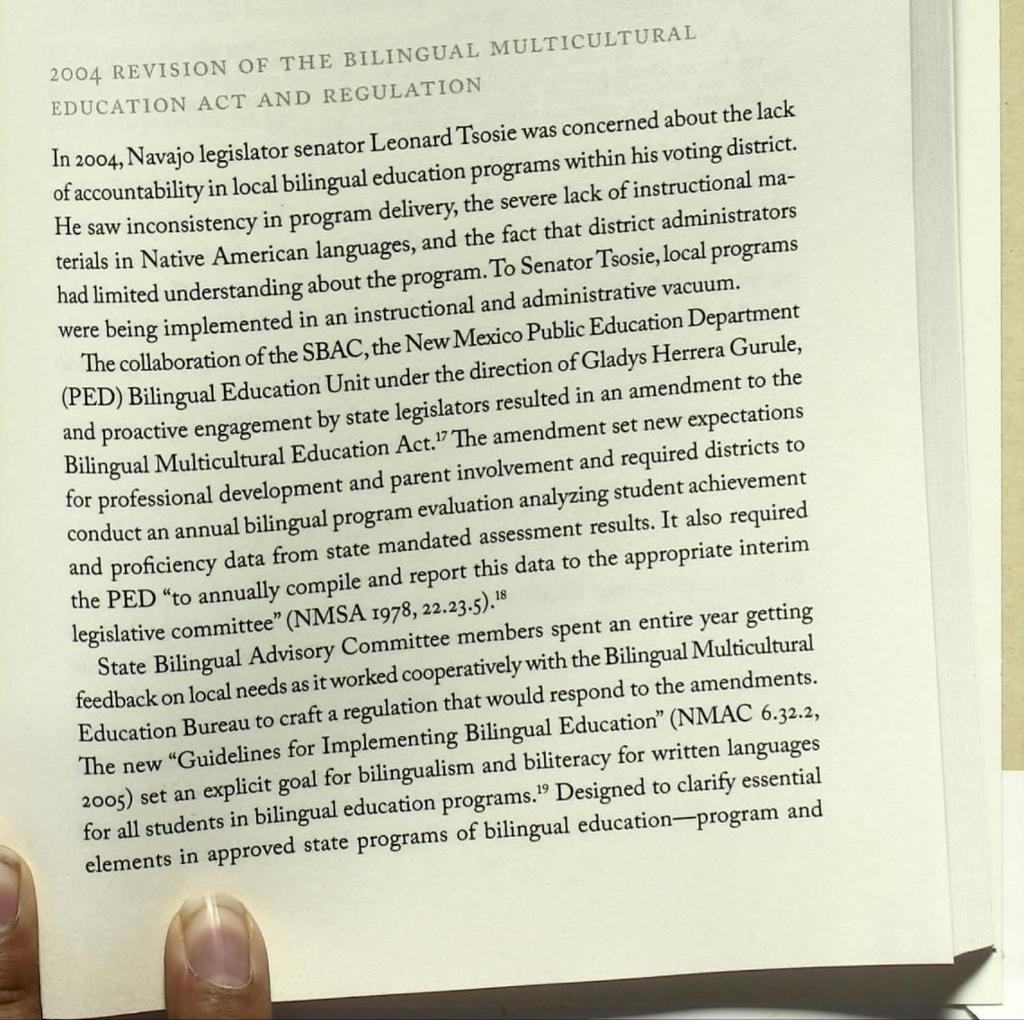
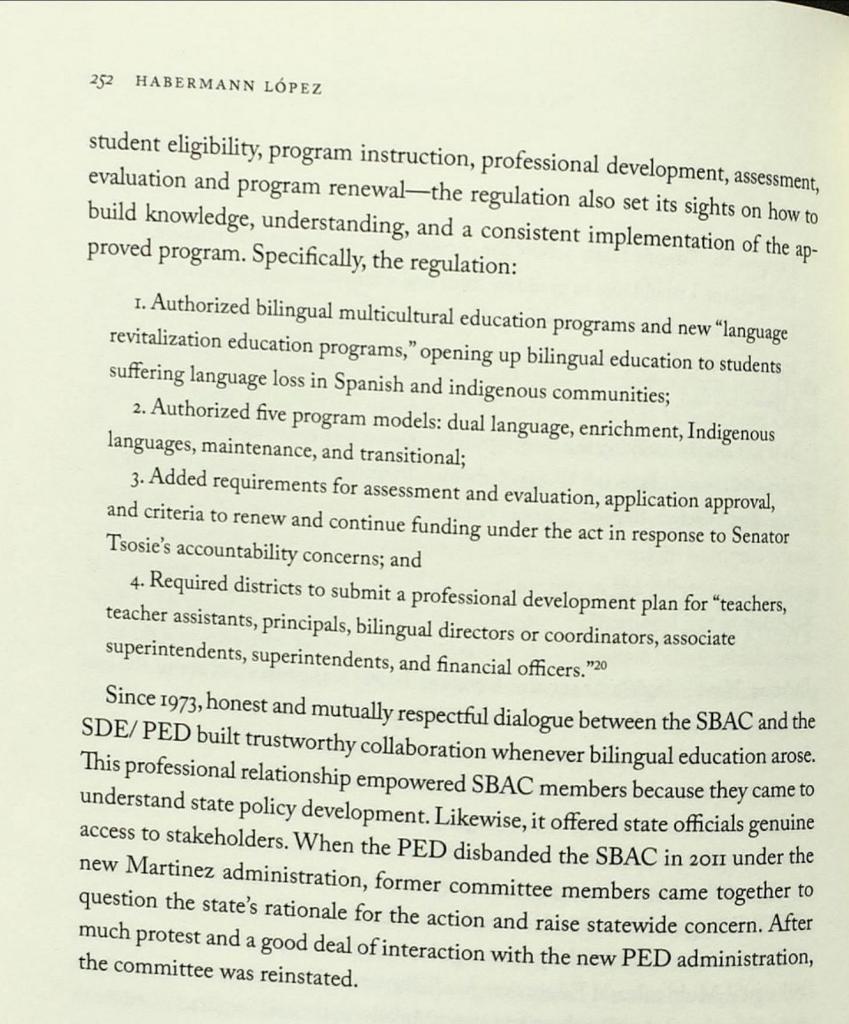
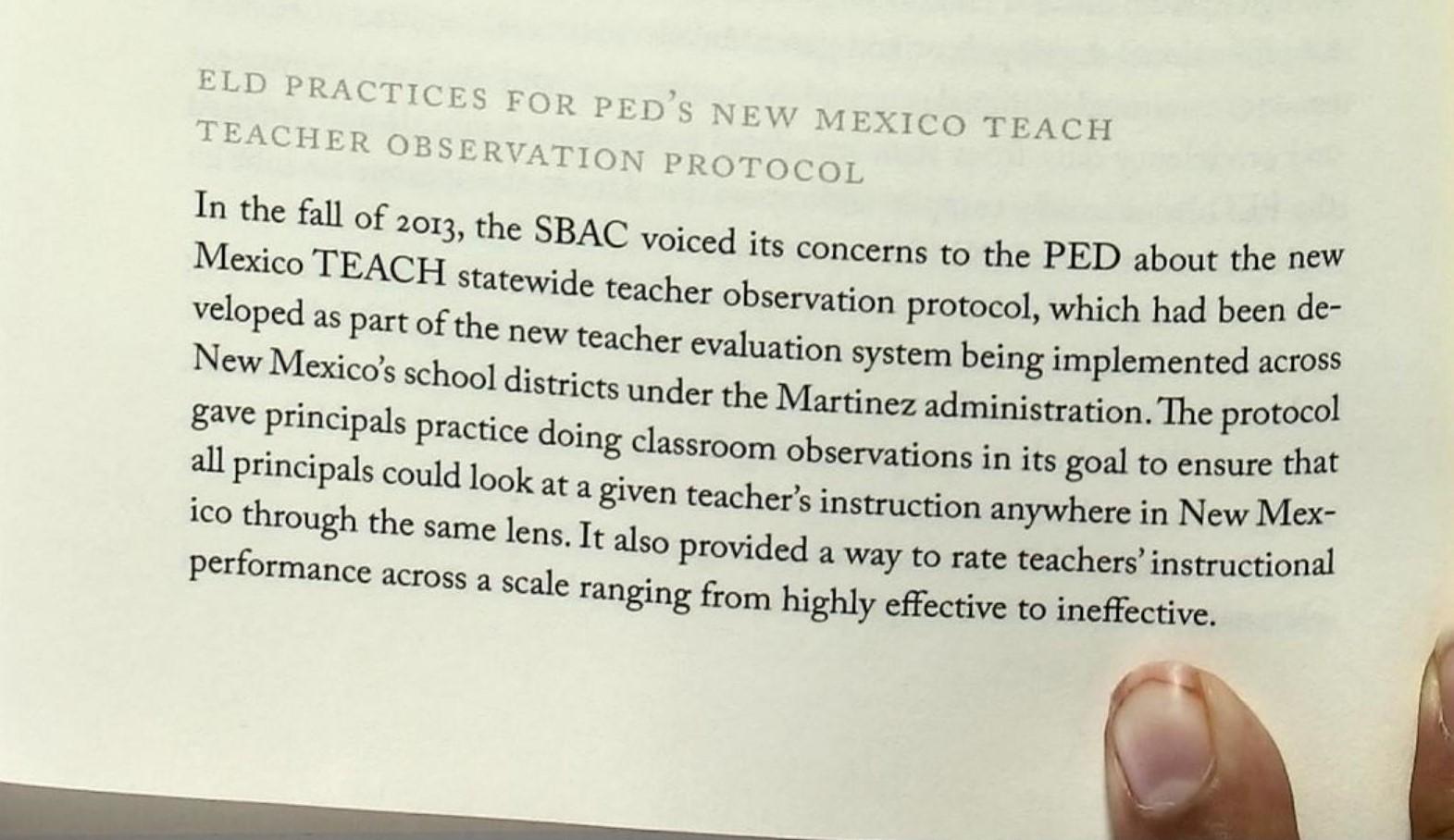
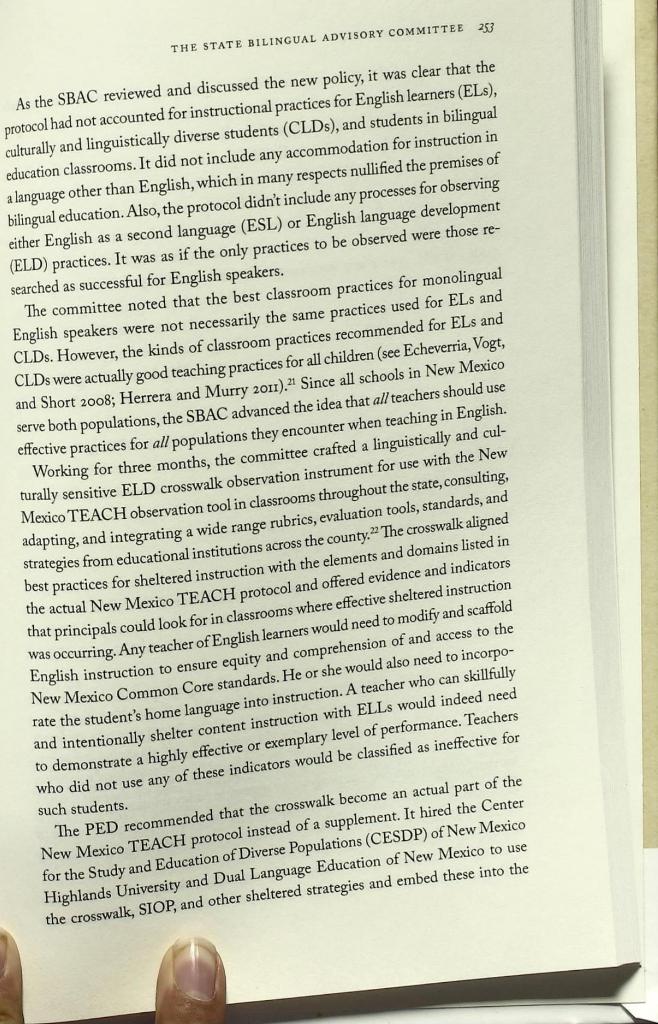
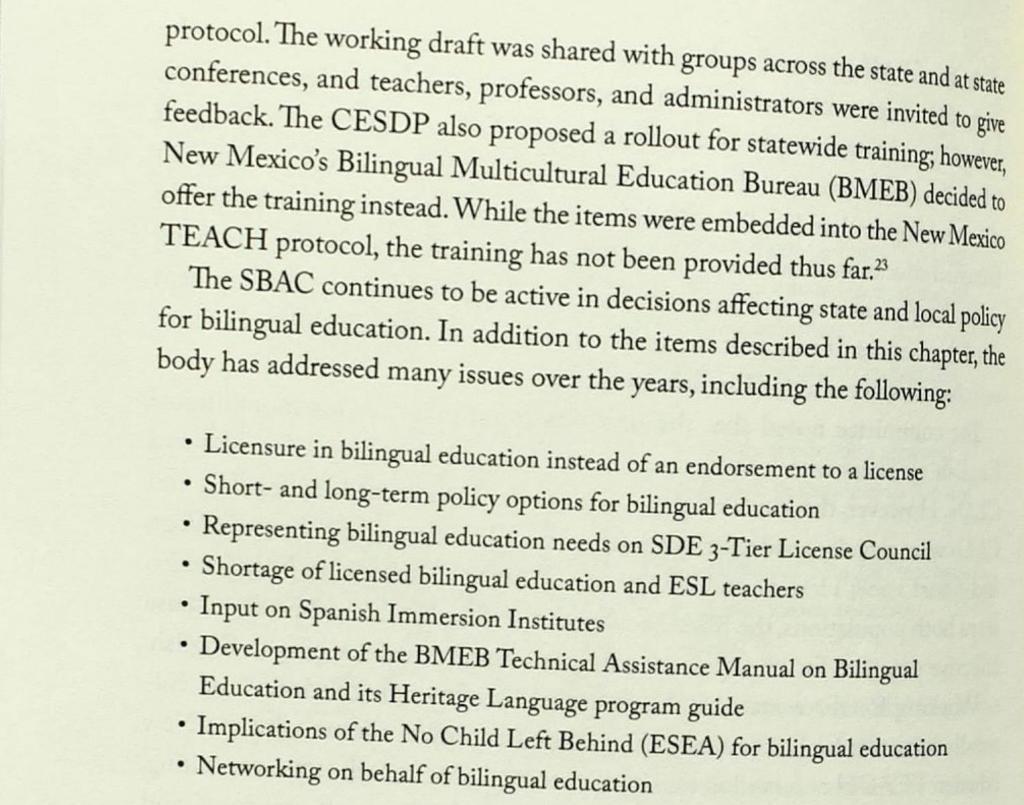
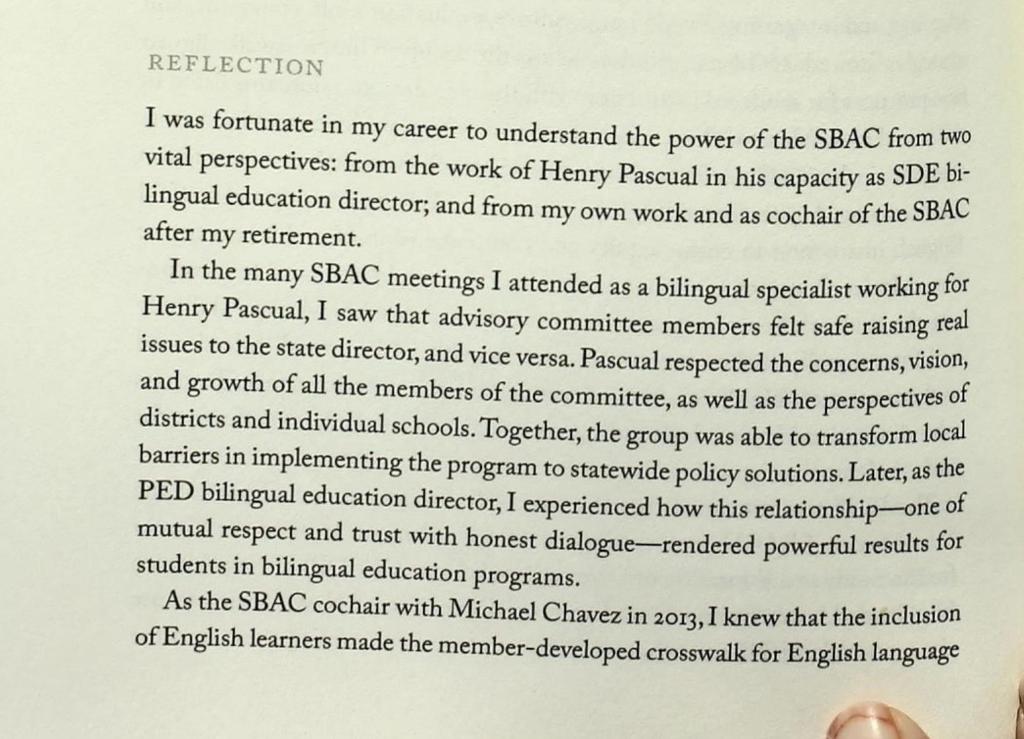
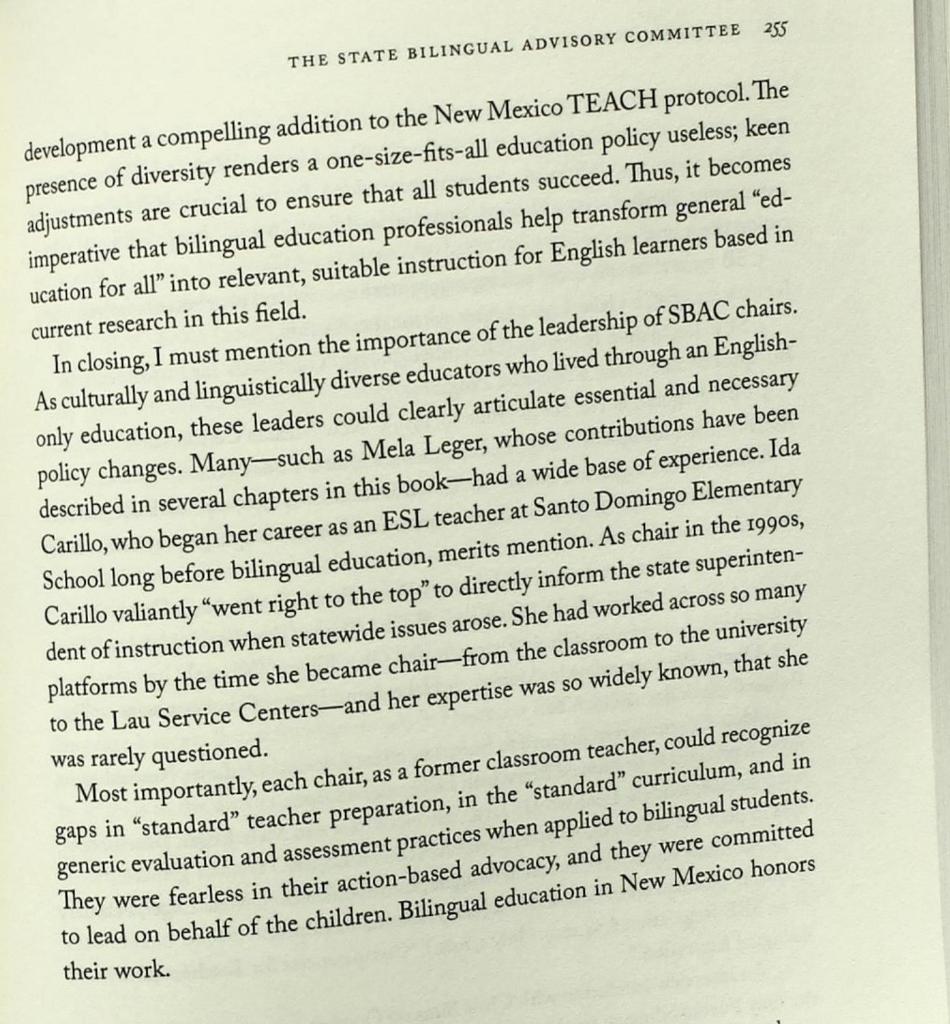
When the State Bilingual Advisory Committee (SBAC) was formed in I970, its members were as new to their advisory roles as their programs were to the newly emerging field of bilingual education. With time, experimentation and emerging research in program delivery helped define content and strategies used in bilingual education classrooms across the state. It also spearheaded trailblazers who, by serving on the SBAC, translated local issues into statewide policy. Mela Leger set the leadership stage for future SBAC chairpersons when she brought an important certification issue to the state superintendent of instruction that directly impacted bilingual education teachers. The synergetic relationship that grew between the New Mexico State Department of Education (SDE) and the committee itself spurred mutual confidence and trust in the work that needed to be done. Little did the New Mexico State Board of Education (SBE) realize when it created SBAC in 1970 that the committee would become a powerful action agent for practitioner-based policy development in bilingual education. 1 The first SBE policy statement on bilingual education in the nation (see Blum Martnez, chapter 6 this volume) set the framework for an ambitious agenda for the committee. By 1973, many schools across New Mexico had been carrying out bilingual education programs for eight years under state and federal funds and through private foundation grants. 2 It was time for the state to set some guiding principles, both for teacher preparation and for the program itself. The first major task given to the SBAC was to develop criteria for the licensure of teachers in bilingual education. Working in conjunction with Henry Pascual of the SDE's Bilingual Education Unit, SBE Regulation 7374T-"Prescribing Program Requirements for Approved Teacher Education Programs in Bilingual Education"-was approved on January 24,1974 . The document described what a bilingual education teacher preparation program would look like (see Hannum and Salazar, chapter io this volume). At that time, existing local programs were teaching some content in the native language, all had a native language arts component, and most included cultural activities within the social studies. 3 Working directly with Henry Pascual, the committee again helped develop guiding principles for the program, which were approved by the SBE on December 5, I975. The "Guidelines for Implementing Bilingual Multicultural Education Programs" (SBE Regulation No. 75-I9) provided a definition of bilingual multicultural education and directed programs to set objectives for "literacy skills to provide proficiency in two languages, one of which is English; and progressive understanding and study of the history and cultures of New Mexico by including these in the curriculum., 14 The instructional program was to consist of daily language arts in the home language, English language development within the English language arts, content areas taught through two languages focusing on "social, cultural and economic values and history of the cultures of the students," and finally, a fine arts component taught in two languages. It also required parent advisory committees to assist and advise in the implementation and evaluation of the program; teachers who were certified in bilingual education; and an annual evaluation "commensurate with local objectives and needs" that should include "student's achievement through English as well as the home language" (SBE Regulation No. 75-I9). Beginning in I975, the SDE began the process of defining actual university course requirements for prospective Spanish and Native American languages teachers seeking a bilingual education endorsement. Both the SBAC and the Native American Bilingual Education Steering Committee worked on this task for their respective language groups. SPANISH-ENGLISH BILINGUAL MULTICULTURAL EDUCATION CERTIFICATION REQUIREMENTS From 1975 to 1979 , the SBAC, working in cooperation with Henry Pascual of the SDE, developed the final version of SBE Regulation No. 79-Io, New Mexico certification requirements for Spanish/English bilingual/bicultural endorsement. 5 The work was arduous and demanding as the committee and the SDE, working with numerous stakeholders, helped create two other SBE-approved regulations during that time period. 6 Difficulties arose in defining coursework and requirements for the endorsement because university education departments lacked teaching staff who could teach in Spanish. The final regulation (SBE regulation No. 79-IO) required teachers to have literacy skills in Spanish and take twelve of twenty-four semester hours taught in Spanish. This regulation remained in existence until I989. NATIVE AMERICAN BILINGUAL EDUCATION CERTIFICATION REQUIREMENTS The Native American Bilingual Education Steering Committee was charged with defining course requirements in February, 1977. The core committee was composed of members approved by tribal councils, tribal chairmen, or education agencies. Mescalero, Jicarilla, Navajo, and Pueblo representatives agreed upon eight necessary content areas courses on August 29, 1980.? According to the minutes, the committee would then develop course descriptions for approval by tribal councils. The New Mexico Educational Standards Commission reviewed final recommendations on January 25,1982 , and tabled its decision on the matter. In an interview on October 5,2018 , former chair Donna Pino stated that early involvement by the tribes in the I970s served as a powerful catalyst for future actions in certifying Native language teachers. 8 In those days, there was no one who could teach the courses at the universities, and the only way to certify proficiency was through the tribes. Later, memoranda of agreement between each pueblo and the state set up tribal processes and procedures that lead to the 520 alternative certificate approved for Native language teachers in the schools (see Sims, chapter 3 this volume). The SBAC and the Bilingual Education Unit at the SDE built a healthy and trusting partnership that consistently linked actual practice with policy. Comprised of Hispanic and Native American practitioners from bilingual education programs across New Mexico, committee members spoke the language being used in their respective program as well as English. In the early years of the committee's history, members served multiple terms, and as their local expertise grew over time, so did their aptitude to pinpoint needed statewide policy adjustments. In many cases, committee members actually did the work necessary to create crucial statewide actions for students and teachers in bilingual education programs. The SBAC also helped raise awareness and resolve general policy decisions that would be harmful to the education of Hispanic and Native American students in the state. One early example stands out. In a November 29 , 1982, letter to then state superintendent of public instruction Leonard J. De Layo, SBAC chairperson Mela Leger wrote about the new SBE policy that would change a teacher's certification to "nonstandard" for any teacher on waiver, and this would threaten their tenure status. Many bilingual education teachers across New Mexico were on waiver while they completed coursework for the endorsement. She wrote: It appears to us that it would be grossly unfair for teachers to lose or postpone their tenure because of the lack of the additional endorsement required for bilingual education. ... Many teachers who are eligible for waivers will not want the district to request a waiver if it will endanger their tenure status. We can appreciate your desire to have fully qualified teachers for bilingual education as well as in every area of instruction. However, we are very concerned that districts will either eliminate bilingual programs or that teachers will be penalized for implementing programs that are sorely needed for proper instruction of Hispanic and Indian children.9 Leger asked that the SBAC be placed on the agenda of the next SBE meeting to discuss the issue. Superintendent De Layo responded on December 15,1982 : "I am conducting a series of internal discussions within the State Department of Education relative to the questions you have raised as well as the broader questions regarding substandard certificates and tenure issues," indicating that the SBE might need to review the policy as well. 10 The SDE recognized the SBAC's commitment and expertise under Leger. A February 7,1984 , letter from then assistant superintendent Alan Morgan to Mela Leger states: "As you may be aware, the State Department of Education has a number of many advisory committees. Few committees conduct their activities with such thoroughness and energy as the Bilingual Education Advisory Committee. .11 Moreover, the SBAC collaborated directly with other SDE offices, such as special education, assessment and evaluation, instructional materials, and teacher licensure, when necessary. In some cases, the SBAC's findings and conclusions actually helped create new legislation, such as the development of the Prueba exam (see Hannum and Salazar, chapter ro this volume). This chapter attempts to tell the story of some of the SBAC's significant actions since its inception in 1973 . CREATION OF BILINGUAL EDUCATION AND ESL COMPETENCIES FOR LICENSURE I989 In 1989 , the SBE authorized a new competency-based teacher preparation system for prospective teachers attending the university. Instead of prescribing the courses required for a teaching license in New Mexico, it now identified the desired competencies teachers must have. Universities had to create course content that would enable teacher candidates to acquire the stipulated teaching competencies. A subcommittee of the SBAC developed the competencies for teachers of bilingual education and also for ESL. For bilingual education, they identified six crucial topic areas: Native languages, culture, English language development, instructional methodology, community/parental involvement, and assessment. To become certified, teachers needed to meet all competencies and demonstrate "at least a minimum eighth grade level of proficiency in the native language in oral and written language skills where the written form exists and is allowed." The latter recognized the fact that Pueblo communities used the oral form. The competencies went into effect on July I, I989. 12 The Prueba exam was created to certify Spanish proficiency to an eighthgrade level for teachers completing university courses for the endorsement (see Hannum and Salazar, chapter Io this volume). Other than the 19771982 work of the Native American Bilingual Education Steering Committee, nothing was in place to certify proficiency for Pueblo language teachers who would seek a bilingual endorsement to their teaching license under the new regulation. A process used in the 1970s set the stage (see Sims, chapter Io this volume) for implementing the 1989 competency requirements for Pueblo languages. While no university programs were available that could offer the required courses for the Pueblo endorsement, the Native language proficiency requirement presented an even more difficult challenge. 13 Nevertheless, a subcommittee of the State Bilingual Advisory in cooperation with the Indian Education unit at the SDE took on this work in 1990 . It was no simple task. There were myriad complex, extensive issues the group identified and studied such as how to actually assess the existing language varieties within each of the of five non-written languages among the pueblos; how to identify relevant language development issues for teachers who would be considered for endorsement among each of the tribes; and how to involve the tribes in designing and planning their process. The result was the SDE's Indian Education Unit recommendation that each pueblo oversee and drive the tribe's development process to determine Pueblo language proficiency. 14 SBAC TESTIMONY BEFORE SBE AND LEGISLATIVE COMMITTEES The SBAC often testified before the SBE and legislative committees through the years in support of bilingual education. 15 Testimony by SBAC member Carlos Chavez and his students before the SBE in 1999 merits discussion. Chavez became a member of the committee in the early i99os. Having received the nationally prestigious Milkin Educator Award for his groundbreaking work in bilingual secondary education, Chavez and his work in bilingual education programs at the secondary level was well known in the Albuquerque area as well as by committee members and the Bilingual Education Unit at the SDE. A graduate of Miguel Encinias's University of Albuquerque bilingual education teacher preparation program (see chapter 9 this volume), Chavez began teaching US history in Spanish in the Title VII ESEA Bilingual Education program at Albuquerque High School in the early i98os. This program was unique not only because it was at the secondary level, but also because teachers proficient in Spanish taught content courses in the language to immigrant and New Mexican Hispanic students. Since there were no US history textbooks available, Chavez translated the English version into Spanish and added material that told the history of Spanish and Native American people in New Mexico. The Chavez translation was used at Rio Grande High School (RGHS) when he later coordinated a Title VII bilingual education grant there. He was an excellent and sorely needed candidate for the SBAC, especially after Representative Taylor's secondary-level bilingual education legislation was fully implemented in 199I (see Hannum and Salazar, chapter ro this volume) Chavez set about a course of action at RGHS that resulted in the first gold seal placed on the diplomas of students who were proficient in two languages, a goal of the school's Title VII federal grant. His zeal, passion, and belief in his students'language capabilities to attain the seal inspired the bilingual program's teachers who taught US and world history and mathematics in Spanish, advanced placement Spanish, and English as a second language. In I998, RGHS graduated its first class of students with the prized gold seal on their diplomas. State Bilingual Advisory Committee member Carlos Chavez presented this stellar accomplishment to the SBE at its October 1999 meeting. Records from the meeting show what a few of the bilingual seal graduates had to say: I respect Rio Grande High School for encouraging, respecting and honoring bilingualism. I would like to graduate from law school and become a lawyer so I can help my community, especially those who cannot speak English and have legal problems. I want to give back to my community what they have given me. (Yahira Olivas) It is not simply speaking the language, it is appreciating the culture. My career plans will benefit from my bilingual abilities. I want to be an agent for the FBI. Azucena Snchez, translated from Spanish. 16 2004 REVISION OF THE BILINGUAL EDUCATION ACT AND REGULATION In 2004, Navajo legislator senator Leonard Tsosie was concerned about the lack of accountability in local bilingual education programs within his voting district. He saw inconsistency in program delivery, the severe lack of instructional materials in Native American languages, and the fact that district administrators had limited understanding about the program. To Senator Tsosie, local programs were being implemented in an instructional and administrative vacuum. The collaboration of the SBAC, the New Mexico Public Education Department (PED) Bilingual Education Unit under the direction of Gladys Herrera Gurule, and proactive engagement by state legislators resulted in an amendment to the Bilingual Multicultural Education Act. 17 The amendment set new expectations for professional development and parent involvement and required districts to conduct an annual bilingual program evaluation analyzing student achievement and proficiency data from state mandated assessment results. It also required the PED "to annually compile and report this data to the appropriate interim legislative committee" (NMSA 197,22.235)18 State Bilingual Advisory Committee members spent an entire year getting feedback on local needs as it worked cooperatively with the Bilingual Multicultural Education Bureau to craft a regulation that would respond to the amendments. The new "Guidelines for Implementing Bilingual Education" (NMAC 6.32.2, 2005) set an explicit goal for bilingualism and biliteracy for written languages for all students in bilingual education programs. 19 Designed to clarify essential elements in approved state programs of bilingual education-program and 252 HABERMANN LPEZ student eligibility, program instruction, professional development, assessment, evaluation and program renewal-the regulation also set its sights on how to build knowledge, understanding, and a consistent implementation of the approved program. Specifically, the regulation: I. Authorized bilingual multicultural education programs and new "language revitalization education programs," opening up bilingual education to students suffering language loss in Spanish and indigenous communities; 2. Authorized five program models: dual language, enrichment, Indigenous languages, maintenance, and transitional; 3. Added requirements for assessment and evaluation, application approval, and criteria to renew and continue funding under the act in response to Senator Tsosie's accountability concerns; and 4. Required districts to submit a professional development plan for "teachers, teacher assistants, principals, bilingual directors or coordinators, associate superintendents, superintendents, and financial officers. 20 Since 1973 , honest and mutually respectful dialogue between the SBAC and the SDE/PED built trustworthy collaboration whenever bilingual education arose. This professional relationship empowered SBAC members because they came to understand state policy development. Likewise, it offered state officials genuine access to stakeholders. When the PED disbanded the SBAC in 2oII under the new Martinez administration, former committee members came together to question the state's rationale for the action and raise statewide concern. After much protest and a good deal of interaction with the new PED administration, the committee was reinstated. ELD PRACTICES FOR PED'S NEW MEXICO TEACH TEACHER OBSERVATION PROTOCOL In the fall of 2013 , the SBAC voiced its concerns to the PED about the new Mexico TEACH statewide teacher observation protocol, which had been developed as part of the new teacher evaluation system being implemented across New Mexico's school districts under the Martinez administration. The protocol gave principals practice doing classroom observations in its goal to ensure that all principals could look at a given teacher's instruction anywhere in New Mexico through the same lens. It also provided a way to rate teachers' instructional performance across a scale ranging from highly effective to ineffective. THE STATE BILINGUAL ADVISORY COMMITTEE 253 As the SBAC reviewed and discussed the new policy, it was clear that the protocol had not accounted for instructional practices for English learners (ELs), culturally and linguistically diverse students (CLDs), and students in bilingual education classrooms. It did not include any accommodation for instruction in a language other than English, which in many respects nullified the premises of bilingual education. Also, the protocol didn't include any processes for observing either English as a second language (ESL) or English language development (ELD) practices. It was as if the only practices to be observed were those researched as successful for English speakers. The committee noted that the best classroom practices for monolingual English speakers were not necessarily the same practices used for ELs and CLDs. However, the kinds of classroom practices recommended for ELs and CLDs were actually good teaching practices for all children (see Echeverria, Vogt, and Short 2008; Herrera and Murry 20iI). 21 Since all schools in New Mexico serve both populations, the SBAC advanced the idea that all teachers should use effective practices for all populations they encounter when teaching in English. Working for three months, the committee crafted a linguistically and culturally sensitive ELD crosswalk observation instrument for use with the New Mexico TEACH observation tool in classrooms throughout the state, consulting, adapting, and integrating a wide range rubrics, evaluation tools, standards, and strategies from educational institutions across the county. 22 The crosswalk aligned best practices for sheltered instruction with the elements and domains listed in the actual New Mexico TEACH protocol and offered evidence and indicators that principals could look for in classrooms where effective sheltered instruction was occurring. Any teacher of English learners would need to modify and scaffold English instruction to ensure equity and comprehension of and access to the New Mexico Common Core standards. He or she would also need to incorporate the student's home language into instruction. A teacher who can skillfully and intentionally shelter content instruction with ELLs would indeed need to demonstrate a highly effective or exemplary level of performance. Teachers who did not use any of these indicators would be classified as ineffective for such students. The PED recommended that the crosswalk become an actual part of the New Mexico TEACH protocol instead of a supplement. It hired the Center for the Study and Education of Diverse Populations (CESDP) of New Mexico Highlands University and Dual Language Education of New Mexico to use the crosswalk, SIOP, and other sheltered strategies and embed these into the protocol. The working draft was shared with groups across the state and at state conferences, and teachers, professors, and administrators were invited to give feedback. The CESDP also proposed a rollout for statewide training; however, New Mexico's Bilingual Multicultural Education Bureau (BMEB) decided to offer the training instead. While the items were embedded into the New Mexico TEACH protocol, the training has not been provided thus far. 23 The SBAC continues to be active in decisions affecting state and local policy for bilingual education. In addition to the items described in this chapter, the body has addressed many issues over the years, including the following: - Licensure in bilingual education instead of an endorsement to a license - Short- and long-term policy options for bilingual education - Representing bilingual education needs on SDE3-Tier License Council - Shortage of licensed bilingual education and ESL teachers - Input on Spanish Immersion Institutes - Development of the BMEB Technical Assistance Manual on Bilingual Education and its Heritage Language program guide - Implications of the No Child Left Behind (ESEA) for bilingual education - Networking on behalf of bilingual education I was fortunate in my career to understand the power of the SBAC from two vital perspectives: from the work of Henry Pascual in his capacity as SDE bilingual education director; and from my own work and as cochair of the SBAC after my retirement. In the many SBAC meetings I attended as a bilingual specialist working for Henry Pascual, I saw that advisory committee members felt safe raising real issues to the state director, and vice versa. Pascual respected the concerns, vision, and growth of all the members of the committee, as well as the perspectives of districts and individual schools. Together, the group was able to transform local barriers in implementing the program to statewide policy solutions. Later, as the PED bilingual education director, I experienced how this relationship-one of mutual respect and trust with honest dialogue-rendered powerful results for students in bilingual education programs. As the SBAC cochair with Michael Chavez in 20r3, I knew that the inclusion of English learners made the member-developed crosswalk for English language THE STATE BILINGUAL ADVISORY COMMITTEE 255 development a compelling addition to the New Mexico TEACH protocol. The presence of diversity renders a one-size-fits-all education policy useless; keen adjustments are crucial to ensure that all students succeed. Thus, it becomes imperative that bilingual education professionals help transform general "education for all" into relevant, suitable instruction for English learners based in current research in this field. In closing, I must mention the importance of the leadership of SBAC chairs. As culturally and linguistically diverse educators who lived through an Englishonly education, these leaders could clearly articulate essential and necessary policy changes. Many-such as Mela Leger, whose contributions have been described in several chapters in this book-had a wide base of experience. Ida Carillo, who began her career as an ESL teacher at Santo Domingo Elementary School long before bilingual education, merits mention. As chair in the r990s, Carillo valiantly "went right to the top" to directly inform the state superintendent of instruction when statewide issues arose. She had worked across so many platforms by the time she became chair-from the classroom to the university to the Lau Service Centers - and her expertise was so widely known, that she was rarely questioned. Most importantly, each chair, as a former classroom teacher, could recognize gaps in "standard" teacher preparation, in the "standard" curriculum, and in generic evaluation and assessment practices when applied to bilingual students. They were fearless in their action-based advocacy, and they were committed to lead on behalf of the children. Bilingual education in New Mexico honors their work
Step by Step Solution
There are 3 Steps involved in it
1 Expert Approved Answer
Step: 1 Unlock

Question Has Been Solved by an Expert!
Get step-by-step solutions from verified subject matter experts
Step: 2 Unlock
Step: 3 Unlock
 Study Help