







Question: Please create a priority_queue_heap.template file and use c++. The files needed are below: HEAP.H #ifndef HEAP_H #define HEAP_H /** * This class implements a heap
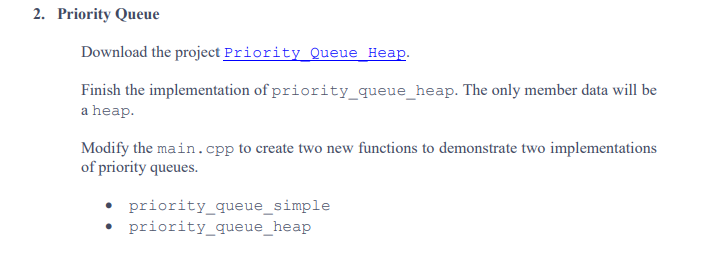
Please create a priority_queue_heap.template file and use c++. The files needed are below:
HEAP.H
#ifndef HEAP_H #define HEAP_H
/** * This class implements a heap as described in the text. * We will treat it as a priority queue. */
template
heap() { size = 0; }
bool is_empty() const { return size == 0;} bool is_full() const { return size == CAPACITY; }
/** * Remove the largest value from this heap and return it. * * Precondition: heap is not empty. */ T remove();
/** * Inserts the 'value' into the heap. * * Precondition: heap is not full */ void insert(const T& value);
/** * Check if the heap is valid. * Prints out each parent and its children (for all nodes with children) * Stops when a parent is less than one or both of its children * Prints 'check' for each parent that is greater than or equal to its children */ bool check_heap();
private: T data[CAPACITY]; int size; };
#include "heap.template"
#endif // HEAP_H
HEAP.Template
#include
/* * parent index is p, children are at indices 2*p+1 and 2*p+2 * You must check that those are in range * * child index is c, parent index is (c-1)/2 (integer division) */
/** * Inserts the 'value' into the heap. * * Precondition: heap is not full */ template
//std::cout
// add the value to a new node in proper position data[size] = value; size++;
// move the value up the tree as needed int child = size-1; // index of the new 'node' int parent = (child-1)/2; // index of the parent
while((child > 0) && (data[parent]
// it's a heap!
}
/** * Remove the largest value from this heap and return it. * * Precondition: heap is not empty. */ template
// grab first element, save it for return later T save = data[0];
// copy last value in list to the beginning // decrement size data[0] = data[size-1]; size--;
// size--; // data[0] = data[size];
// sift the new first element down until it finds its place int parent = 0; int left_child = 2*parent+1; int right_child = 2*parent+2; bool still_working = true;
while(still_working && left_child = size) { // only the left child to worry about if(data[parent] data[right_child]) { //left child larger if(data[parent]
return save; }
/** * Check if the heap is valid. * Prints out each parent and its children (for all nodes with children) * Stops when a parent is less than one or both of its children * Prints 'check' for each parent that is greater than or equal to its children */ template PRIORTITY-QUEUE_HEAP.h #ifndef PRIORITY_QUEUE_HEAP_H #define PRIORITY_QUEUE_HEAP_H template bool is_empty() const; bool is_full() const; /** * Remove the largest value from this priority queue and return it. * * Precondition: priority queue is not empty. */ T remove(); /** * Inserts the 'value' into the priority queue. * * Precondition: priority queue is not full */ void insert(const T& value); }; #include "priority_queue_heap.template" #endif // PRIORITY_QUEUE_HEAP_H PRIORITY_QUEUE_SIMPLE.H #ifndef PRIORITY_QUEUE_SIMPLE_H #define PRIORITY_QUEUE_SIMPLE_H /** * This class implements a priority queue using a very simple strategy: * Store the values in an array. * Add new values at the end. * When asked to remove a value, search for the largest (linear search) * */ template priority_queue_simple() { size = 0; } bool is_empty() const { return size == 0; } bool is_full() const { return size == CAPACITY; } /** * Remove the largest value from this priority queue and return it. * * Precondition: priority queue is not empty. */ T remove(); /** * Inserts the 'value' into the priority queue. * * Precondition: priority queue is not full */ void insert(const T& value); private: T data[CAPACITY]; int size; }; #include "priority_queue_simple.template" #endif // PRIORITY_QUEUE_SIMPLE_H PRIORITY_QUEUE_SIMPLE.Template #include /** * Remove the largest value from this priority queue and return it. * * Precondition: priority queue is not empty. */ template /** * Inserts the 'value' into the priority queue. * * Precondition: priority queue is not full */ template
Step by Step Solution
There are 3 Steps involved in it

Get step-by-step solutions from verified subject matter experts
 Study Help