



Question: Please create an ER-Diagram and the relational schema for the below auction site: Introduction In this project, you will design and implement a relational database
Please create an ER-Diagram and the relational schema for the below auction site:
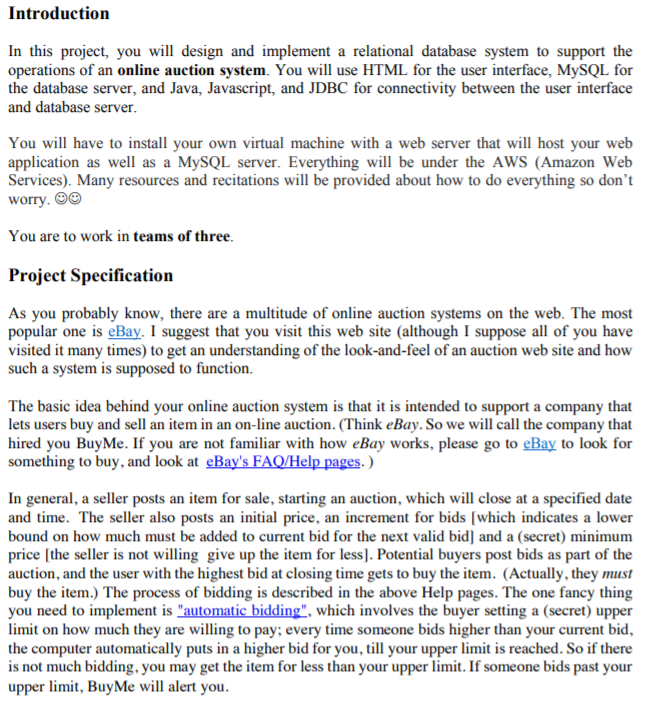
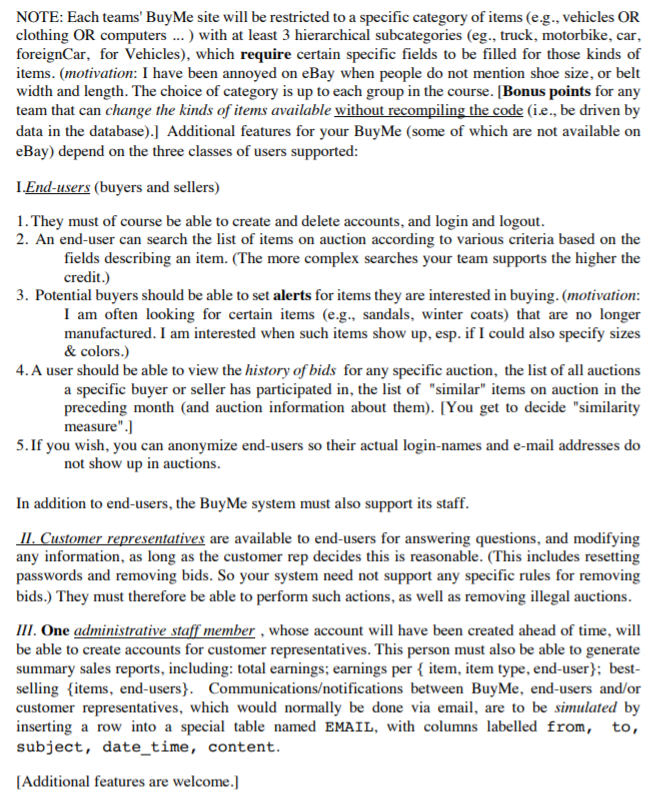
Introduction In this project, you will design and implement a relational database system to support the operations of an online auction system. You will use HTML for the user interface, MySQL for the database server, and Java, Javascript, and JDBC for connectivity between the user interface and database server You will have to instal application as well as a MySQL server. Everything will be under the AWS (Amazon Web Services). Many resources and recitations will be provided about how to do everything so don't worry. l your own virtual machine with a web server that will host your web You are to work in teams of three Project Specification As you probably know, there are a multitude of online auction systems on the web. The most popular one is eBay. I suggest that you visit this web site (although I suppose all of you have visited it many times) to get an understanding of the look-and-feel of an auction web site and how such a system is supposed to function. The basic idea behind your online auction system is that it is intended to support a company that lets users buy and sell an item in an on-line auction. (Think eBay. So we will call the company that hired you BuyMe. If you are not familiar with how eBay works, please go to eBay to look for something to buy, and look at eBay's FAQ/Help pages.) In general, a seller posts an item for sale, starting an auction, which will close at a specified date and time. The seller also posts an initial price, an increment for bids [which indicates a lower bound on how much must be added to current bid for the next valid bid] and a (secret) minimum price the seller is not wlling give up the item for less]. Potential buyers post bids as part of the auction, and the user with the highest bid at closing time gets to buy the item. (Actually, they must buy the item.) The process of bidding is described in the above Help pages. The one fancy thing you need to implement is limit on how much they are willing to pay; every time someone bids higher than your current bid the computer automatically puts in a higher bid for you, till your upper limit is reached. So if there is not much bidding, you may get the item for less than your upper limit. If someone bids past your upper t, BuyMe will alert you , which involves the buyer setting a (secret) upper
Step by Step Solution
There are 3 Steps involved in it

Get step-by-step solutions from verified subject matter experts