







Question: Please Develop a cost sheet for Training Class. And Briefly discuss how you will determine if transfer of training is successful for YOUR TRAINING and
Please Develop a cost sheet for Training Class.
And Briefly discuss how you will determine if transfer of training is successful for YOUR TRAINING and how you would measure ROI (return on investment). 1PAGE
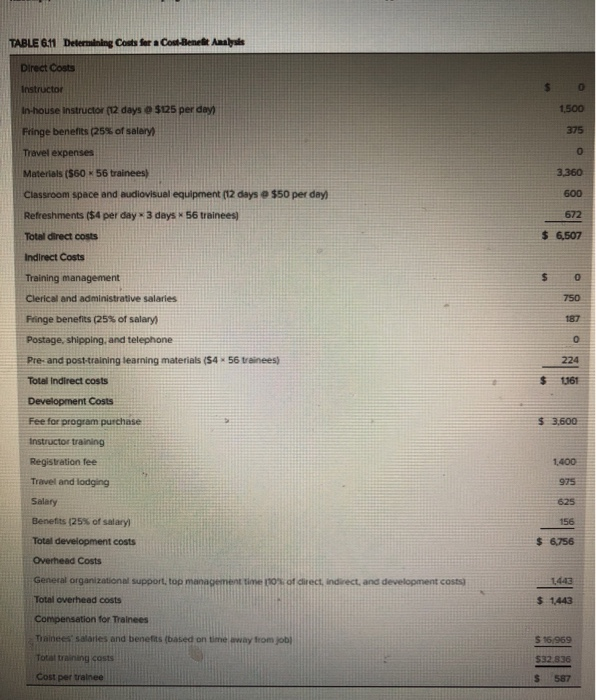
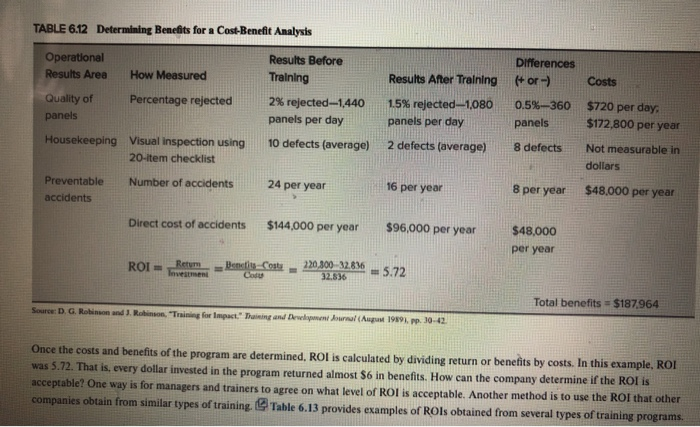
TABLE 6.11 Determining Costs fet a Cost-Benefit Amalais Direct Costs Instructor 1,500 375 In-house instructor (12 days o $125 per day Fringe benefits (25% of salary) Travel expenses Materials (560 56 trainees) Classroom space and audiovisual equipment (12 days @ $50 per day Refreshments ($4 per day 3 days * 56 trainees) Total direct costs Indirect Costs 3,360 600 672 $ 6,507 Training management 750 Clerical and administrative salaries Fringe benefits (25% of salary 56 Vinees) 224 Postage, shipping, and telephone Pre- and post-training learning materials (54 Total Indirect costs Development Costs 1161 Fee for program purchase $ 3.600 Instructor training Registration fee 1.400 Travel and lodging 975 Salary 625 $ 6,756 1443 Benefits 25% of salary Total development costs Overhead Costs General organization support, top management time of direct. Indirect, and development costa Total overhead costs Compensation for Trainees Trainees salaries and benefits (based on time away from job Total training costs $ 1443 $16.959 Cost per trainee TABLE 6.12 Determining Benefits for a Cost-Benefit Analysis Operational Results Area How Measured Quality of Percentage rejected panels Housekeeping Visual inspection using 20-item checklist Preventable Number of accidents accidents Direct cost of accidents Results Before Training 2% rejected-1440 panels per day 10 defects (average) Results After Training 1.5% rejected-1,080 panels per day 2 defects (average) Differences tor) 0.5%-360 panels 8 defects Costs $720 per day $172,800 per year Not measurable in dollars $48.000 per year 24 per year 16 per year 8 per year $144,000 per year $96,000 per year $48,000 per year ROI Retom Bonecos - 120.800 12836 5.72 32.536 Total benefits = $187.964 Sour G. Robinson and Time for Impact." During and Deve l (Aust 1989. pp. 10-12 Once the costs and benefits of the program are determined, ROI is calculated by dividing return or benefits by costs. In this example, ROI was 5.72. That is, every dollar invested in the program returned almost $6 in benefits. How can the company determine if the ROI is acceptable? One way is for managers and trainers to agree on what level of ROI is acceptable. Another method is to use the Rol that other companies obtain from similar types of training Table 6.13 provides examples of Rols obtained from several types of training programs TABLE 6.11 Determining Costs fet a Cost-Benefit Amalais Direct Costs Instructor 1,500 375 In-house instructor (12 days o $125 per day Fringe benefits (25% of salary) Travel expenses Materials (560 56 trainees) Classroom space and audiovisual equipment (12 days @ $50 per day Refreshments ($4 per day 3 days * 56 trainees) Total direct costs Indirect Costs 3,360 600 672 $ 6,507 Training management 750 Clerical and administrative salaries Fringe benefits (25% of salary 56 Vinees) 224 Postage, shipping, and telephone Pre- and post-training learning materials (54 Total Indirect costs Development Costs 1161 Fee for program purchase $ 3.600 Instructor training Registration fee 1.400 Travel and lodging 975 Salary 625 $ 6,756 1443 Benefits 25% of salary Total development costs Overhead Costs General organization support, top management time of direct. Indirect, and development costa Total overhead costs Compensation for Trainees Trainees salaries and benefits (based on time away from job Total training costs $ 1443 $16.959 Cost per trainee TABLE 6.12 Determining Benefits for a Cost-Benefit Analysis Operational Results Area How Measured Quality of Percentage rejected panels Housekeeping Visual inspection using 20-item checklist Preventable Number of accidents accidents Direct cost of accidents Results Before Training 2% rejected-1440 panels per day 10 defects (average) Results After Training 1.5% rejected-1,080 panels per day 2 defects (average) Differences tor) 0.5%-360 panels 8 defects Costs $720 per day $172,800 per year Not measurable in dollars $48.000 per year 24 per year 16 per year 8 per year $144,000 per year $96,000 per year $48,000 per year ROI Retom Bonecos - 120.800 12836 5.72 32.536 Total benefits = $187.964 Sour G. Robinson and Time for Impact." During and Deve l (Aust 1989. pp. 10-12 Once the costs and benefits of the program are determined, ROI is calculated by dividing return or benefits by costs. In this example, ROI was 5.72. That is, every dollar invested in the program returned almost $6 in benefits. How can the company determine if the ROI is acceptable? One way is for managers and trainers to agree on what level of ROI is acceptable. Another method is to use the Rol that other companies obtain from similar types of training Table 6.13 provides examples of Rols obtained from several types of training programs
Step by Step Solution
There are 3 Steps involved in it

Get step-by-step solutions from verified subject matter experts
 Study Help