







Question: please did the second part with Hoare Quick select algorithm with java programming language Do the same analysis as part one run time with different
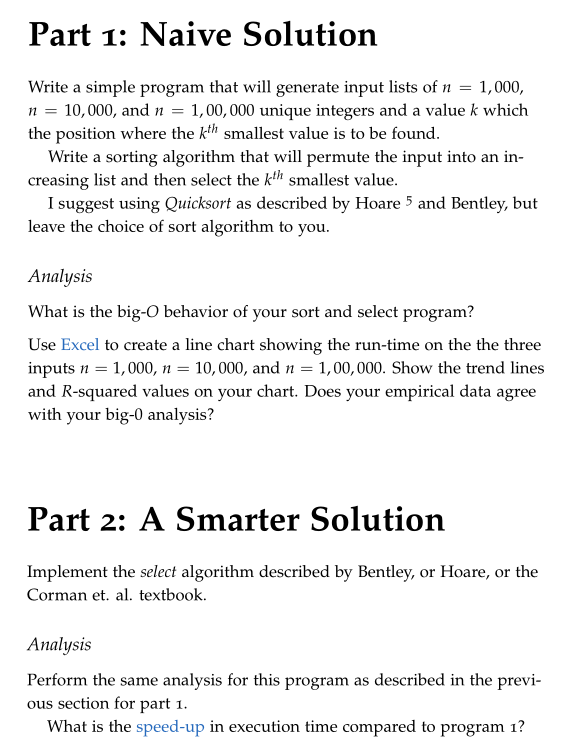
please did the second part with Hoare Quick select algorithm with java programming language
Do the same analysis as part one
run time with different n values and big O behavior
Part 1: Naive Solution Write a simple program that will generate input lists of n 1,000, n = 10,000, and n = 1,00,000 unique integers and a value k which the position where the kth smallest value is to be found. Write a sorting algorithm that will permute the input into an in- creasing list and then select the kth smallest value. I suggest using Quicksort as described by Hoare 5 and Bentley, but leave the choice of sort algorithm to you. Analysis What is the big-O behavior of your sort and select program? Use Excel to create a line chart showing the run-time on the the three inputs n = 1,000, n = 10,000, and n = 1,00,000. Show the trend lines and R-squared values on your chart. Does your empirical data agree with your big-O analysis? Part 2: A Smarter Solution Implement the select algorithm described by Bentley, or Hoare, or the Corman et. al. textbook. Analysis Perform the same analysis for this program as described in the previ- ous section for part 1. What is the speed-up in execution time compared to program 1
Step by Step Solution
There are 3 Steps involved in it

Get step-by-step solutions from verified subject matter experts
 Study Help