







Question: Please do #4 Client #1 IP 160.16.0.19 MAC 00:01:02:03:04:22 Client #2 IP 160.16.0.21 MAC 00:01:02:03:04:06 Client #3 IP 160.16.0.20 MAC 00:01:02:03:04:07, Interface Fa0/0 IP 160.16.0.17
 Please do #4
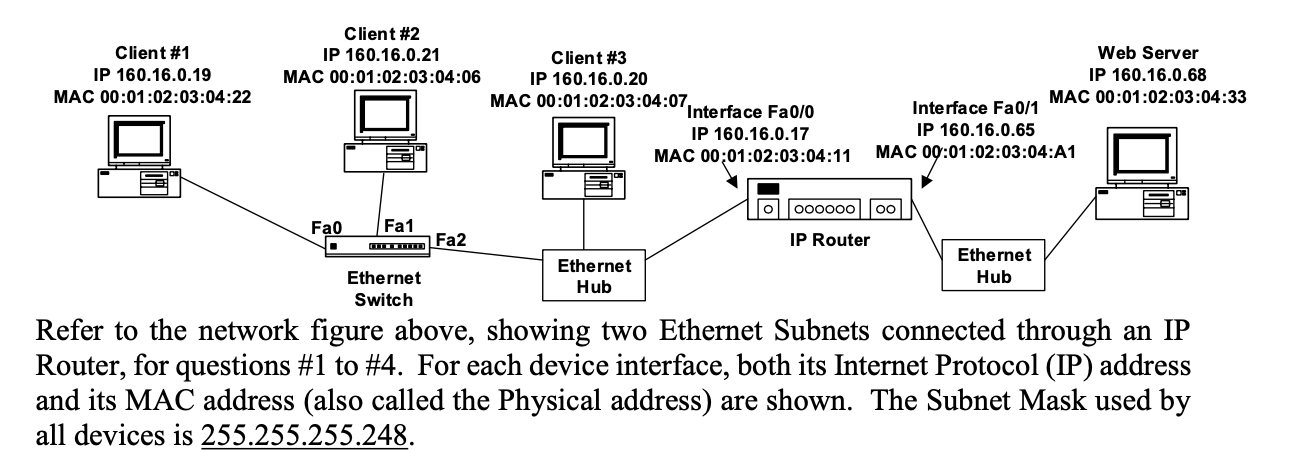
Client #1 IP 160.16.0.19 MAC 00:01:02:03:04:22 Client #2 IP 160.16.0.21 MAC 00:01:02:03:04:06 Client #3 IP 160.16.0.20 MAC 00:01:02:03:04:07, Interface Fa0/0 IP 160.16.0.17 MAC 00:01:02:03:04:11 Web Server IP 160.16.0.68 MAC 00:01:02:03:04:33 Interface Fa0/1 IP 160.16.0.65 MAC 09:01:02:03:04:A1 O oooooo oo Fao Fa 1 Fa2 IP Router Ethernet Hub Ethernet Hub Ethernet Switch Refer to the network figure above, showing two Ethernet Subnets connected through an IP Router, for questions #1 to #4. For each device interface, both its Internet Protocol (IP) address and its MAC address (also called the Physical address) are shown. The Subnet Mask used by all devices is 255.255.255.248. 4. (4 points) Assume that the Web Server wants to send 2 data packets Packet A and Packet B (in that order) - to Client #1. Packet A is sent with TCP Sequence Number = 2280 and contains 700 data bytes. Packet B contains 1400 data bytes. Assuming no errors, what Sequence Number value will the Web Server put in the TCP header of Packet B (sent right after Packet A)
Step by Step Solution
There are 3 Steps involved in it

Get step-by-step solutions from verified subject matter experts
 Study Help