







Question: please do (a) 4. Short Answer Question (30 points) Recall the graphs we did in class for the labor income tax and capital income tax,
please do (a)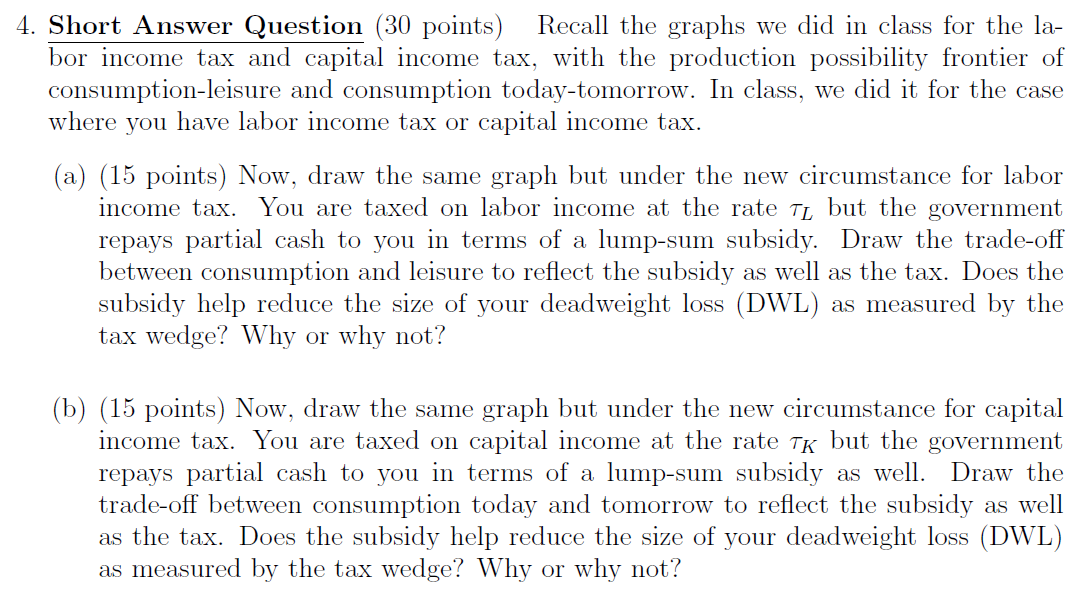
4. Short Answer Question (30 points) Recall the graphs we did in class for the labor income tax and capital income tax, with the production possibility frontier of consumption-leisure and consumption today-tomorrow. In class, we did it for the case where you have labor income tax or capital income tax. (a) (15 points) Now, draw the same graph but under the new circumstance for labor income tax. You are taxed on labor income at the rate L but the government repays partial cash to you in terms of a lump-sum subsidy. Draw the trade-off between consumption and leisure to reflect the subsidy as well as the tax. Does the subsidy help reduce the size of your deadweight loss (DWL) as measured by the tax wedge? Why or why not? (b) (15 points) Now, draw the same graph but under the new circumstance for capital income tax. You are taxed on capital income at the rate K but the government repays partial cash to you in terms of a lump-sum subsidy as well. Draw the trade-off between consumption today and tomorrow to reflect the subsidy as well as the tax. Does the subsidy help reduce the size of your deadweight loss (DWL) as measured by the tax wedge? Why or why not? 4. Short Answer Question (30 points) Recall the graphs we did in class for the labor income tax and capital income tax, with the production possibility frontier of consumption-leisure and consumption today-tomorrow. In class, we did it for the case where you have labor income tax or capital income tax. (a) (15 points) Now, draw the same graph but under the new circumstance for labor income tax. You are taxed on labor income at the rate L but the government repays partial cash to you in terms of a lump-sum subsidy. Draw the trade-off between consumption and leisure to reflect the subsidy as well as the tax. Does the subsidy help reduce the size of your deadweight loss (DWL) as measured by the tax wedge? Why or why not? (b) (15 points) Now, draw the same graph but under the new circumstance for capital income tax. You are taxed on capital income at the rate K but the government repays partial cash to you in terms of a lump-sum subsidy as well. Draw the trade-off between consumption today and tomorrow to reflect the subsidy as well as the tax. Does the subsidy help reduce the size of your deadweight loss (DWL) as measured by the tax wedge? Why or why not
Step by Step Solution
There are 3 Steps involved in it

Get step-by-step solutions from verified subject matter experts
 Study Help