Question: PLEASE DO A ARTICLE REVIEW OF THE BELOW ATTACHED ARTICLE IN 1000 WORDS. (WILL THUMBS UP THIS ANSWER FROM MY SIDE & 4-5 FRIENDS ACCOUNT
PLEASE DO A ARTICLE REVIEW OF THE BELOW ATTACHED ARTICLE IN 1000 WORDS.
(WILL THUMBS UP THIS ANSWER FROM MY SIDE & 4-5 FRIENDS ACCOUNT AS WELL IF U DO IT PROPERLY) THANK YOU
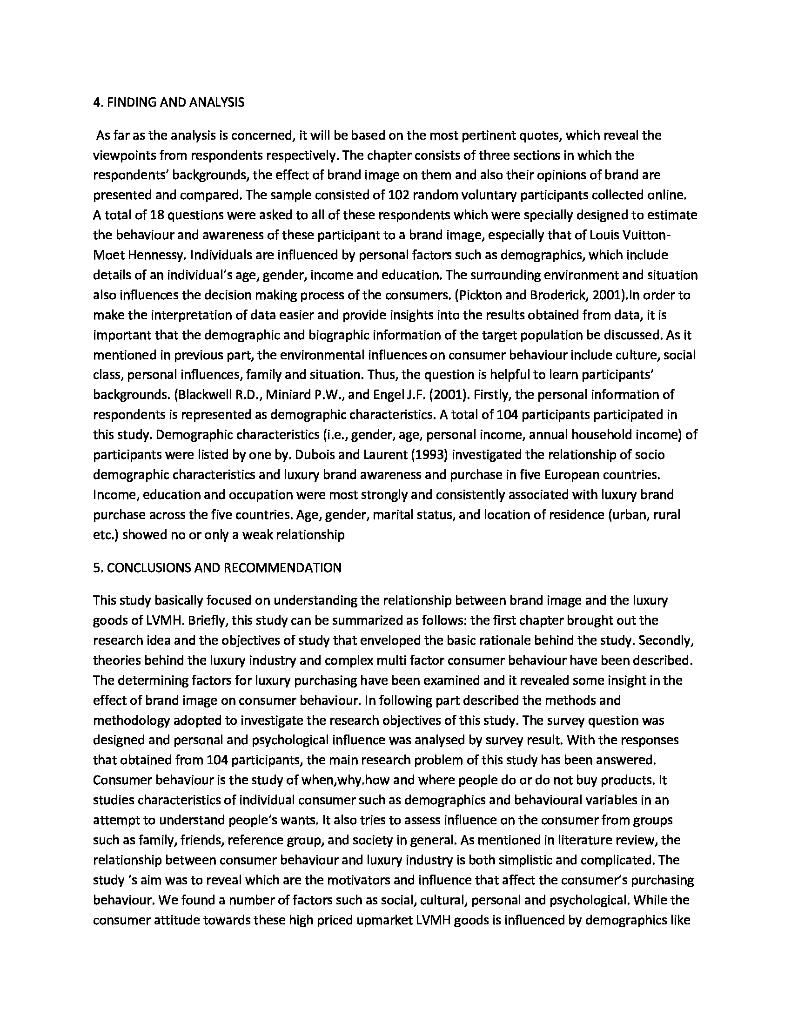
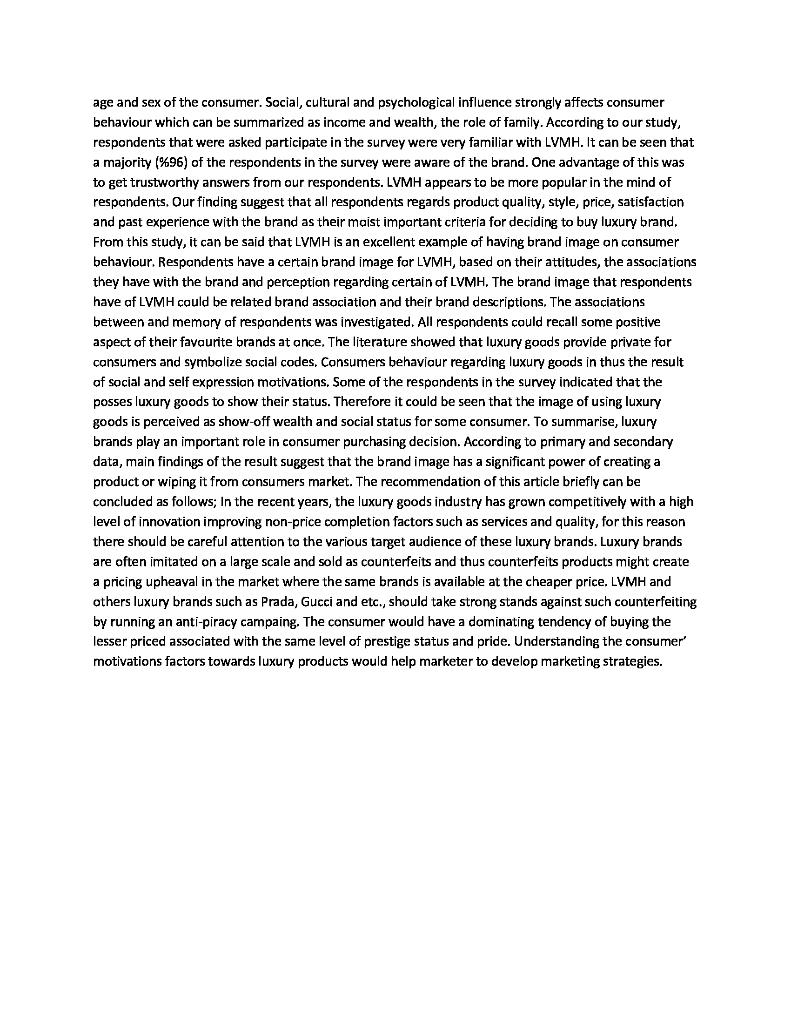
PLEASE DO A ARTICLE REVIEW OF THE BELOW ATTACHED ARTICLE IN 1000 WORDS. TOPIC: The Effect of Brand Image on Consumer Behaviour Abstract Consumers are influenced by many psychological, social and personal factors that influence their perception of a brand. Brand is a powerful tool to attract more consumers to buy particular products and, has become important in the luxury market. A very important factor that influences consumer's perceptions of a brand is strong brand image. The main purpose of this article is to study and analyze the role of brand image on consumer behaviour. This study examines how brand image affects consumer behaviour from a consumer's perspective. In order to more practical approach, the study concerned case study of LVMH. All data and result based on literature is collected from mainly books, joumal, articles, and online material. The methodology for this study was quantitative. A questionnaire was designed to provide answer to research question. In this study, one hundred four random participants were collected online. INTRODUCTION The purchasing process is a combination of and physical activities that nds with an actual purchase almost daily (Sheth & Mittal 2004) Therefore it is interesting to study the connection within "what we buy" and "why we buy it". In this circumstance, brands play a leading role in customer decision making. There are many factors or attributes of consumers effecting their view and decisions, In today's increasing competitive marketplace, Consumers differ in their perceptions; they would necessarily hold different images for any specific brand and often have to make a choice among a range of products or brands in the market that differ very little in its price or unction. In such circumstances, their final decision depends on the image they associate with different brand. Brand image has been an important concept in consumer behaviour research and is a crucial factor influencing the purchasing of luxury product decision. Keller (1997) demonstrates that the brand image is essential in apparel purchase behaviour because it impacts consumers' preferences and purchase intentions as well as their willingness to pay a premium price and recommend the brand to others. Thus, when consumers hold a strong and constructive brand image, they will be more likely to evaluate the apparel product positively, regardless of price. Furthermore the luxury goods sector is particularly chosen in this research. To be successful in a luxury business, it requires different rules from non-luxury sector. Often, luxury customers are not shopping based on price; in fact they rather value the distinctive experience, design and quality. A specific brand is the subject of this research study. LVMH is a world-renowned brand and generally considered as a brand that signifies high quality. The connection within brand and consumer behaviour has been focus of much research in the past years. The main purpose of this research is to explore the relationship between a luxury brand, its brand image and the consumer's attitude and alliance with it presenting a study of luxury brand demand. The relationship between brand image and consumer behaviour will be investigated while identifying the major aspects of brand image that influences the consumers' purchasing decision using a case study on how brand image affects the consumer behaviour. The study will also investigate and analyse the changes in the relationship between brand image and consumer purchasing decision, while focusing on the value of the brand and establish the impact of brand image on consumer' observation about quality, value and benefits of the product, overall attitude toward the product, and decision to purchase the product. 2. LITERATURE REVIEWS 2.1, Brand Equity The author Aaker, in his study demonstrates that the power of brand is often expressed by brand equity and how do consumers respond to different brands? Another question would be asked that is, how do brands distinguish themselves from each ather? According to Aaker the answer to the question is brand equity where he stated; "Brand equity is a set of brand assets and liabilities linked with a brand, including its name and symbol that could impose beneficial or detrimental effects on the values arising from the product or services".(Aaker 1996,7). There is an example which can describe how people recognise and respond to a brand. In De Chernatony's book, the author consider and indicates that a test between Diet Pepsi and Diet Coke and in addition, when the two brands are concealed, the test shows that 51% of the consumers prefer Pepsi while 44% of them prefer Coke and 5% of them cannot tell the difference. For contrast, another test is conducted without concealing the brands. 2.2. Brand Awareness According to Aaker, brand awareness is one of major determinants of brand equity and he stated that it can be referred to as the degree of consumer' familiarity with a brand. According to Keller conceptualized Brand awareness as comprising of brand recall and brand awareness. Keller also stated that the Brand awareness relates to consumers' capacity to verify previous exposure to the brand when given the brand as a cure. On the other hand Aaker claims that the brand awareness is the ability of a possible buyer to classify and to bring to mind that a brand is an associate of a certain goods category. He stated that there are three level of brand awareness which are brand recognition, brand recall and top of mind. In following the two authors Rossiter and Percy demonstrated in their research that it is related to the strength of brand clew in memory which allows to consumers to ascertain the brand under dissimilar situations. Finally both authors claim that it is the strength of a brand's existence in the mind of the consumer (Rossiter et al 2000) 2.3. Brand Image According to Kahle and Kim in the present day's growing competitive market place, consumers have to make their choice between a variety of product or brands in the market that differ very small in its price or function. They argue that in such situations, their final decision depends on the image they relate with dissimilar brands. Additionally the authors express that the brand image has increased reputation as the feelings and images associated with brand and a wellknown and accepted brand image is one of the most important assets a firm possesses (Kahle and Kim, 2006) 2.4. Brand Associations In his article Aaker examines the Brand image and he indicates that associations are the key world when analysing literature on brand image. He claims that the building of a brand association is critical to develop the image of a brand and which different brands have different associations to their prospective customers. For example he claims that such kind of relations can provide bases for them to make purchase decisions and even become loyal to the brand. Moreover he indicates that associations towards a brand can create value for the firm and alongside its customers in a number of ways. 2.5. Consumer Behaviour According to Solomon consumer behaviour is about human responses in a commercial word. He stated that people consume things and also consume and buy these products according to their needs, preferences and buying power and these can be consumable goods, durable goods, speciality goods or, industrial goods. For example he demonstrate this, what we buy, how we buy, where and when we buy, in how much quantity we buy depends on our perception, self concept, social and cultural background and our age and family cycle, our attitudes, beliefs values, motivation, personality, social class and many other factors that are both internal and external to us. While buying, we also regard as whether to buy or not to buy and, from which source or seller to buy (Solomon, 2011). Furthermore, Solomon indicates that consumer behaviour involves the psychological methods that consumers go through in identifying needs and finding ways to resolve these requirements, through making purchase decisions. For example, he also implies that whether or not to purchase a product and, if so, which brand and where. Other example is that interpret information, make plans, and implement these plans and by engaging in comparison shopping or actually purchasing a product. In addition Solomon defines consumer as the decision-making process and physical activity concerned in acquiring, evaluating, using and disposing of goods and services, 2.5.2. Characteristics Affecting Consumer Behaviour Cultural Factors In his study Fill indicate that culture factors are essential and he also point out that the culture is part of the external influences that impact the consumer and consumer behaviour is deeply influenced by cultural factors such as; buyer culture, subculture, and social class, Fill defines that culture is the most basic cause of a person's wants and behaviour, for him every graup or saciety has a cultural influence on buying behaviour may differ greatly from country to country, or even neighbourhood to neighbourhood. (Fill, 2009). Furthermore he points outs that each culture has different subcultures such as religions, nationalities, geographic regions, racial groups. Social Factors Other essential aspect for behaviour of customers is social factors and there is a big impact on this issue of buying behaviour of consumers. One of the important social factors is: reference groups, family, role and status (Kotler and Armstrong, 2008). The affect of reference group which contains potential in forming a person attitude or behaviour varies across products and brands. For example if the product is visible such as dress, shoes, car etc then the influence of reference groups will be high. Reference groups also include opinion leader (a person who influences other because of his special skill, knowledge or other characteristics). As to the roles and status, in the society each person possesses different roles and status depending upon the groups, family, clubs, organization etc. to which he/she belongs. The good example specified by the authors that when a woman is working in an organization as finance manager and now she is playing two roles, one of finance manager and other of mother. Therefore her buying decisions will be influenced by her role and status, Persanal factors Research has shown that consumer's purchase decisions are also affected by his personal characteristics such as age, sex, and stage in family life-cycle, education, occupation, income, life-style, his overall personality and overall self-concept. (Pickton and Broderick, 2001). Cultural Factors In his study Fill indicate that culture factors are essential and he also point out that the culture is part of the external influences that impact the consumer and consumer behaviour is deeply influenced by cultural factors such as: buyer culture, subculture, and social class. Fill defines that culture is the most basic cause of a person's wants and behaviour, for him every group or society has a cultural influence on buying behaviour may differ greatly from country to country, or even neighbourhood to neighbourhood. (Fill, 2009). Furthermore he points outs that each culture has different subcultures such as religions, nationalities, geographic regions, racial groups. Social Factors essential aspect for behaviour of customers is social factors and there is a big impact on this issue of buying behaviour of consumers. One of the important social factors is: reference groups, family, role and status (Kotler and Armstrong, 2008). The affect of reference group which contains potential in forming a person attitude or behaviour varies across products and brands. For example if the product is visible such as dress, shoes, car etc then the influence of reference groups will be high. Reference groups also include opinion leader (a person who influences other because of his special skill, knowledge or ather characteristics). As to the roles and status, in the society each person possesses different roles and status depending upon the groups, family, clubs, organization etc. to which he/she belongs. The good example specified by the authors that when a woman is working in an organization as finance manager and now she is playing two roles, one of finance manager and other of mother. Therefore her buying decisions will be influenced by her role and status, Personal factors Research has shown that consumer's purchase decisions are also affected by his personal characteristics such as age, sex, and stage in family life-cycle, education, occupation, income, life-style, his overall personality and overall self-concept. (Pickton and Broderick, 2001). 4. FINDING AND ANALYSIS As far as the analysis is concerned, it will be based on the most pertinent quotes, which reveal the viewpoints from respondents respectively. The chapter consists of three sections in which the respondents' backgrounds, the effect of brand image on them and also their opinions of brand are presented and compared. The sample consisted of 102 random voluntary participants collected anline. A total of 18 questions were asked to all of these respondents which were specially designed to estimate the behaviour and awareness of these participant to a brand image, especially that of Louis Vuitton- Moet Hennessy, Individuals are influenced by personal factors such as demographics, which include details of an individual's age, gender, income and education. The surrounding environment and situation also influences the decision making process of the consumers. (Pickton and Broderick, 2001).In order to make the interpretation of data easier and provide insights into the results obtained from data, it is important that the demographic and biographic information of the target population be discussed. As it mentioned in previous part, the environmental influences on consumer behaviour include culture, social class, personal influences, family and situation. Thus, the question is helpful to learn participants' backgrounds. (Blackwell R.D., Miniard P.W., and Engel J.F. (2001). Firstly, the personal information of respondents is represented as demographic characteristics. A total of 104 participants participated in this study. Demographic characteristics (i.e., gender, age, personal income, annual household income) of participants were listed by one by. Dubois and Laurent (1993) investigated the relationship of socio demographic characteristics and luxury brand awareness and purchase in five European countries. Income, education and occupation were most strongly and consistently associated with luxury brand purchase across the five countries. Age, gender, marital status, and location of residence (urban, rural etc.) showed no or only a weak relationship 5. CONCLUSIONS AND RECOMMENDATION This study basically focused on understanding the relationship between brand image and the luxury goods of LVMH. Briefly, this study can be summarized as follows: the first chapter brought out the research idea and the objectives of study that enveloped the basic rationale behind the study. Secondly, theories behind the luxury industry and complex multi factor consumer behaviour have been described. The determining factors for luxury purchasing have been examined and it revealed some insight in the effect of brand image on consumer behaviour. In following part described the methods and methodology adopted to investigate the research objectives of this study. The survey question was designed and personal and psychological influence was analysed by survey result. With the responses that obtained from 104 participants, the main research problem of this study has been answered. Consumer behaviour is the study of when why.how and where people do ar do not buy products. It studies characteristics of individual consumer such as demographics and behavioural variables in an attempt to understand people's wants. It also tries to assess influence on the consumer from groups such as family, friends, reference group, and society in general. As mentioned in literature review, the relationship between consumer behaviour and luxury industry is both simplistic and complicated. The study's aim was to reveal which are the motivators and influence that affect the consumer's purchasing behaviour. We found a number of factors such as social, cultural, personal and psychological. While the consumer attitude towards these high priced upmarket LVMH goods is influenced by demographics like age and sex of the consumer. Social, cultural and psychological influence strongly affects consumer behaviour which can be summarized as income and wealth, the role of family. According to our study, respondents that were asked participate in the survey were very familiar with LVMH. It can be seen that a majority (%96) of the respondents in the survey were aware of the brand. One advantage of this was to get trustworthy answers from our respondents. LVMH appears to be more popular in the mind of respondents. Our finding suggest that all respondents regards product quality, style, price, satisfaction and past experience with the brand as their maist important criteria for deciding to buy luxury brand. From this study, it can be said that LVMH is an excellent example of having brand image on consumer behaviour. Respondents have a certain brand image for LVMH, based on their attitudes, the associations they have with the brand and perception regarding certain of LVMH. The brand image that respondents have af LVMH could be related brand association and their brand descriptions. The associations between and memory of respondents was investigated. All respondents could recall some positive aspect of their favourite brands at once. The literature showed that luxury goods provide private for consumers and symbolize social codes. Consumers behaviour regarding luxury goods in thus the result of social and self expression motivations. Some of the respondents in the survey indicated that the posses luxury goods to show their status. Therefore it could be seen that the image of using luxury goods is perceived as show-off wealth and social status for some consumer. To summarise, luxury brands play an important role in consumer purchasing decision. According to primary and secondary data, main findings of the result suggest that the brand image has a significant power of creating a product or wiping it from consumers market. The recommendation of this article briefly can be concluded as follows; In the recent years, the luxury goods industry has grown competitively with a high level of innovation improving non-price completion factors such as services and quality, for this reason there should be careful attention to the various target audience of these luxury brands. Luxury brands are often imitated on a large scale and sold as counterfeits and thus counterfeits products might create a pricing upheaval in the market where the same brands is available at the cheaper price. LVMH and others luxury brands such as Prada, Gucci and etc., should take strong stands against such counterfeiting by running an anti-piracy campaing. The consumer would have a dominating tendency of buying the lesser priced associated with the same level of prestige status and pride. Understanding the consumer motivations factors towards luxury products would help marketer to develop marketing strategies









 Study Help