







Question: Please do all math in excel and show formulas. Mortgage Pass-Through Payment Mechanics Illustrated Exhibit 19-3 illustrates cash flow patterns that are important when evaluating
Please do all math in excel and show formulas. 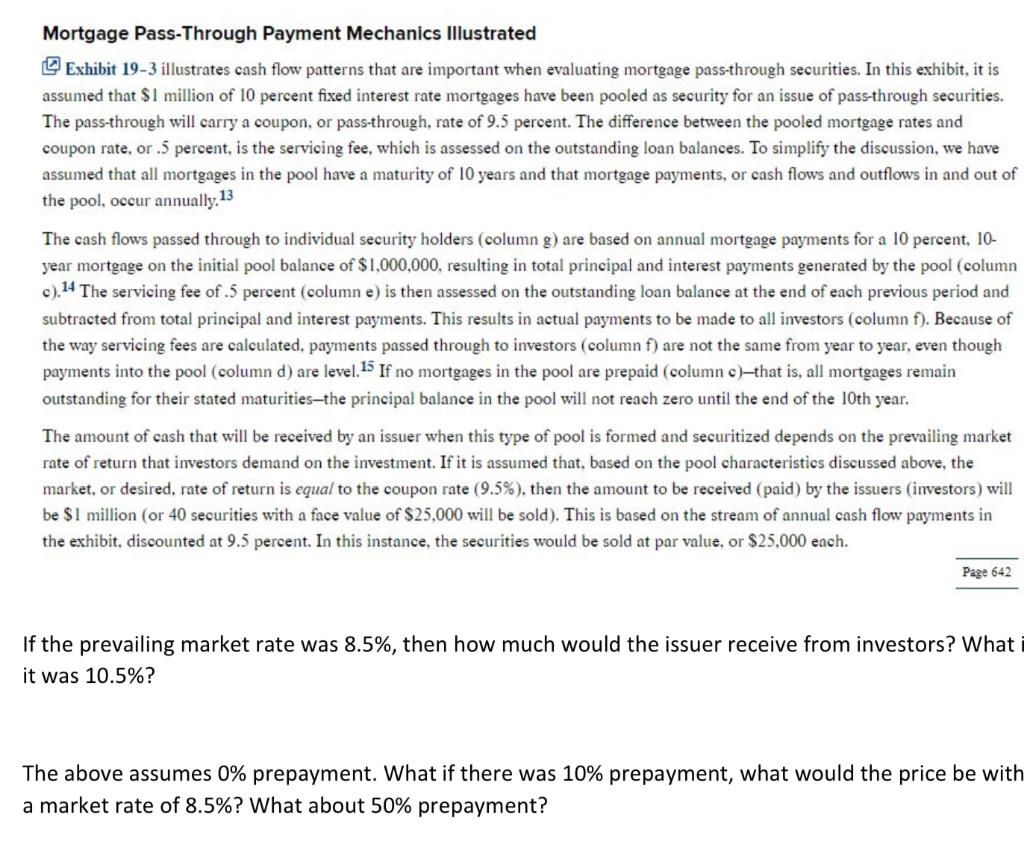
Mortgage Pass-Through Payment Mechanics Illustrated Exhibit 19-3 illustrates cash flow patterns that are important when evaluating mortgage pass-through securities. In this exhibit, it is assumed that $1 million of 10 percent fixed interest rate mortgages have been pooled as security for an issue of pass-through securities. The pass-through will carry a coupon, or pass-through, rate of 9.5 percent. The difference between the pooled mortgage rates and coupon rate, or .5 percent, is the servicing fee, which is assessed on the outstanding loan balances. To simplify the discussion, we have assumed that all mortgages in the pool have a maturity of 10 years and that mortgage payments, or cash flows and outflows in and out of the pool, occur annually.13 The cash flows passed through to individual security holders (column g) are based on annual mortgage payments for a 10 percent, 10- year mortgage on the initial pool balance of $1,000,000, resulting in total principal and interest payments generated by the pool (column c).14 The servicing fee of 5 percent (column e) is then assessed on the outstanding loan balance at the end of each previous period and subtracted from total principal and interest payments. This results in actual payments to be made to all investors (column f). Because of the way servicing fees are calculated payments passed through to investors (column f) are not the same from year to year, even though payments into the pool (column d) are level. 15 If no mortgages in the pool are prepaid (column c)-that is, all mortgages remain outstanding for their stated maturitiesthe principal balance in the pool will not reach zero until the end of the 10th year. The amount of cash that will be received by an issuer when this type of pool is formed and securitized depends on the prevailing market rate of urn that investors demand on the investment. If it is assumed that, based on the pool characteristics discussed the market, or desired, rate of return is equal to the coupon rate (9.5%), then the amount to be received (paid) by the issuers (investors) will be $1 million (or 40 securities with a face value of $25,000 will be sold). This is based on the stream of annual cash flow payments in the exhibit, discounted at 9.5 percent. In this instance, the securities would be sold at par value, or $25,000 each. Page 642 If the prevailing market rate was 8.5%, then how much would the issuer receive from investors? What it was 10.5%? The above assumes 0% prepayment. What if there was 10% prepayment, what would the price be with a market rate of 8.5%? What about 50% prepayment? Mortgage Pass-Through Payment Mechanics Illustrated Exhibit 19-3 illustrates cash flow patterns that are important when evaluating mortgage pass-through securities. In this exhibit, it is assumed that $1 million of 10 percent fixed interest rate mortgages have been pooled as security for an issue of pass-through securities. The pass-through will carry a coupon, or pass-through, rate of 9.5 percent. The difference between the pooled mortgage rates and coupon rate, or .5 percent, is the servicing fee, which is assessed on the outstanding loan balances. To simplify the discussion, we have assumed that all mortgages in the pool have a maturity of 10 years and that mortgage payments, or cash flows and outflows in and out of the pool, occur annually.13 The cash flows passed through to individual security holders (column g) are based on annual mortgage payments for a 10 percent, 10- year mortgage on the initial pool balance of $1,000,000, resulting in total principal and interest payments generated by the pool (column c).14 The servicing fee of 5 percent (column e) is then assessed on the outstanding loan balance at the end of each previous period and subtracted from total principal and interest payments. This results in actual payments to be made to all investors (column f). Because of the way servicing fees are calculated payments passed through to investors (column f) are not the same from year to year, even though payments into the pool (column d) are level. 15 If no mortgages in the pool are prepaid (column c)-that is, all mortgages remain outstanding for their stated maturitiesthe principal balance in the pool will not reach zero until the end of the 10th year. The amount of cash that will be received by an issuer when this type of pool is formed and securitized depends on the prevailing market rate of urn that investors demand on the investment. If it is assumed that, based on the pool characteristics discussed the market, or desired, rate of return is equal to the coupon rate (9.5%), then the amount to be received (paid) by the issuers (investors) will be $1 million (or 40 securities with a face value of $25,000 will be sold). This is based on the stream of annual cash flow payments in the exhibit, discounted at 9.5 percent. In this instance, the securities would be sold at par value, or $25,000 each. Page 642 If the prevailing market rate was 8.5%, then how much would the issuer receive from investors? What it was 10.5%? The above assumes 0% prepayment. What if there was 10% prepayment, what would the price be with a market rate of 8.5%? What about 50% prepayment
Step by Step Solution
There are 3 Steps involved in it

Get step-by-step solutions from verified subject matter experts
 Study Help