







Question: Please do all parts including the Matlab code. 1. A person is performing a slow arm curl with a 10 lb ball held in their
Please do all parts including the Matlab code.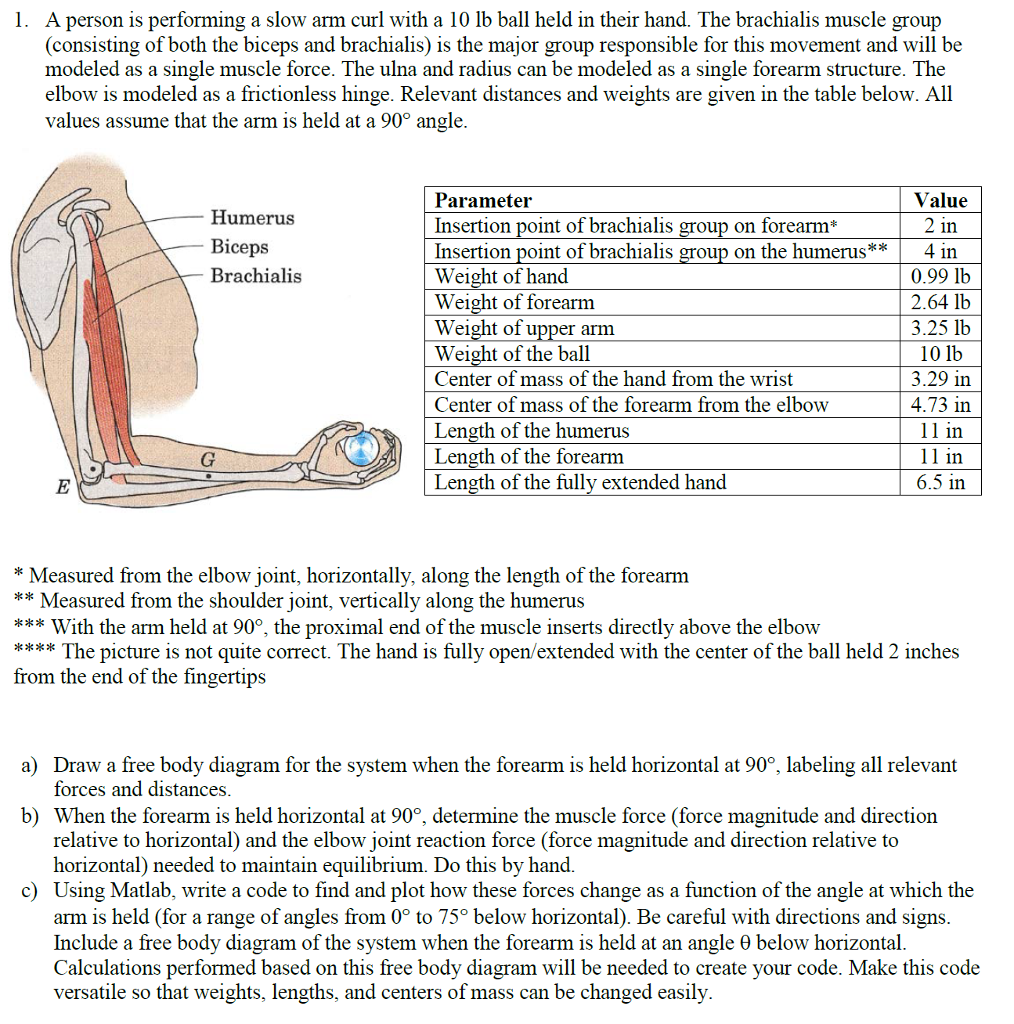
1. A person is performing a slow arm curl with a 10 lb ball held in their hand. The brachialis muscle group (consisting of both the biceps and brachialis) is the major group responsible for this movement and will be modeled as a single muscle force. The ulna and radius can be modeled as a single forearm structure. The elbow is modeled as a frictionless hinge. Relevant distances and weights are given in the table below. All values assume that the arm is held at a 90 angle Parameter Insertion point of brachialis group on forearm* Insertion point of brachialis group on the humerus**4 in Weight of hand Weight of forearm Weight of upper arm Weight of the ball Center of mass of the hand from the wrist Center of mass of the forearm from the elbow Length of the humerus Length of the forearm Length of the fully extended hand Value Humerus Biceps Brachialis in 0.99 lb 2.64 lb 3.25 lb 10 lb 3.29 in 4.73 in 11 in 11 in 6.5 in * Measured from the elbow joint, horizontally, along the length of the forearm ** Measured from the shoulder joint, vertically along the humerus ***With the arm held at 90, the proximal end of the muscle inserts directly above the elbow The picture is not quite correct. The hand is fully open/extended with the center of the ball held 2 inches from the end of the fingertips a) Draw a free body diagram for the system when the forearm is held horizontal at 90, labeling all relevant forces and distances b) When the forearm is held horizontal at 90, determine the muscle force (force magnitude and direction relative to horizontal) and the elbow joint reaction force (force magnitude and direction relative to horizontal) needed to maintain equilibrium. Do this by hand. c) Using Matlab, write a code to find and plot how these forces change as a function of the angle at which the arm is held (for a range of angles from 0 to 75 below horizontal). Be careful with directions and signs Include a free body diagram of the system when the forearm is held at an angle 0 below horizontal Calculations performed based on this free bodv diagram will be needed to create vour code. Make this code versatile so that weights, lengths, and centers of mass can be changed easily 1. A person is performing a slow arm curl with a 10 lb ball held in their hand. The brachialis muscle group (consisting of both the biceps and brachialis) is the major group responsible for this movement and will be modeled as a single muscle force. The ulna and radius can be modeled as a single forearm structure. The elbow is modeled as a frictionless hinge. Relevant distances and weights are given in the table below. All values assume that the arm is held at a 90 angle Parameter Insertion point of brachialis group on forearm* Insertion point of brachialis group on the humerus**4 in Weight of hand Weight of forearm Weight of upper arm Weight of the ball Center of mass of the hand from the wrist Center of mass of the forearm from the elbow Length of the humerus Length of the forearm Length of the fully extended hand Value Humerus Biceps Brachialis in 0.99 lb 2.64 lb 3.25 lb 10 lb 3.29 in 4.73 in 11 in 11 in 6.5 in * Measured from the elbow joint, horizontally, along the length of the forearm ** Measured from the shoulder joint, vertically along the humerus ***With the arm held at 90, the proximal end of the muscle inserts directly above the elbow The picture is not quite correct. The hand is fully open/extended with the center of the ball held 2 inches from the end of the fingertips a) Draw a free body diagram for the system when the forearm is held horizontal at 90, labeling all relevant forces and distances b) When the forearm is held horizontal at 90, determine the muscle force (force magnitude and direction relative to horizontal) and the elbow joint reaction force (force magnitude and direction relative to horizontal) needed to maintain equilibrium. Do this by hand. c) Using Matlab, write a code to find and plot how these forces change as a function of the angle at which the arm is held (for a range of angles from 0 to 75 below horizontal). Be careful with directions and signs Include a free body diagram of the system when the forearm is held at an angle 0 below horizontal Calculations performed based on this free bodv diagram will be needed to create vour code. Make this code versatile so that weights, lengths, and centers of mass can be changed easily
Step by Step Solution
There are 3 Steps involved in it

Get step-by-step solutions from verified subject matter experts
 Study Help