







Question: PLEASE DO ALL Q 1.1 Convolutional Neural Netoworks (a) Given an input image of dimension 10 x 11, what will be output dimension after applying
PLEASE DO ALL Q
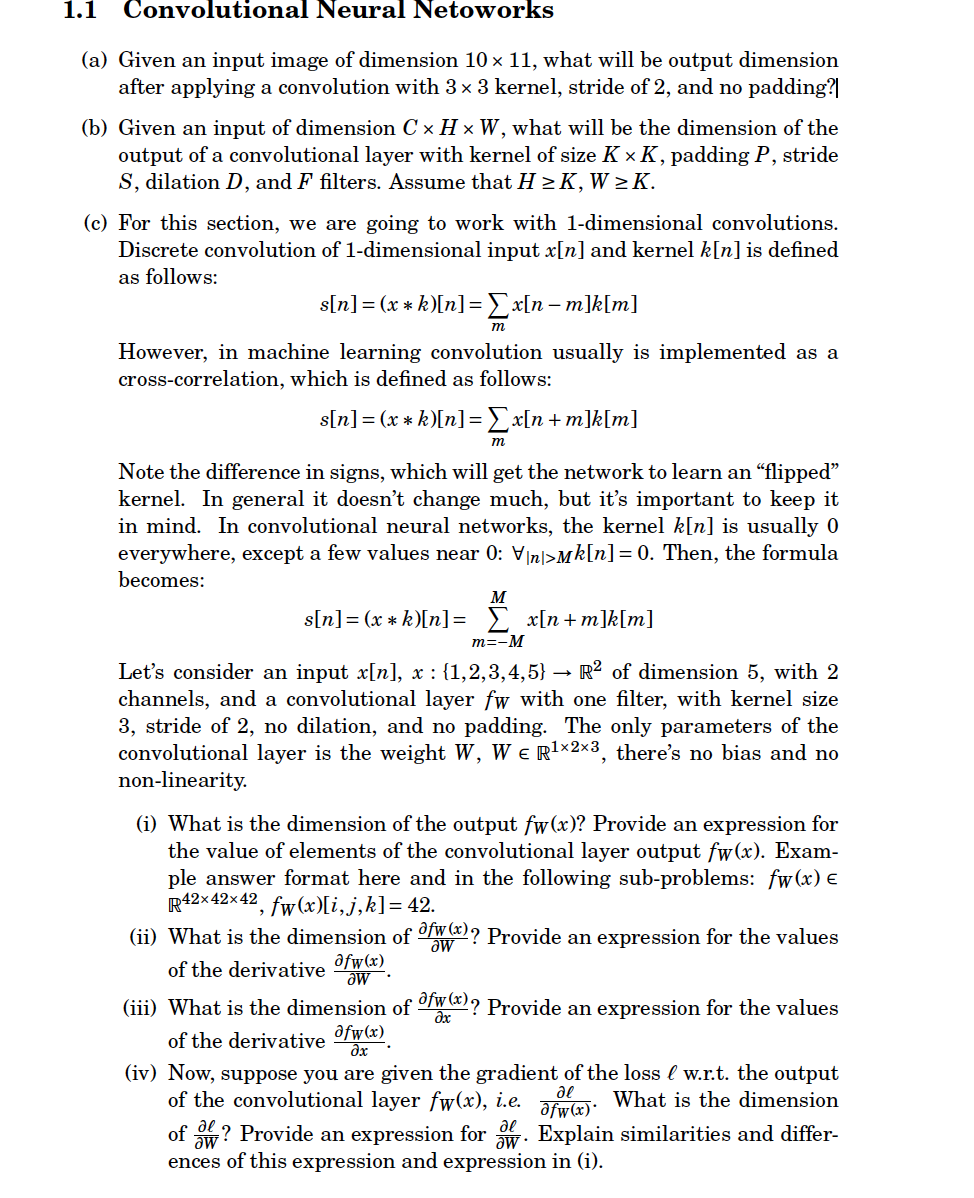
1.1 Convolutional Neural Netoworks (a) Given an input image of dimension 10 x 11, what will be output dimension after applying a convolution with 3 x 3 kernel, stride of 2, and no padding? (b) Given an input of dimension C x H x W, what will be the dimension of the output of a convolutional layer with kernel of size K K, padding P, stride S, dilation D, and F filters. Assume that H ZK, W OK. (c) For this section, we are going to work with 1-dimensional convolutions. Discrete convolution of 1-dimensional input x[n] and kernel k[n] is defined as follows: s[n]= (x * k)[n] = { x[n m]k[m] However, in machine learning convolution usually is implemented as a cross-correlation, which is defined as follows: s[n]= (x *k)[n]={x[n+m]k[m] m m Note the difference in signs, which will get the network to learn an flipped kernel. In general it doesn't change much, but it's important to keep it in mind. In convolutional neural networks, the kernel k[n] is usually 0 everywhere, except a few values near 0: Vinl>Mk[n] = 0. Then, the formula becomes: M s[n]= (x * k)[n]= I x[n+m]k[m] m=-M Let's consider an input x[n], x : {1,2,3,4,5} R2 of dimension 5, with 2 channels, and a convolutional layer fw with one filter, with kernel size 3, stride of 2, no dilation, and no padding. The only parameters of the convolutional layer is the weight W, WeR1x2x3, there's no bias and no non-linearity. (i) What is the dimension of the output fw(x)? Provide an expression for the value of elements of the convolutional layer output fw(x). Exam- ple answer format here and in the following sub-problems: fw(x) R42x 42x 42, fw(x)[i,j,k] = 42. (ii) What is the dimension of Ofw(a)? Provide an expression for the values of the derivative Ofw(x) (iii) What is the dimension of ofw(x)? Provide an expression for the values of the derivative (iv) Now, suppose you are given the gradient of the loss I w.r.t. the output of the convolutional layer fw(x), i.e. What is the dimension afw(x) of ? Provide an expression for S. Explain similarities and differ- ences of this expression and expression in (i). aw. afw(x). al 1.1 Convolutional Neural Netoworks (a) Given an input image of dimension 10 x 11, what will be output dimension after applying a convolution with 3 x 3 kernel, stride of 2, and no padding? (b) Given an input of dimension C x H x W, what will be the dimension of the output of a convolutional layer with kernel of size K K, padding P, stride S, dilation D, and F filters. Assume that H ZK, W OK. (c) For this section, we are going to work with 1-dimensional convolutions. Discrete convolution of 1-dimensional input x[n] and kernel k[n] is defined as follows: s[n]= (x * k)[n] = { x[n m]k[m] However, in machine learning convolution usually is implemented as a cross-correlation, which is defined as follows: s[n]= (x *k)[n]={x[n+m]k[m] m m Note the difference in signs, which will get the network to learn an flipped kernel. In general it doesn't change much, but it's important to keep it in mind. In convolutional neural networks, the kernel k[n] is usually 0 everywhere, except a few values near 0: Vinl>Mk[n] = 0. Then, the formula becomes: M s[n]= (x * k)[n]= I x[n+m]k[m] m=-M Let's consider an input x[n], x : {1,2,3,4,5} R2 of dimension 5, with 2 channels, and a convolutional layer fw with one filter, with kernel size 3, stride of 2, no dilation, and no padding. The only parameters of the convolutional layer is the weight W, WeR1x2x3, there's no bias and no non-linearity. (i) What is the dimension of the output fw(x)? Provide an expression for the value of elements of the convolutional layer output fw(x). Exam- ple answer format here and in the following sub-problems: fw(x) R42x 42x 42, fw(x)[i,j,k] = 42. (ii) What is the dimension of Ofw(a)? Provide an expression for the values of the derivative Ofw(x) (iii) What is the dimension of ofw(x)? Provide an expression for the values of the derivative (iv) Now, suppose you are given the gradient of the loss I w.r.t. the output of the convolutional layer fw(x), i.e. What is the dimension afw(x) of ? Provide an expression for S. Explain similarities and differ- ences of this expression and expression in (i). aw. afw(x). al
Step by Step Solution
There are 3 Steps involved in it

Get step-by-step solutions from verified subject matter experts
 Study Help