



Question: Please do D, E, F, and G. A silicone tube (Ri=6.35mm,Ro=9.55mm) is used to deliver oxygen to an aqueous medium (large volume, with oxygen concentration
Please do D, E, F, and G.
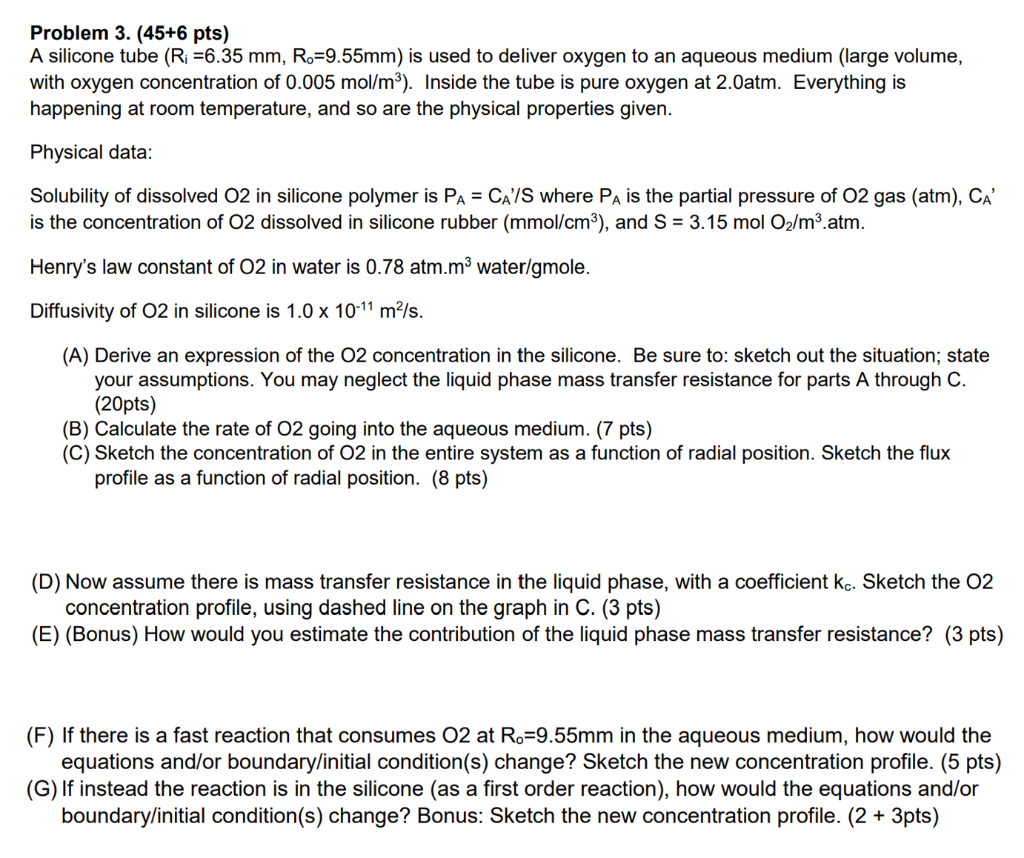
A silicone tube (Ri=6.35mm,Ro=9.55mm) is used to deliver oxygen to an aqueous medium (large volume, with oxygen concentration of 0.005mol/m3 ). Inside the tube is pure oxygen at 2.0atm. Everything is happening at room temperature, and so are the physical properties given. Physical data: Solubility of dissolved O2 in silicone polymer is PA=CA/S where PA is the partial pressure of O2 gas (atm), CA is the concentration of O2 dissolved in silicone rubber (mmol/cm3), and S=3.15molO2/m3.atm. Henry's law constant of O2 in water is 0.78 atm. m3 water/gmole. Diffusivity of O2 in silicone is 1.01011m2/s. (A) Derive an expression of the O2 concentration in the silicone. Be sure to: sketch out the situation; state your assumptions. You may neglect the liquid phase mass transfer resistance for parts A through C. (20pts) (B) Calculate the rate of O2 going into the aqueous medium. (7 pts) (C) Sketch the concentration of O2 in the entire system as a function of radial position. Sketch the flux profile as a function of radial position. (8 pts) (D) Now assume there is mass transfer resistance in the liquid phase, with a coefficient kc. Sketch the O2 concentration profile, using dashed line on the graph in C. (3 pts) (E) (Bonus) How would you estimate the contribution of the liquid phase mass transfer resistance? (3 pts) ( F ) If there is a fast reaction that consumes O2 at R0=9.55mm in the aqueous medium, how would the equations and/or boundary/initial condition(s) change? Sketch the new concentration profile. (5 pts) (G) If instead the reaction is in the silicone (as a first order reaction), how would the equations and/or boundary/initial condition(s) change? Bonus: Sketch the new concentration profile. ( 2+3 pts) A silicone tube (Ri=6.35mm,Ro=9.55mm) is used to deliver oxygen to an aqueous medium (large volume, with oxygen concentration of 0.005mol/m3 ). Inside the tube is pure oxygen at 2.0atm. Everything is happening at room temperature, and so are the physical properties given. Physical data: Solubility of dissolved O2 in silicone polymer is PA=CA/S where PA is the partial pressure of O2 gas (atm), CA is the concentration of O2 dissolved in silicone rubber (mmol/cm3), and S=3.15molO2/m3.atm. Henry's law constant of O2 in water is 0.78 atm. m3 water/gmole. Diffusivity of O2 in silicone is 1.01011m2/s. (A) Derive an expression of the O2 concentration in the silicone. Be sure to: sketch out the situation; state your assumptions. You may neglect the liquid phase mass transfer resistance for parts A through C. (20pts) (B) Calculate the rate of O2 going into the aqueous medium. (7 pts) (C) Sketch the concentration of O2 in the entire system as a function of radial position. Sketch the flux profile as a function of radial position. (8 pts) (D) Now assume there is mass transfer resistance in the liquid phase, with a coefficient kc. Sketch the O2 concentration profile, using dashed line on the graph in C. (3 pts) (E) (Bonus) How would you estimate the contribution of the liquid phase mass transfer resistance? (3 pts) ( F ) If there is a fast reaction that consumes O2 at R0=9.55mm in the aqueous medium, how would the equations and/or boundary/initial condition(s) change? Sketch the new concentration profile. (5 pts) (G) If instead the reaction is in the silicone (as a first order reaction), how would the equations and/or boundary/initial condition(s) change? Bonus: Sketch the new concentration profile. ( 2+3 pts)
Step by Step Solution
There are 3 Steps involved in it

Get step-by-step solutions from verified subject matter experts