







Question: please do help in sloving and explaining all the question. your help is much appreciated. Case Study 1: Panera Bread: Occupying a Favourable Position in
please do help in sloving and explaining all the question. your help is much appreciated.
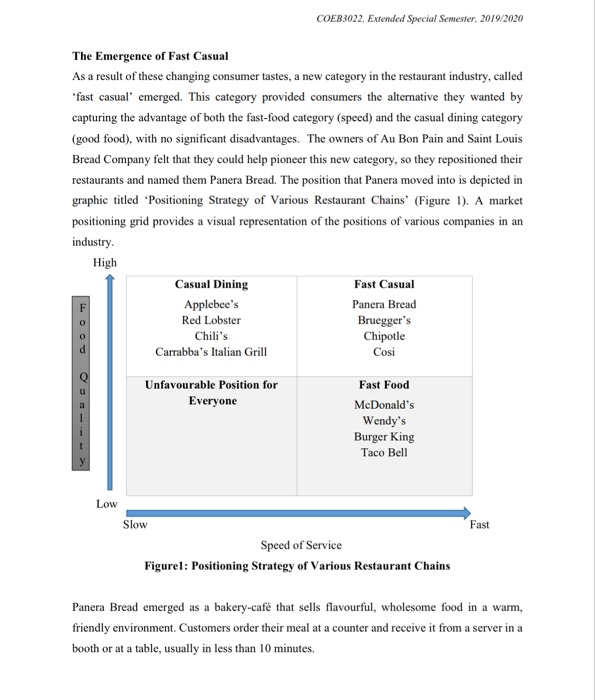
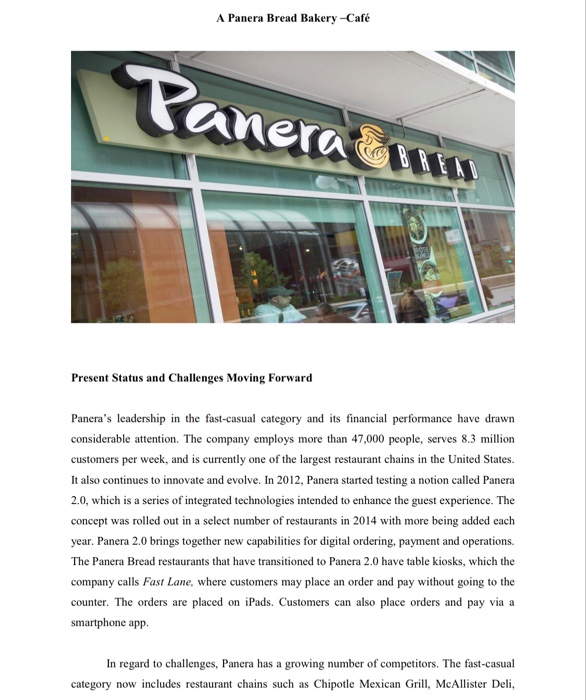
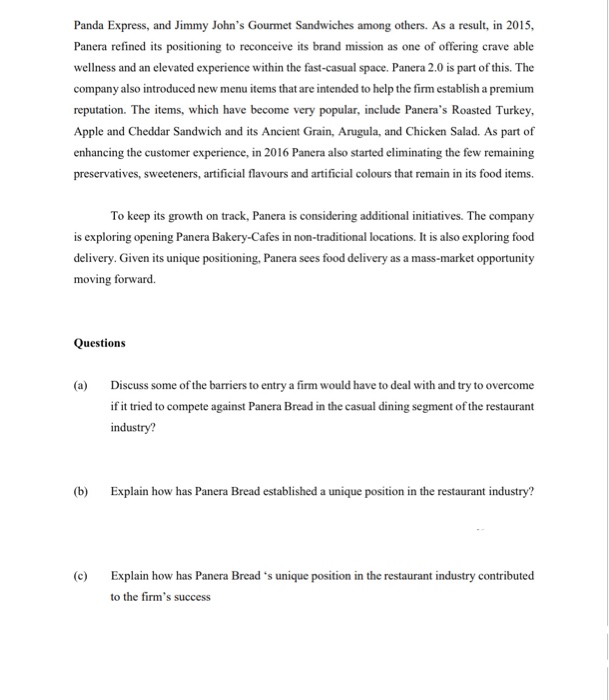
Case Study 1: Panera Bread: Occupying a Favourable Position in a Highly Competitive Industry Introduction If you analysed the restaurant industry using Porter's five forces model, you wouldn't be favourably impressed with the results. Three of threats to profitability, the threat of substitutes, the threat of new entrants and rivalry among existing firms are high. Despite these threats, one restaurant chain is moving forward in a very positive direction. St. Louis-based Panera Bread, a chain of speciality bakery-cafes, has grown from 602 company owned and franchised units in 2003 to 2,100 in early 2017. In 2016, system wide sales reached $2.7 billion, up 6 percent from the previous year, and, sales revenue was ticking upward in 2017 as well. These numbers reflect a strong performance for a restaurant chain. So, what's Panera's secret? How is it that this company flourishes while its industry as a whole is experiencing difficulty? As we'll see, Panera Bread's success can be explained in two words: positioning and execution. Changing Consumer Taste Panera's roots go back to 1981, when it was founded under the name of Au Bon Pain Co. and consisted of three Au Bon Pain bakery-cafes and one cookie store. The company grew slowly until the mid-1990s, when it acquired Saint Louis Bread Company, a chain of 20 bakery-cafes located in the St. Louis area. About that time, the owners of the newly combined companies observed that people were increasingly looking for products that were special meaning that they differed from run-of-the-mill restaurant food. Second, they noted that although consumers were tiring of standard fast food fare, they didn't want to give up the convenience of quick service. This trend led the company to conclude that consumers wanted the convenience of fast food combined with a higher-quality experience. In slightly different words, they wanted good food served quickly in an enjoyable environment COEB3022. Extended Special Semester, 2019/2020 The Emergence of Fast Casual As a result of these changing consumer tastes, a new category in the restaurant industry, called "fast casual' emerged. This category provided consumers the alternative they wanted by capturing the advantage of both the fast-food category (speed) and the casual dining category (good food), with no significant disadvantages. The owners of Au Bon Pain and Saint Louis Bread Company felt that they could help pioneer this new category, so they repositioned their restaurants and named them Panera Bread. The position that Panera moved into is depicted in graphic titled 'Positioning Strategy of Various Restaurant Chains' (Figure 1). A market positioning grid provides a visual representation of the positions of various companies in an industry. High Casual Dining Fast Casual Applebee's Panera Bread Red Lobster Bruegger's Chili's Chipotle Carrabba's Italian Grill Cosi Unfavourable Position for Everyone Fast Food McDonald's Wendy's Burger King Taco Bell Low Fast Slow Speed of Service Figurel: Positioning Strategy of Various Restaurant Chains Panera Bread emerged as a bakery-caf that sells flavourful, wholesome food in a warm, friendly environment. Customers order their meal at a counter and receive it from a server in a booth or at a table, usually in less than 10 minutes. Panera's Version of Fast Casual To establish itself as the leader in the fast-casual category and to distinguish itself from its rivals, Panera (which is Latin for time for bread') added a bonus to the mix, specialty food. The company has become known as the nation's bread expert and offers variety of artisan and other specialty breads, along with bagels, pastries, muffins, scones, and baked goods. The bread and bakery items are typically baked by an on-staff baker each day before dawn. Some locations also participate in a program that donates their unsold baked goods to local charities after closing each day. Panera Bread's restaurants are open for breakfast, lunch and dinner, and also offer hand-tossed salads, signature sandwiches and hearty soups served in edible sourdough bread bowls, along with hot and cold coffee drinks and other beverages. The company also provides catering services. Its restaurants present customers with a neighbourly atmosphere and relaxing dcor, adding to their appeal. Panera even suggests a new time of day to eat specialty foods, calling the time between lunch and dinner chill-out' time. With high hopes for future expansion, Panera Bread is an acknowledged leader in the fast-casual category. Its unique blend of fast-casual service and specialty foods also continues to gain momentum. This sentiment is captured in the following quote from Mark von Waaden, an investor and restaurateur who signed an agreement to open 20 Panera Bread restaurants in the Houston, Texas, area early in the company's growth spurt. Commenting on why he was attracted to Panera Breads opposed to other restaurant chains, von Waaden said, 'My wife, Monica and I fell in love with the fresh-baked breads and the beautiful bakery-cafes. We think the Panera Bread concept of outstanding bread coupled with a warm, inviting environment is a natural fit with the sophistication that the Houston market represents'. The spirit of von Waaden's statement captures the essence of Panera's advantage. It isn't just another restaurant. By observing trends and listening to customers, its leaders helped the firm carve out a unique and favourable position in a difficult industry. A Panera Bread Bakery -Caf anera Paneta Present Status and Challenges Moving Forward Panera's leadership in the fast-casual category and its financial performance have drawn considerable attention. The company employs more than 47,000 people, serves 8.3 million customers per week, and is currently one of the largest restaurant chains in the United States. It also continues to innovate and evolve. In 2012, Panera started testing a notion called Panera 2.0, which is a series of integrated technologies intended to enhance the guest experience. The concept was rolled out in a select number of restaurants in 2014 with more being added each year. Panera 2.0 brings together new capabilities for digital ordering, payment and operations. The Panera Bread restaurants that have transitioned to Panera 2.0 have table kiosks, which the company calls Fast Lane, where customers may place an order and pay without going to the counter. The orders are placed on iPads. Customers can also place orders and pay via a smartphone app In regard to challenges, Panera has a growing number of competitors. The fast-casual category now includes restaurant chains such as Chipotle Mexican Grill, McAllister Deli, Panda Express, and Jimmy John's Gourmet Sandwiches among others. As a result, in 2015, Panera refined its positioning to reconceive its brand mission as one of offering crave able wellness and an elevated experience within the fast-casual space. Panera 2.0 is part of this. The company also introduced new menu items that are intended to help the firm establish a premium reputation. The items, which have become very popular, include Panera's Roasted Turkey, Apple and Cheddar Sandwich and its Ancient Grain, Arugula, and Chicken Salad. As part of enhancing the customer experience, in 2016 Panera also started eliminating the few remaining preservatives, sweeteners, artificial flavours and artificial colours that remain in its food items. To keep its growth on track, Pancra is considering additional initiatives. The company is exploring opening Panera Bakery-Cafes in non-traditional locations. It is also exploring food delivery. Given its unique positioning, Panera sees food delivery as a mass-market opportunity moving forward. Questions Discuss some of the barriers to entry a firm would have to deal with and try to overcome if it tried to compete against Panera Bread in the casual dining segment of the restaurant industry? (b) Explain how has Panera Bread established a unique position in the restaurant industry? (c) Explain how has Panera Bread 's unique position in the restaurant industry contributed to the firm's success (d) Identify what are Panera Bread 's primary sources of competitive advantages? (e) Explain and justify the ways that Panera Bread can conduct ethical and proper form of competitive analysis to learn about potential competitors entering the fast- casual category. Subject: entrepreneurship and financial management Step by Step Solution
There are 3 Steps involved in it
1 Expert Approved Answer
Step: 1 Unlock

Question Has Been Solved by an Expert!
Get step-by-step solutions from verified subject matter experts
Step: 2 Unlock
Step: 3 Unlock
 Study Help