







Question: PLEASE DO IN EXCEL AND SCREEN SHOT Consider the following changes in the Cambridge Software Corporation case study: 1) The willingness to pay of the
PLEASE DO IN EXCEL AND SCREEN SHOT
Consider the following changes in the Cambridge Software Corporation
case study:
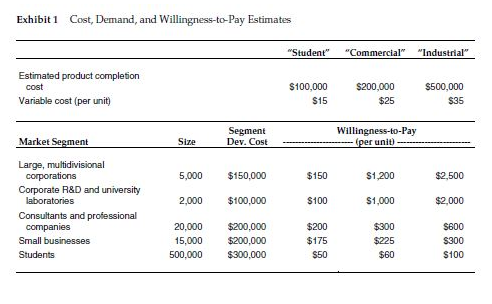
1) The willingness to pay of the large multidivisional corporations for
the commercial version of the Modeler has risen to $1,500 and for
the industrial version of the Modeler has risen to $2,800
2) The willingness to pay of the corporate R&D and University Lab
s for
the commercial version of the Modeler has risen to $1,200
3) The willingness to pay of the consultants and commercial companies
for the commercial version of the Modeler has risen to $400
4) The willingness to pay of the small businesses for the commercial
version of the Modeler has risen to $250
5) The willingness to pay of students for the commercial version of the
Modeler has risen to $70
6) The bookstore has agreed to reduce its commission of selling
Modeler to 30%, netting CSC 70% of the selling price
Given the above mentioned changes answer the following questions:
a) If CSC only offers one version of the Modeler which version it should
offer and at what price?
b) If CSC only offers two versions of the Modeler which versions it
should offer and at what prices?
c) Should CSC offer all three versions? If yes, at what prices? If no, why
not?
Show transcribed image text
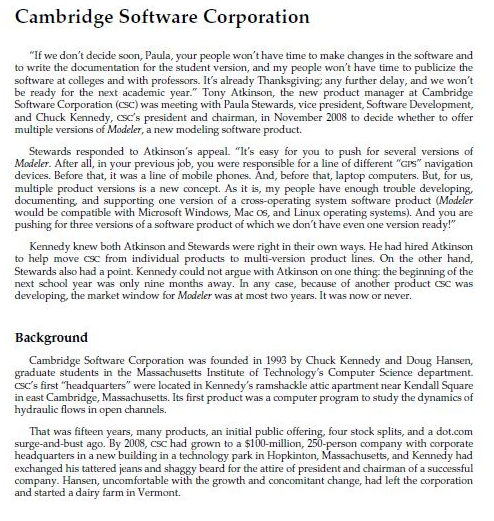
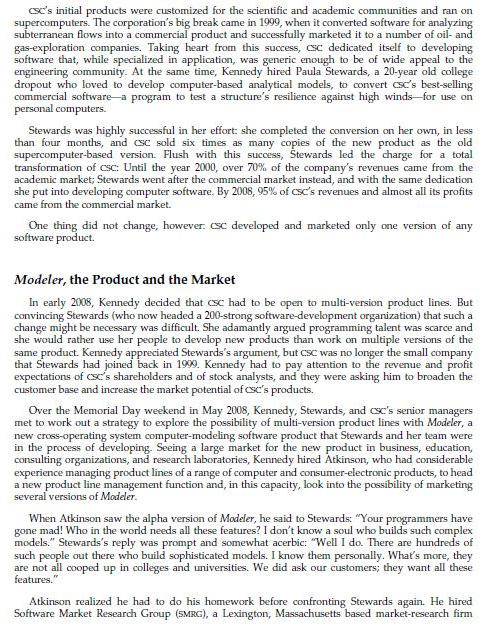
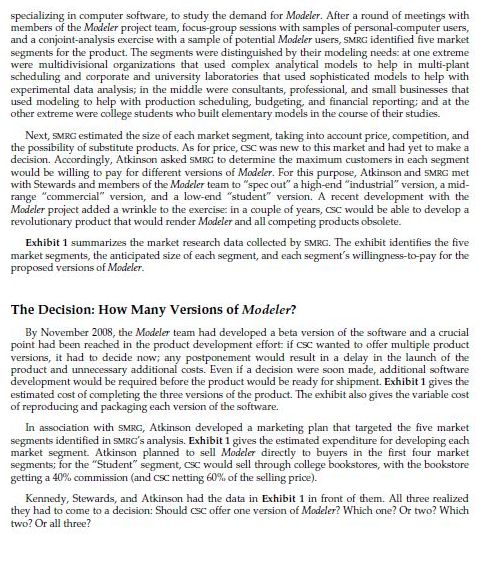
Cambridge Software Corporation "If we don't decide soon, Paula, your people won't have time to make changes in the software and to write the documentation for the student version, and my people won't have time to publicize the software at colleges and with professors. It's already Thanksgiving; any further delay, and we won't be ready for the next academic yr" Tony Atkinson, the new product manager at Cambridge Software Corporation (csc) was meeting with Paula Stewards, vice president, Software Development, and Chuck Kennedy, csc's president and chairman, in November 2008 to decide whether to offer multiple versions of Modeler, a new modeling software product. Stewards responded to Atkinson's appeal. "It's easy for you to push for several versions of Modeler. After all, in your previous job, you were responsible for a line of different "GPs navigation devices. Before that, it was a line of mobile phones. And, before that, laptop computers. But, for us multiple product versions is a new concept. As it is, my people have enough trouble developing, documenting, and supporting one version of a cross-operating system software product (Modeler would be compatible with Microsoft Windows, Mac os, and Linux operating systems). And you are pushing for three versions of a software product of which we don't have even one version ready! Kennedy knew both Atkinson and Stewards were right in their own ways. He had hired Atkinson to help move CSC from individual products to multi-version product lines. On the other hand Stewards also had a point. Kennedy could not argue with Atkinson on one thing the next school year was only nine months away. In any case, because of another product CSC was developing, the market window for Modeler was at most two years. It was now or never. beginning of the Background Cambridge Software Corporation was founded in 1993 by Chuck Kennedy and Doug Hanser, graduate students in the Massachusetts Institute of Technology's Computer Science department. CSC's first "headquarters" were located in Kennedy's ramshackle attic apartment near Kendall Square in east Cambridge, Massachusetts. Its first product was a computer program to study the dynamics of hydraulic flows in open channels. That was fifteen years, many products, an initial public offering, four stock splits, and a dot.com surge-and-bust ago. By 2008, csc had grown to a $100-million, 250-person company with corporate headquarters in a new building in a technology park in Hopkinton, Massachusetts, and Kennedy had exchanged his tattered jeans and shaggy beard for the attire of president and chairman of a successful company. Hansen, uncomfortable with the growth and concomitant change, had left the corporation and started a dairy farm in Vermont. Cambridge Software Corporation "If we don't decide soon, Paula, your people won't have time to make changes in the software and to write the documentation for the student version, and my people won't have time to publicize the software at colleges and with professors. It's already Thanksgiving; any further delay, and we won't be ready for the next academic yr" Tony Atkinson, the new product manager at Cambridge Software Corporation (csc) was meeting with Paula Stewards, vice president, Software Development, and Chuck Kennedy, csc's president and chairman, in November 2008 to decide whether to offer multiple versions of Modeler, a new modeling software product. Stewards responded to Atkinson's appeal. "It's easy for you to push for several versions of Modeler. After all, in your previous job, you were responsible for a line of different "GPs navigation devices. Before that, it was a line of mobile phones. And, before that, laptop computers. But, for us multiple product versions is a new concept. As it is, my people have enough trouble developing, documenting, and supporting one version of a cross-operating system software product (Modeler would be compatible with Microsoft Windows, Mac os, and Linux operating systems). And you are pushing for three versions of a software product of which we don't have even one version ready! Kennedy knew both Atkinson and Stewards were right in their own ways. He had hired Atkinson to help move CSC from individual products to multi-version product lines. On the other hand Stewards also had a point. Kennedy could not argue with Atkinson on one thing the next school year was only nine months away. In any case, because of another product CSC was developing, the market window for Modeler was at most two years. It was now or never. beginning of the Background Cambridge Software Corporation was founded in 1993 by Chuck Kennedy and Doug Hanser, graduate students in the Massachusetts Institute of Technology's Computer Science department. CSC's first "headquarters" were located in Kennedy's ramshackle attic apartment near Kendall Square in east Cambridge, Massachusetts. Its first product was a computer program to study the dynamics of hydraulic flows in open channels. That was fifteen years, many products, an initial public offering, four stock splits, and a dot.com surge-and-bust ago. By 2008, csc had grown to a $100-million, 250-person company with corporate headquarters in a new building in a technology park in Hopkinton, Massachusetts, and Kennedy had exchanged his tattered jeans and shaggy beard for the attire of president and chairman of a successful company. Hansen, uncomfortable with the growth and concomitant change, had left the corporation and started a dairy farm in Vermont
Step by Step Solution
There are 3 Steps involved in it

Get step-by-step solutions from verified subject matter experts
 Study Help