







Question: Please do it on Excel and show formulas. Please lay out 10 years of cash flows like the text said. Please calculate the IRR and
Please do it on Excel and show formulas. Please lay out 10 years of cash flows like the text said. Please calculate the IRR and NPV using EXCEL functions.
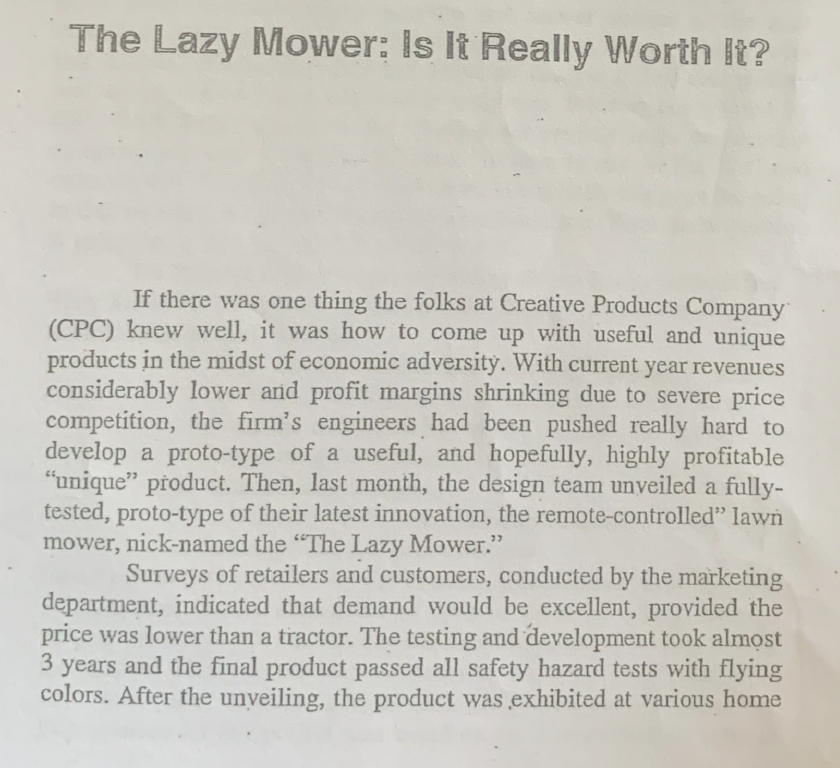
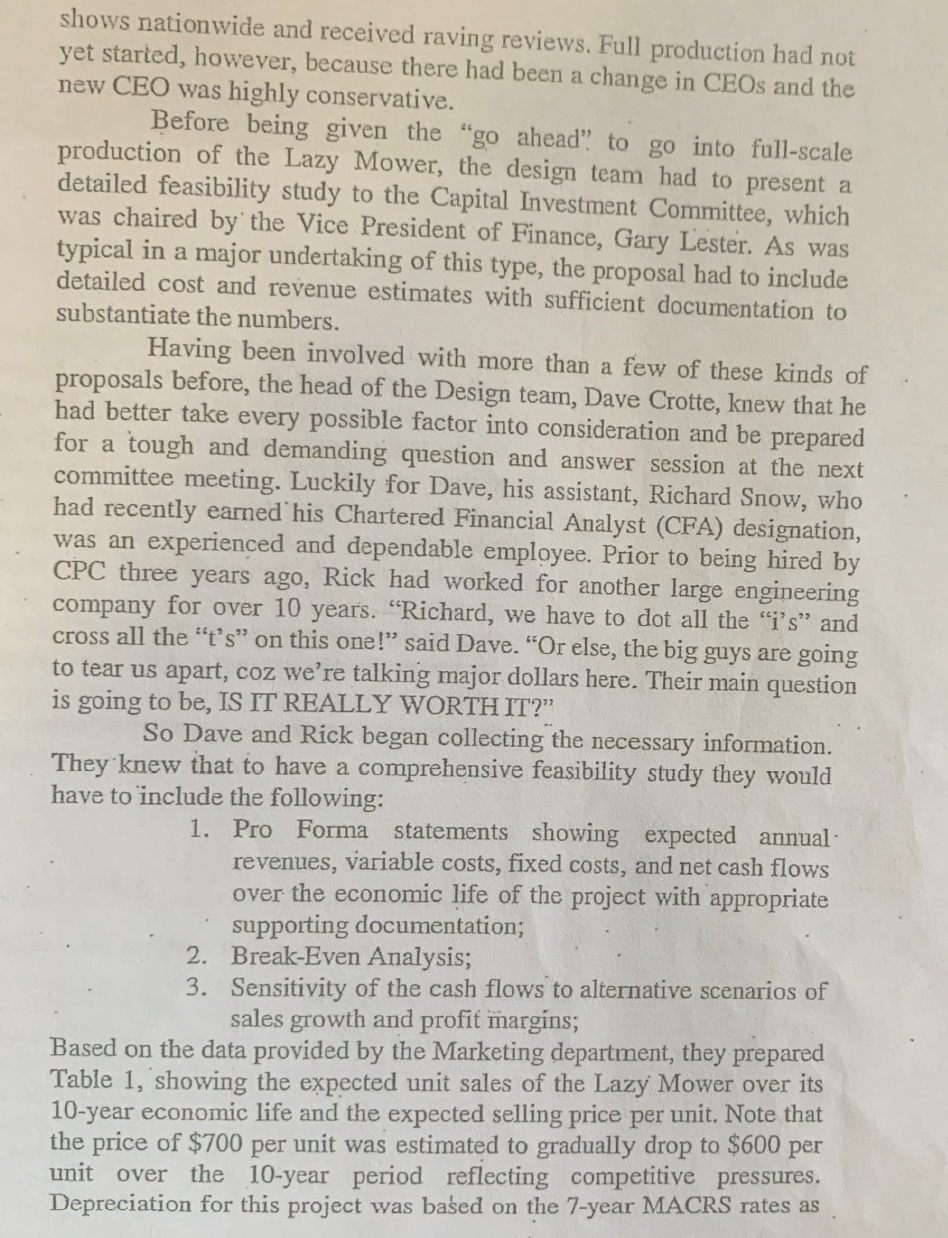
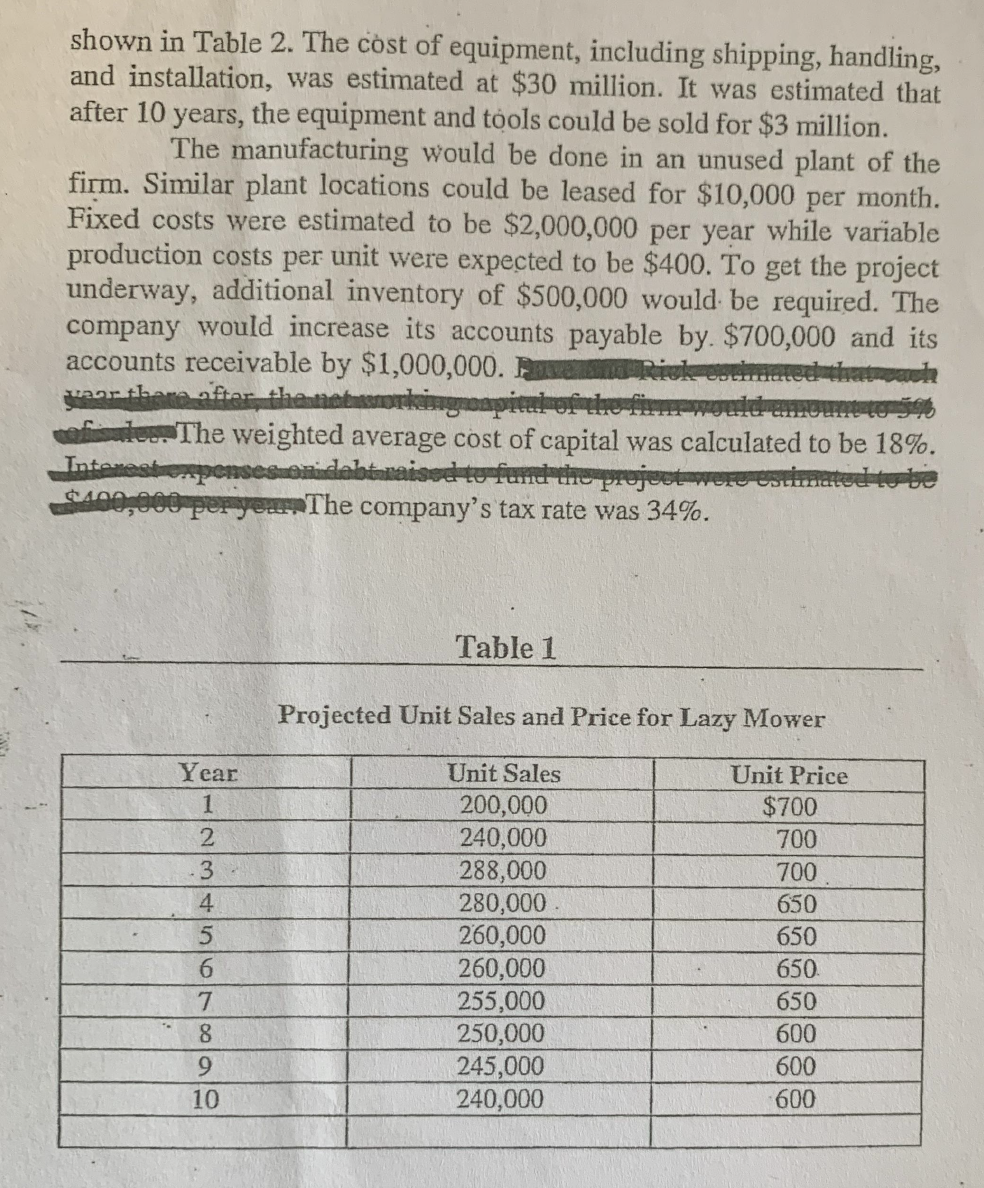
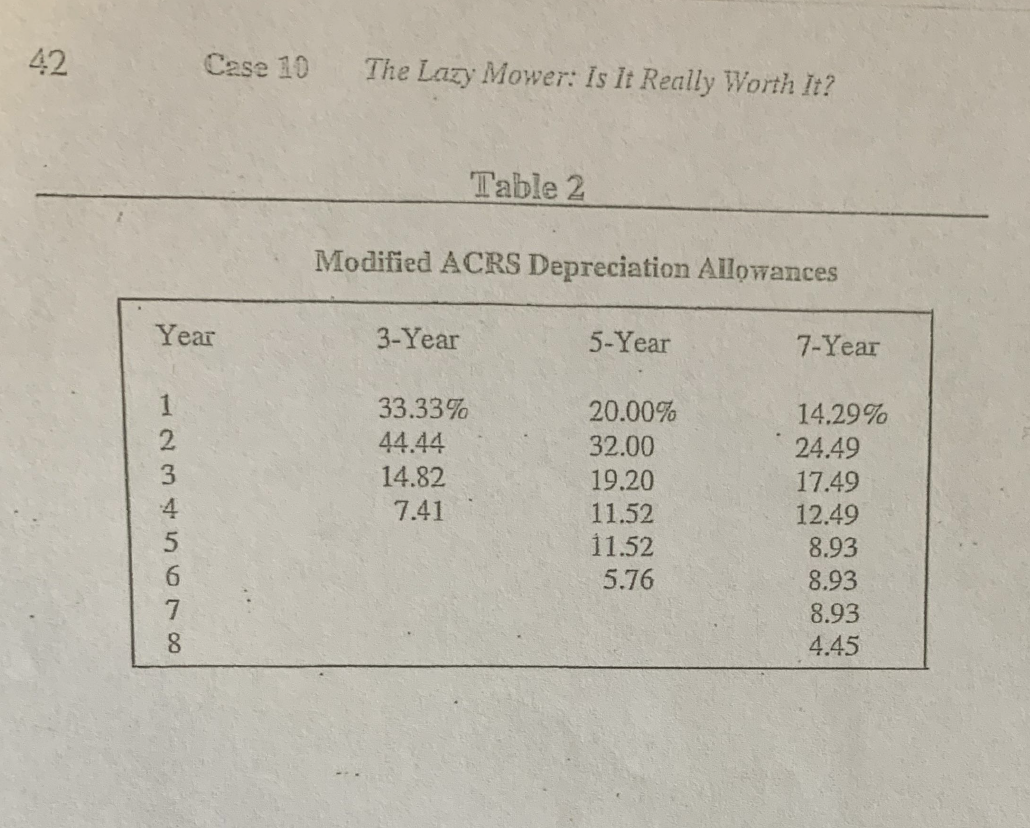
The Lazy Mower: Is It Really Worth It? If there was one thing the folks at Creative Products Company (CPC) knew well, it was how to come up with useful and unique products in the midst of economic adversity. With current year revenues considerably lower and profit margins shrinking due to severe price competition, the firm's engineers had been pushed really hard to develop a proto-type of a useful, and hopefully, highly profitable "unique product. Then, last month, the design team unveiled a fully- tested, proto-type of their latest innovation, the remote-controlled lawn mower, nick-named the "The Lazy Mower." Surveys of retailers and customers, conducted by the marketing department, indicated that demand would be excellent, provided the price was lower than a tractor. The testing and development took almost 3 years and the final product passed all safety hazard tests with flying colors. After the unveiling, the product was exhibited at various home shows nationwide and received raving reviews. Full production had not yet started, however, because there had been a change in CEOs and the new CEO was highly conservative. Before being given the "go ahead" to go into full-scale production of the Lazy Mower, the design team had to present a detailed feasibility study to the Capital Investment Committee, which was chaired by the Vice President of Finance, Gary Lester. As was typical in a major undertaking of this type, the proposal had to include detailed cost and revenue estimates with sufficient documentation to substantiate the numbers. Having been involved with more than a few of these kinds of proposals before, the head of the Design team, Dave Crotte, knew that he had better take every possible factor into consideration and be prepared for a tough and demanding question and answer session at the next committee meeting. Luckily for Dave, his assistant, Richard Snow, who had recently earned his Chartered Financial Analyst (CFA) designation, was an experienced and dependable employee. Prior to being hired by CPC three years ago, Rick had worked for another large engineering company for over 10 years. Richard, we have to dot all the "Ts and cross all the "t's on this one! said Dave. "Or else, the big guys are going to tear us apart, coz we're talking major dollars here. Their main question is going to be, IS IT REALLY WORTH IT? So Dave and Rick began collecting the necessary information. They knew that to have a comprehensive feasibility study they would have to include the following: 1. Pro Forma statements showing expected annual revenues, variable costs, fixed costs, and net cash flows over the economic life of the project with appropriate supporting documentation; 2. Break-Even Analysis; 3. Sensitivity of the cash flows to alternative scenarios of sales growth and profit margins; Based on the data provided by the Marketing department, they prepared Table 1, showing the expected unit sales of the Lazy Mower over its 10-year economic life and the expected selling price per unit. Note that the price of $700 per unit was estimated to gradually drop to $600 per unit over the 10-year period reflecting competitive pressures. Depreciation for this project was based on the 7-year MACRS rates as shown in Table 2. The cost of equipment, including shipping, handling, and installation, was estimated at $30 million. It was estimated that after 10 years, the equipment and tools could be sold for $3 million. The manufacturing would be done in an unused plant of the firm. Similar plant locations could be leased for $10,000 per month. Fixed costs were estimated to be $2,000,000 per year while variable production costs per unit were expected to be $400. To get the project underway, additional inventory of $500,000 would be required. The company would increase its accounts payable by. $700,000 and its accounts receivable by $1,000,000. A rich outlet waarbare after the workingroapital of the firm would to *** f. The weighted average cost of capital was calculated to be 18%. ponses to fund the project estimated to be $400,000 per year. The company's tax rate was 34%. Intonant Table 1 Projected Unit Sales and Price for Lazy Mower Year 1 2 3 4 5 6 7 8 9 10 Unit Sales 200,000 240,000 288,000 280,000 260,000 260,000 255,000 250,000 245,000 240,000 Unit Price $700 700 700 650 650 650 650 600 600 600 42 Case 10 The Lazy Mower: Is It Really Worth It? Table 2 Modified ACRS Depreciation Allowances Year 3-Year 5-Year 7-Year 1 2 33.33% 44.44 14.82 7.41 20.00% 32.00 19.20 11.52 11.52 5.76 14.29% 24.49 17.49 12.49 8.93 8.93 8.93 4.45 6 7. 8 The Lazy Mower: Is It Really Worth It? If there was one thing the folks at Creative Products Company (CPC) knew well, it was how to come up with useful and unique products in the midst of economic adversity. With current year revenues considerably lower and profit margins shrinking due to severe price competition, the firm's engineers had been pushed really hard to develop a proto-type of a useful, and hopefully, highly profitable "unique product. Then, last month, the design team unveiled a fully- tested, proto-type of their latest innovation, the remote-controlled lawn mower, nick-named the "The Lazy Mower." Surveys of retailers and customers, conducted by the marketing department, indicated that demand would be excellent, provided the price was lower than a tractor. The testing and development took almost 3 years and the final product passed all safety hazard tests with flying colors. After the unveiling, the product was exhibited at various home shows nationwide and received raving reviews. Full production had not yet started, however, because there had been a change in CEOs and the new CEO was highly conservative. Before being given the "go ahead" to go into full-scale production of the Lazy Mower, the design team had to present a detailed feasibility study to the Capital Investment Committee, which was chaired by the Vice President of Finance, Gary Lester. As was typical in a major undertaking of this type, the proposal had to include detailed cost and revenue estimates with sufficient documentation to substantiate the numbers. Having been involved with more than a few of these kinds of proposals before, the head of the Design team, Dave Crotte, knew that he had better take every possible factor into consideration and be prepared for a tough and demanding question and answer session at the next committee meeting. Luckily for Dave, his assistant, Richard Snow, who had recently earned his Chartered Financial Analyst (CFA) designation, was an experienced and dependable employee. Prior to being hired by CPC three years ago, Rick had worked for another large engineering company for over 10 years. Richard, we have to dot all the "Ts and cross all the "t's on this one! said Dave. "Or else, the big guys are going to tear us apart, coz we're talking major dollars here. Their main question is going to be, IS IT REALLY WORTH IT? So Dave and Rick began collecting the necessary information. They knew that to have a comprehensive feasibility study they would have to include the following: 1. Pro Forma statements showing expected annual revenues, variable costs, fixed costs, and net cash flows over the economic life of the project with appropriate supporting documentation; 2. Break-Even Analysis; 3. Sensitivity of the cash flows to alternative scenarios of sales growth and profit margins; Based on the data provided by the Marketing department, they prepared Table 1, showing the expected unit sales of the Lazy Mower over its 10-year economic life and the expected selling price per unit. Note that the price of $700 per unit was estimated to gradually drop to $600 per unit over the 10-year period reflecting competitive pressures. Depreciation for this project was based on the 7-year MACRS rates as shown in Table 2. The cost of equipment, including shipping, handling, and installation, was estimated at $30 million. It was estimated that after 10 years, the equipment and tools could be sold for $3 million. The manufacturing would be done in an unused plant of the firm. Similar plant locations could be leased for $10,000 per month. Fixed costs were estimated to be $2,000,000 per year while variable production costs per unit were expected to be $400. To get the project underway, additional inventory of $500,000 would be required. The company would increase its accounts payable by. $700,000 and its accounts receivable by $1,000,000. A rich outlet waarbare after the workingroapital of the firm would to *** f. The weighted average cost of capital was calculated to be 18%. ponses to fund the project estimated to be $400,000 per year. The company's tax rate was 34%. Intonant Table 1 Projected Unit Sales and Price for Lazy Mower Year 1 2 3 4 5 6 7 8 9 10 Unit Sales 200,000 240,000 288,000 280,000 260,000 260,000 255,000 250,000 245,000 240,000 Unit Price $700 700 700 650 650 650 650 600 600 600 42 Case 10 The Lazy Mower: Is It Really Worth It? Table 2 Modified ACRS Depreciation Allowances Year 3-Year 5-Year 7-Year 1 2 33.33% 44.44 14.82 7.41 20.00% 32.00 19.20 11.52 11.52 5.76 14.29% 24.49 17.49 12.49 8.93 8.93 8.93 4.45 6 7. 8
Step by Step Solution
There are 3 Steps involved in it

Get step-by-step solutions from verified subject matter experts
 Study Help