







Question: please do not answer the same way as it was before, that's not a correct one Recursively Defined Sequence #1: Bit Strings Define the sequence
 please do not answer the same way as it was before, that's not a correct one
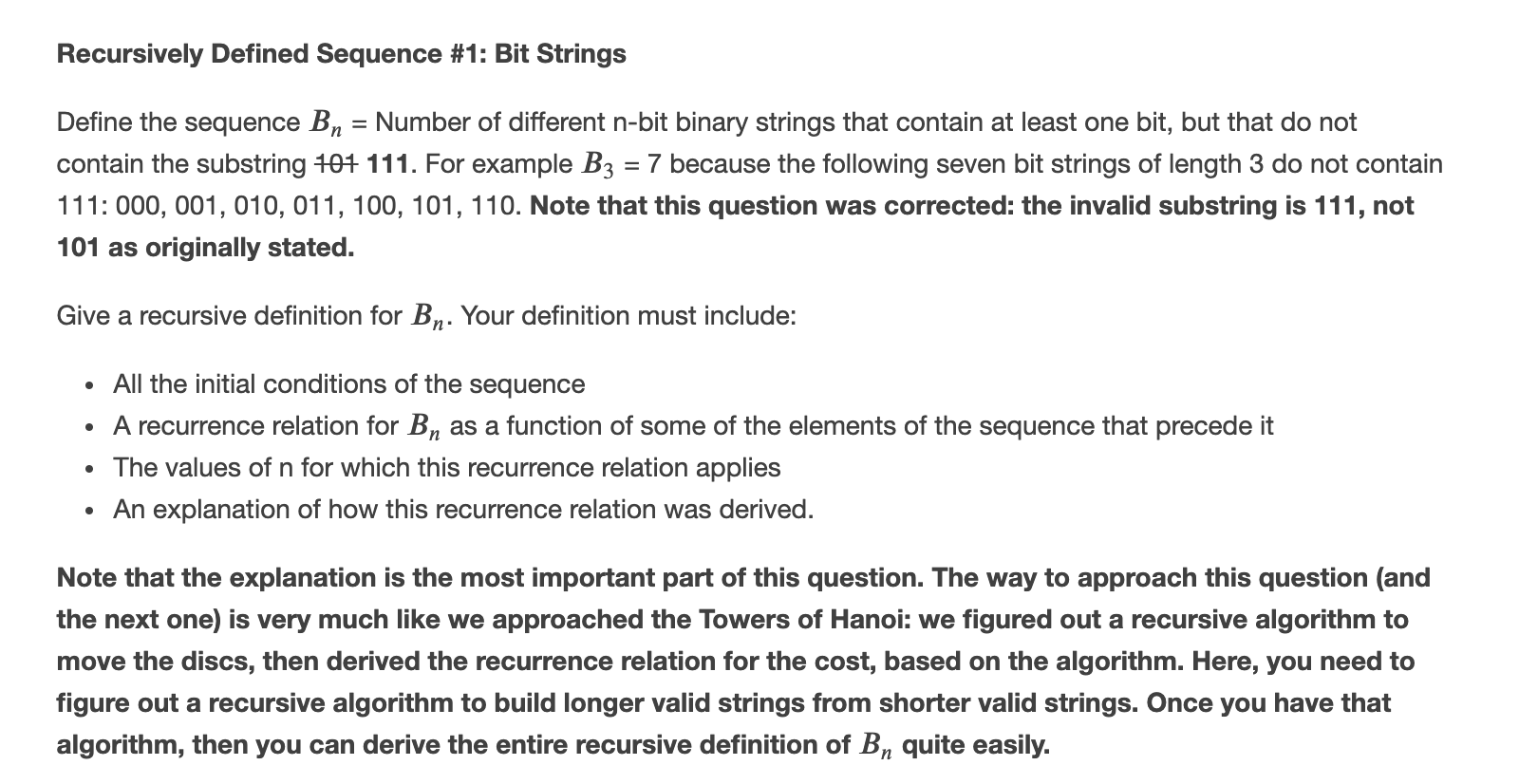
Recursively Defined Sequence #1: Bit Strings Define the sequence Bn = Number of different n-bit binary strings that contain at least one bit, but that do not contain the substring 101 111. For example B3 = 7 because the following seven bit strings of length 3 do not contain 111: 000, 001, 010, 011, 100, 101, 110. Note that this question was corrected: the invalid substring is 111, not 101 as originally stated. Give a recursive definition for Bn. Your definition must include: . All the initial conditions of the sequence A recurrence relation for Bn as a function of some of the elements of the sequence that precede it The values of n for which this recurrence relation applies An explanation of how this recurrence relation was derived. Note that the explanation is the most important part of this question. The way to approach this question (and the next one) is very much like we approached the Towers of Hanoi: we figured out a recursive algorithm to move the discs, then derived the recurrence relation for the cost, based on the algorithm. Here, you need to figure out a recursive algorithm to build longer valid strings from shorter valid strings. Once you have that algorithm, then you can derive the entire recursive definition of Bn quite easily. Recursively Defined Sequence #1: Bit Strings Define the sequence Bn = Number of different n-bit binary strings that contain at least one bit, but that do not contain the substring 101 111. For example B3 = 7 because the following seven bit strings of length 3 do not contain 111: 000, 001, 010, 011, 100, 101, 110. Note that this question was corrected: the invalid substring is 111, not 101 as originally stated. Give a recursive definition for Bn. Your definition must include: . All the initial conditions of the sequence A recurrence relation for Bn as a function of some of the elements of the sequence that precede it The values of n for which this recurrence relation applies An explanation of how this recurrence relation was derived. Note that the explanation is the most important part of this question. The way to approach this question (and the next one) is very much like we approached the Towers of Hanoi: we figured out a recursive algorithm to move the discs, then derived the recurrence relation for the cost, based on the algorithm. Here, you need to figure out a recursive algorithm to build longer valid strings from shorter valid strings. Once you have that algorithm, then you can derive the entire recursive definition of Bn quite easily
Step by Step Solution
There are 3 Steps involved in it

Get step-by-step solutions from verified subject matter experts
 Study Help