







Question: PLEASE DO NOT COPY AND PASTE SOMEONE ELSE'S ANSWERS- IT WILL GET THUMBS DOWN Stanley Ford makes mountains out of molehills. He can do this
PLEASE DO NOT COPY AND PASTE SOMEONE ELSE'S ANSWERS- IT WILL GET THUMBS DOWN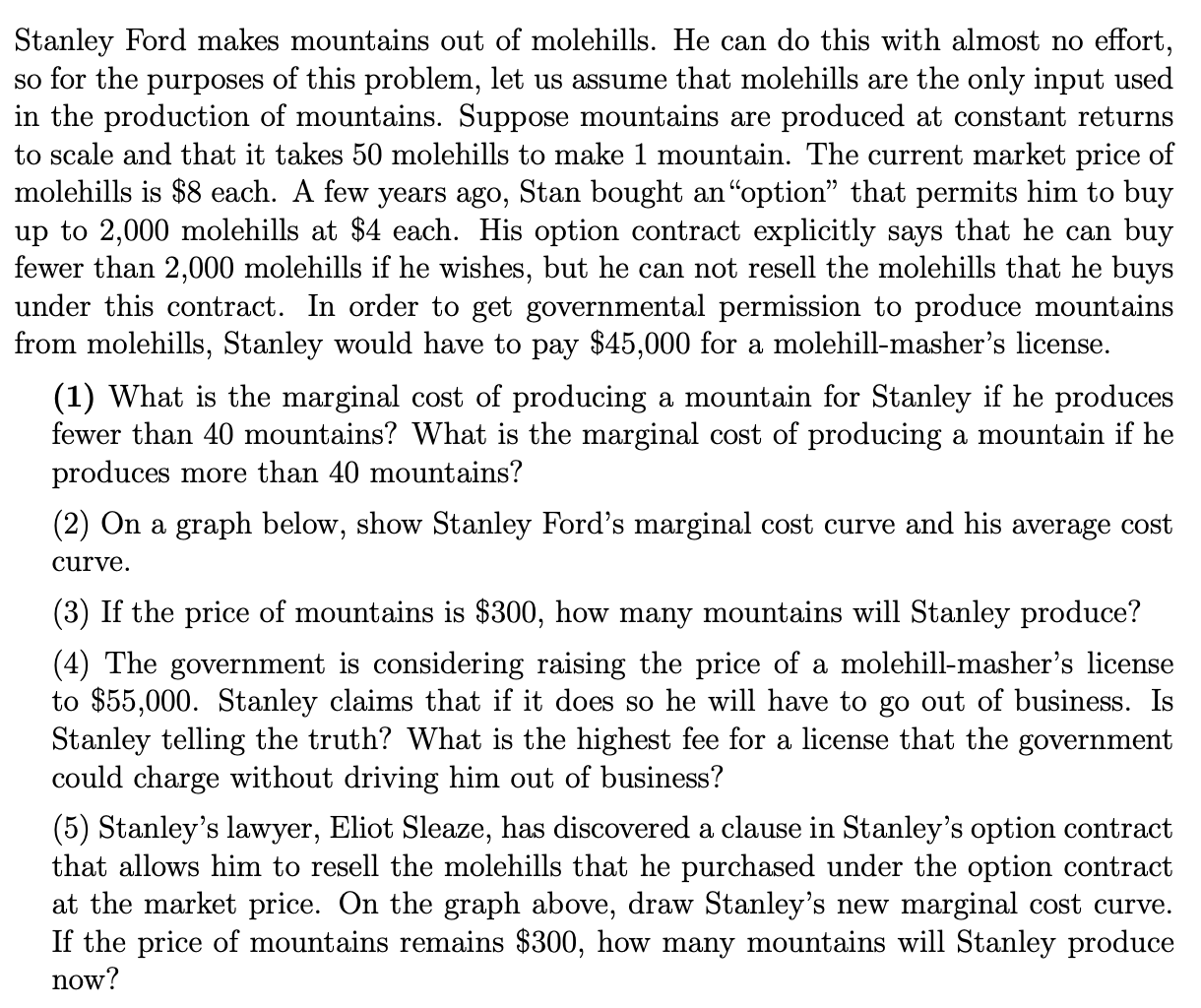
Stanley Ford makes mountains out of molehills. He can do this with almost no effort, so for the purposes of this problem, let us assume that molehills are the only input used in the production of mountains. Suppose mountains are produced at constant returns to scale and that it takes 50 molehills to make 1 mountain. The current market price of molehills is $8 each. A few years ago, Stan bought an option that permits him to buy up to 2,000 molehills at $4 each. His option contract explicitly says that he can buy fewer than 2,000 molehills if he wishes, but he can not resell the molehills that he buys under this contract. In order to get governmental permission to produce mountains from molehills, Stanley would have to pay $45,000 for a molehill-masher's license. (1) What is the marginal cost of producing a mountain for Stanley if he produces fewer than 40 mountains? What is the marginal cost of producing a mountain if he produces more than 40 mountains? (2) On a graph below, show Stanley Ford's marginal cost curve and his average cost curve. (3) If the price of mountains is $300, how many mountains will Stanley produce? (4) The government is considering raising the price of a molehill-masher's license to $55,000. Stanley claims that if it does so he will have to go out of business. Is Stanley telling the truth? What is the highest fee for a license that the government could charge without driving him out of business? (5) Stanley's lawyer, Eliot Sleaze, has discovered a clause in Stanley's option contract that allows him to resell the molehills that he purchased under the option contract at the market price. On the graph above, draw Stanleys new marginal cost curve. If the price of mountains remains $300, how many mountains will Stanley produce now? a Stanley Ford makes mountains out of molehills. He can do this with almost no effort, so for the purposes of this problem, let us assume that molehills are the only input used in the production of mountains. Suppose mountains are produced at constant returns to scale and that it takes 50 molehills to make 1 mountain. The current market price of molehills is $8 each. A few years ago, Stan bought an option that permits him to buy up to 2,000 molehills at $4 each. His option contract explicitly says that he can buy fewer than 2,000 molehills if he wishes, but he can not resell the molehills that he buys under this contract. In order to get governmental permission to produce mountains from molehills, Stanley would have to pay $45,000 for a molehill-masher's license. (1) What is the marginal cost of producing a mountain for Stanley if he produces fewer than 40 mountains? What is the marginal cost of producing a mountain if he produces more than 40 mountains? (2) On a graph below, show Stanley Ford's marginal cost curve and his average cost curve. (3) If the price of mountains is $300, how many mountains will Stanley produce? (4) The government is considering raising the price of a molehill-masher's license to $55,000. Stanley claims that if it does so he will have to go out of business. Is Stanley telling the truth? What is the highest fee for a license that the government could charge without driving him out of business? (5) Stanley's lawyer, Eliot Sleaze, has discovered a clause in Stanley's option contract that allows him to resell the molehills that he purchased under the option contract at the market price. On the graph above, draw Stanleys new marginal cost curve. If the price of mountains remains $300, how many mountains will Stanley produce now? a
Step by Step Solution
There are 3 Steps involved in it

Get step-by-step solutions from verified subject matter experts
 Study Help