







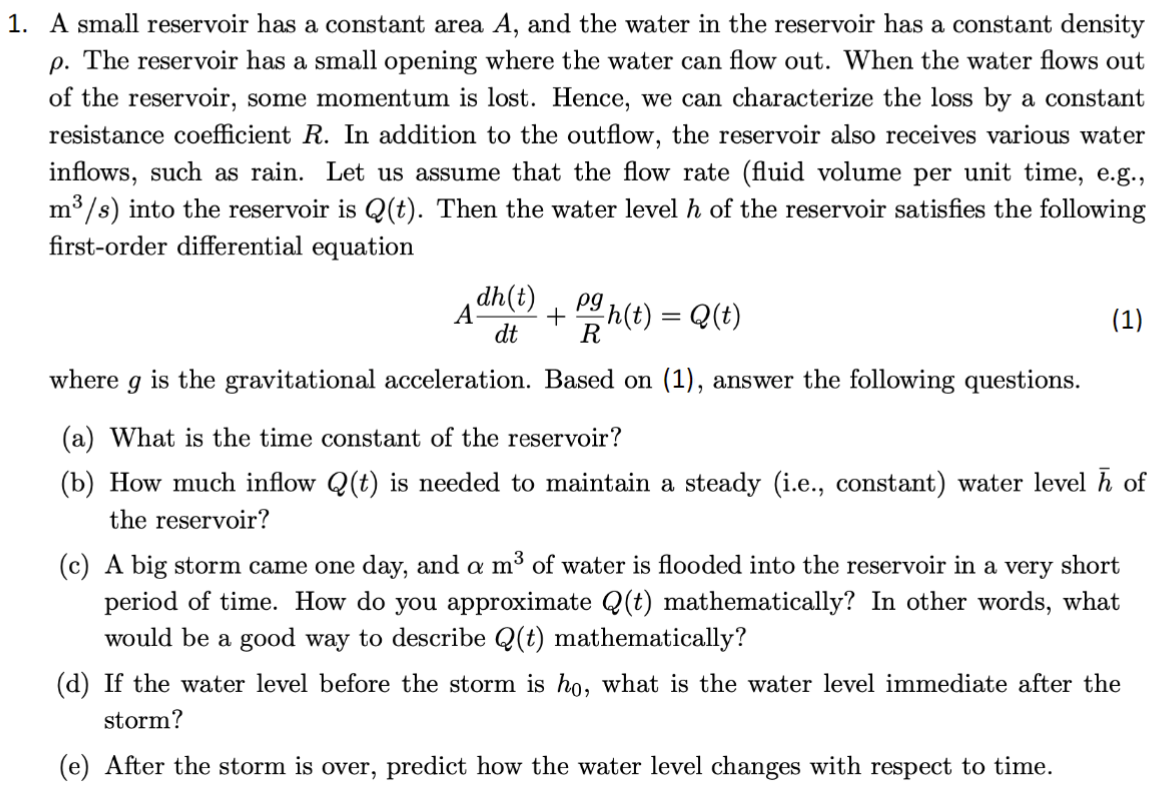
Question: ( PLEASE DO NOT COPY ANYONE ELSES WORK!!! AND SOLVE ALL PARTS OF THE PROBLEM!!! ) A small reservoir has a constant area A ,
PLEASE DO NOT COPY ANYONE ELSES WORK!!! AND SOLVE ALL PARTS OF THE PROBLEM!!!
A small reservoir has a constant area and the water in the reservoir has a constant density
The reservoir has a small opening where the water can flow out. When the water flows out
of the reservoir, some momentum is lost. Hence, we can characterize the loss by a constant
resistance coefficient In addition to the outflow, the reservoir also receives various water
inflows, such as rain. Let us assume that the flow rate fluid volume per unit time, eg
: into the reservoir is Then the water level of the reservoir satisfies the following
firstorder differential equation
where is the gravitational acceleration. Based on answer the following questions.
a What is the time constant of the reservoir?
b How much inflow is needed to maintain a steady ie constant water level of
the reservoir?
c A big storm came one day, and of water is flooded into the reservoir in a very short
period of time. How do you approximate mathematically? In other words, what
would be a good way to describe mathematically?
d If the water level before the storm is what is the water level immediate after the
storm?
e After the storm is over, predict how the water level changes with respect to time.PLWA
Step by Step Solution
There are 3 Steps involved in it
1 Expert Approved Answer
Step: 1 Unlock

Question Has Been Solved by an Expert!
Get step-by-step solutions from verified subject matter experts
Step: 2 Unlock
Step: 3 Unlock
 Study Help