



Question: PLEASE do not copy other's wrong answers. All other chegg's answers are wrong for this question. 3. This data from this article in the Colorado
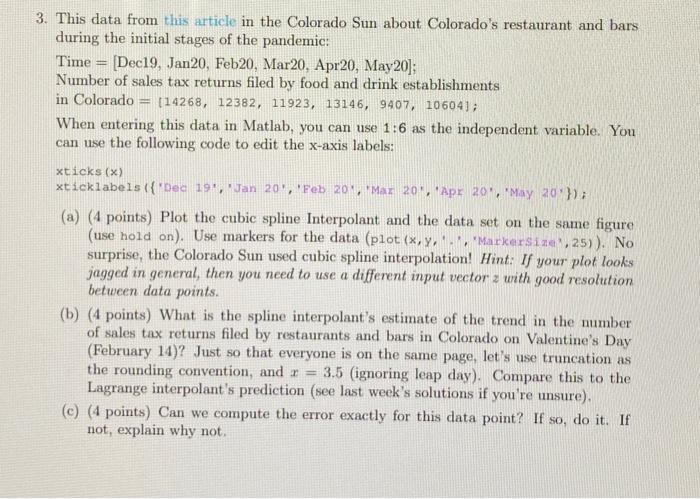
3. This data from this article in the Colorado Sun about Colorado's restaurant and bars during the initial stages of the pandemic: Time [Dec 19, Jan 20, Feb20, Mar20. Apr20, May20]; Number of sales tax returns filed by food and drink establishments in Colorado [14268, 12382, 11923, 13146, 9407, 106041; When entering this data in Matlab, you can use 1:6 as the independent variable. You can use the following code to edit the x-axis labels: xticks (x) xticklabels({ "Dec 19. Jan 20, Feb 2012 May 20%, 'Apr 20, May 20}); (a) (4 points) Plot the cubic spline Interpolant and the data set on the same figure (use hold on). Use markers for the data (plot(X,Y,'., 'Markersize, 25)). No surprise, the Colorado Sun used cubic spline interpolation! Hint: If your plot looks jagged in general, then you need to use a different input vector 2 with good resolution between data points. (b) (4 points) What is the spline interpolant's estimate of the trend in the number of sales tax returns filed by restaurants and bars in Colorado on Valentine's Day (February 14)? Just so that everyone is on the same page, let's use truncation as the rounding convention, and x = 3.5 (ignoring leap day). Compare this to the Lagrange interpolant's prediction (see last week's solutions if you're unsure). (c) (4 points) Can we compute the error exactly for this data point? If so, do it. If not, explain why not, 3. This data from this article in the Colorado Sun about Colorado's restaurant and bars during the initial stages of the pandemic: Time [Dec 19, Jan 20, Feb20, Mar20. Apr20, May20]; Number of sales tax returns filed by food and drink establishments in Colorado [14268, 12382, 11923, 13146, 9407, 106041; When entering this data in Matlab, you can use 1:6 as the independent variable. You can use the following code to edit the x-axis labels: xticks (x) xticklabels({ "Dec 19. Jan 20, Feb 2012 May 20%, 'Apr 20, May 20}); (a) (4 points) Plot the cubic spline Interpolant and the data set on the same figure (use hold on). Use markers for the data (plot(X,Y,'., 'Markersize, 25)). No surprise, the Colorado Sun used cubic spline interpolation! Hint: If your plot looks jagged in general, then you need to use a different input vector 2 with good resolution between data points. (b) (4 points) What is the spline interpolant's estimate of the trend in the number of sales tax returns filed by restaurants and bars in Colorado on Valentine's Day (February 14)? Just so that everyone is on the same page, let's use truncation as the rounding convention, and x = 3.5 (ignoring leap day). Compare this to the Lagrange interpolant's prediction (see last week's solutions if you're unsure). (c) (4 points) Can we compute the error exactly for this data point? If so, do it. If not, explain why not
Step by Step Solution
There are 3 Steps involved in it

Get step-by-step solutions from verified subject matter experts