







Question: PLEASE DO NOT COPY THE ANSWER ALREADY ON CHEGG ITS A REQUEST TO PROVIDE A NEW ANSWER What other qualitative factors should be taken into
PLEASE DO NOT COPY THE ANSWER ALREADY ON CHEGG ITS A REQUEST TO PROVIDE A NEW ANSWER
What other qualitative factors should be taken into consideration by A.B. Corp. before they decide on the best CWH location? Explain.
.
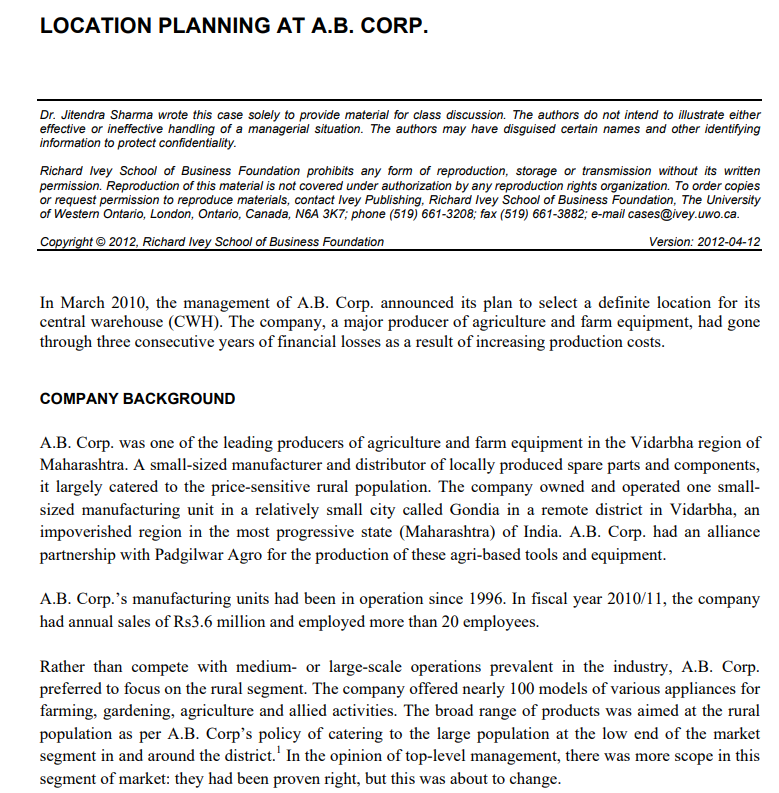
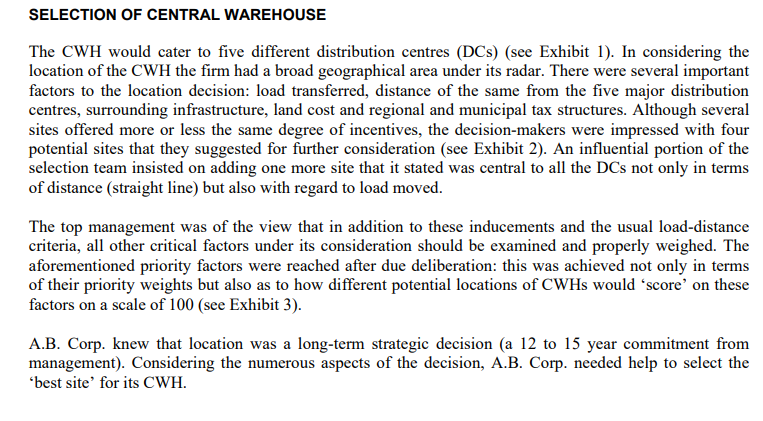
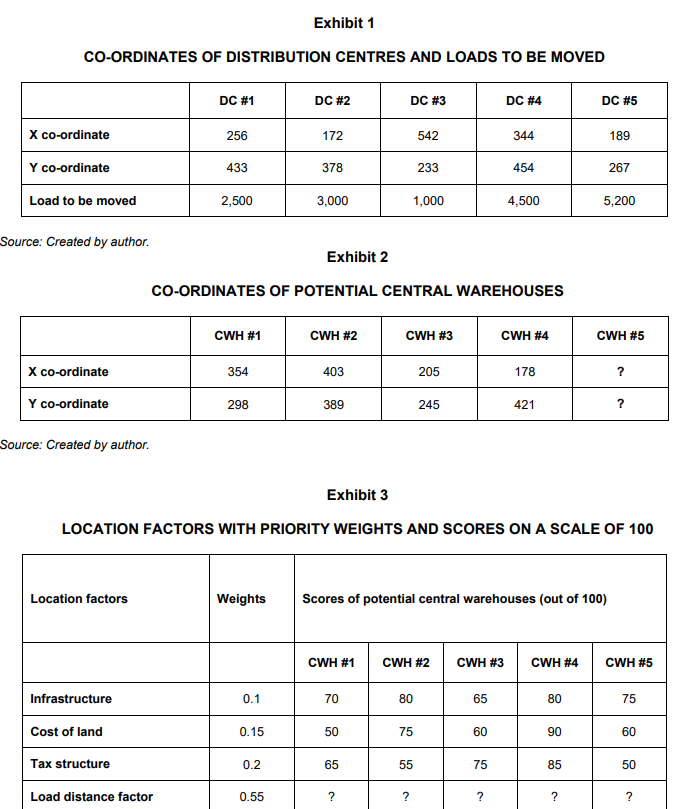
LOCATION PLANNING AT A.B. CORP. Dr. Jitendra Sharma wrote this case solely to provide material for class discussion. The authors do not intend to illustrate either effective or ineffective handling of a managerial situation. The authors may have disguised certain names and other identifying information to protect confidentiality. Richard Ivey School of Business Foundation prohibits any form of reproduction, storage or transmission without its written permission. Reproduction of this material is not covered under authorization by any reproduction rights organization. To order copies or request permission to reproduce materials, contact Ivey Publishing, Richard Ivey School of Business Foundation, The University of Western Ontario, London, Ontario, Canada, N6A 3K7; phone (519) 661-3208, fax (519) 661-3882; e-mail cases@ivey.uwo.ca. Copyright 2012, Richard Ivey School of Business Foundation Version: 2012-04-12 In March 2010, the management of A.B. Corp. announced its plan to select a definite location for its central warehouse (CWH). The company, a major producer of agriculture and farm equipment, had gone through three consecutive years of financial losses as a result of increasing production costs. COMPANY BACKGROUND A.B. Corp. was one of the leading producers of agriculture and farm equipment in the Vidarbha region of Maharashtra. A small-sized manufacturer and distributor of locally produced spare parts and components, it largely catered to the price-sensitive rural population. The company owned and operated one small- sized manufacturing unit in a relatively small city called Gondia in a remote district in Vidarbha, an impoverished region in the most progressive state (Maharashtra) of India. A.B. Corp. had an alliance partnership with Padgilwar Agro for the production of these agri-based tools and equipment. A.B. Corp.s manufacturing units had been in operation since 1996. In fiscal year 2010/11, the company had annual sales of Rs3.6 million and employed more than 20 employees. Rather than compete with medium- or large-scale operations prevalent in the industry, A.B. Corp. preferred to focus on the rural segment. The company offered nearly 100 models of various appliances for farming, gardening, agriculture and allied activities. The broad range of products was aimed at the rural population as per A.B. Corp's policy of catering to the large population at the low end of the market segment in and around the district.' In the opinion of top-level management, there was more scope in this segment of market: they had been proven right, but this was about to change. SELECTION OF CENTRAL WAREHOUSE The CWH would cater to five different distribution centres (DCs) (see Exhibit 1). In considering the location of the CWH the firm had a broad geographical area under its radar. There were several important factors to the location decision: load transferred, distance of the same from the five major distribution centres, surrounding infrastructure, land cost and regional and municipal tax structures. Although several sites offered more or less the same degree of incentives, the decision-makers were impressed with four potential sites that they suggested for further consideration (see Exhibit 2). An influential portion of the selection team insisted on adding one more site that it stated was central to all the DCs not only in terms of distance (straight line) but also with regard to load moved. The top management was of the view that in addition to these inducements and the usual load-distance criteria, all other critical factors under its consideration should be examined and properly weighed. The aforementioned priority factors were reached after due deliberation: this was achieved not only in terms of their priority weights but also as to how different potential locations of CWHs would score' on these factors on a scale of 100 (see Exhibit 3). A.B. Corp. knew that location was a long-term strategic decision (a 12 to 15 year commitment from management). Considering the numerous aspects of the decision, A.B. Corp. needed help to select the 'best site for its CWH. Exhibit 1 CO-ORDINATES OF DISTRIBUTION CENTRES AND LOADS TO BE MOVED DC #1 DC #2 DC #3 DC #4 DC #5 X co-ordinate 256 172 542 344 189 Y co-ordinate 433 378 233 454 267 Load to be moved 2,500 3,000 1,000 4,500 5,200 Source: Created by author. Exhibit 2 CO-ORDINATES OF POTENTIAL CENTRAL WAREHOUSES CWH #1 CWH #2 CWH #3 CWH #4 CWH #5 X co-ordinate 354 403 205 178 ? Y co-ordinate 298 389 245 421 ? Source: Created by author. Exhibit 3 LOCATION FACTORS WITH PRIORITY WEIGHTS AND SCORES ON A SCALE OF 100 Location factors Weights Scores of potential central warehouses (out of 100) CWH #1 CWH #2 CWH #3 CWH #4 CWH #5 Infrastructure 0.1 70 80 65 80 75 Cost of land 0.15 50 75 60 90 60 Tax structure 0.2 65 55 75 85 50 Load distance factor 0.55 Step by Step Solution
There are 3 Steps involved in it
1 Expert Approved Answer
Step: 1 Unlock

Question Has Been Solved by an Expert!
Get step-by-step solutions from verified subject matter experts
Step: 2 Unlock
Step: 3 Unlock
 Study Help