







Question: PLEASE DO NOT USE SAME ANSWER AS OTHER POSTS! Puzzle/Output is determined by input provided by a gradescript - DO NOT use a hard coded
PLEASE DO NOT USE SAME ANSWER AS OTHER POSTS! Puzzle/Output is determined by input provided by a gradescript - DO NOT use a hard coded table for input please.
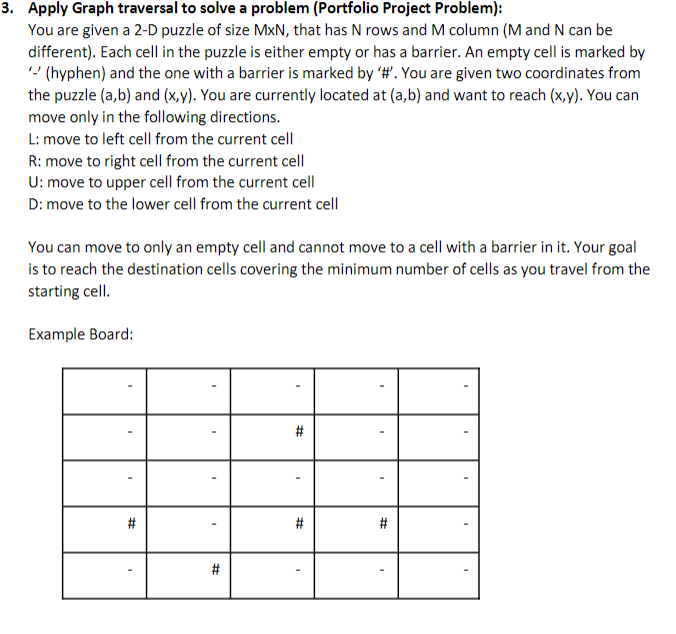
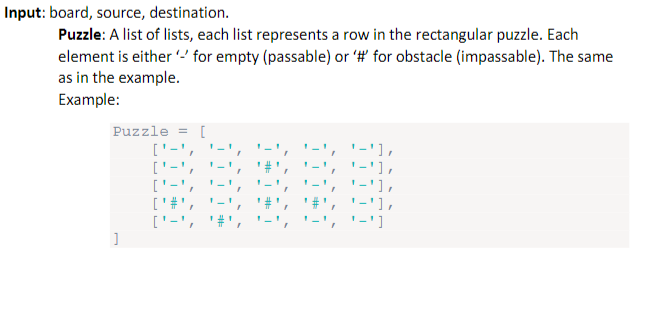
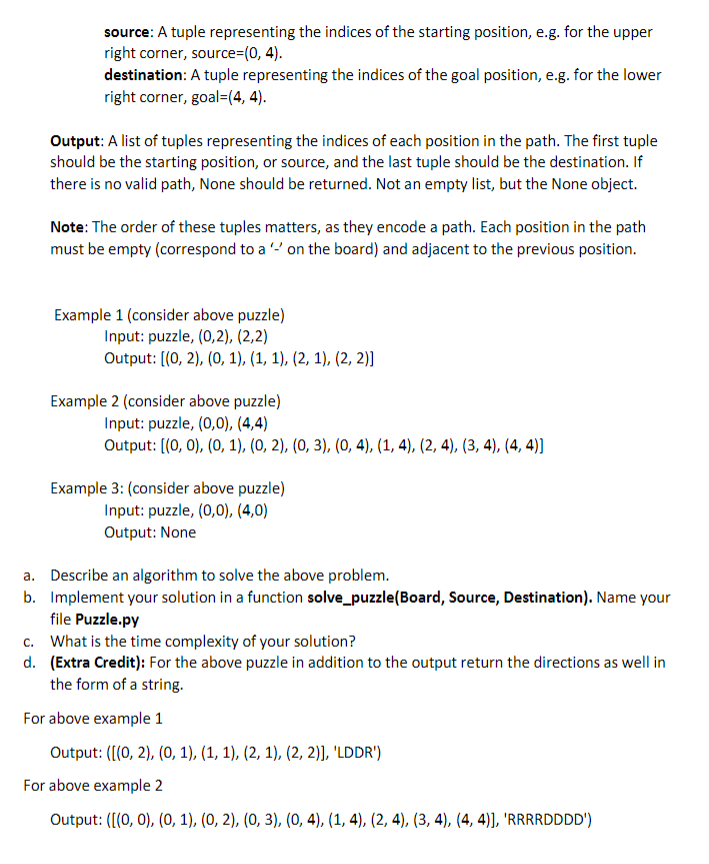
Apply Graph traversal to solve a problem (Portfolio Project Problem): You are given a 2-D puzzle of size MxN, that has N rows and M column ( M and N can be different). Each cell in the puzzle is either empty or has a barrier. An empty cell is marked by '-' (hyphen) and the one with a barrier is marked by '\#'. You are given two coordinates from the puzzle (a,b) and (x,y). You are currently located at (a,b) and want to reach (x,y). You can move only in the following directions. L: move to left cell from the current cell R: move to right cell from the current cell U: move to upper cell from the current cell D: move to the lower cell from the current cell You can move to only an empty cell and cannot move to a cell with a barrier in it. Your goal is to reach the destination cells covering the minimum number of cells as you travel from the starting cell. nput: board, source, destination. Puzzle: A list of lists, each list represents a row in the rectangular puzzle. Each element is either '-' for empty (passable) or '\#' for obstacle (impassable). The same as in the example. Example: source: A tuple representing the indices of the starting position, e.g. for the upper right corner, source =(0,4). destination: A tuple representing the indices of the goal position, e.g. for the lower right corner, goal =(4,4). Output: A list of tuples representing the indices of each position in the path. The first tuple should be the starting position, or source, and the last tuple should be the destination. If there is no valid path, None should be returned. Not an empty list, but the None object. Note: The order of these tuples matters, as they encode a path. Each position in the path must be empty (correspond to a- on the board) and adjacent to the previous position. Example 1 (consider above puzzle) Input: puzzle, (0,2),(2,2) Output: [(0,2),(0,1),(1,1),(2,1),(2,2)] Example 2 (consider above puzzle) Input: puzzle, (0,0),(4,4) Output: [(0,0),(0,1),(0,2),(0,3),(0,4),(1,4),(2,4),(3,4),(4,4)] Example 3: (consider above puzzle) Input: puzzle, (0,0),(4,0) Output: None Describe an algorithm to solve the above problem. b. Implement your solution in a function solve_puzzle(Board, Source, Destination). Name your file Puzzle.py c. What is the time complexity of your solution? d. (Extra Credit): For the above puzzle in addition to the output return the directions as well in the form of a string. For above example 1 Output: ([(0,2),(0,1),(1,1),(2,1),(2,2)], 'LDDR') For above example 2 Output: ([(0,0),(0,1),(0,2),(0,3),(0,4),(1,4),(2,4),(3,4),(4,4)], 'RRRRDDDD')
Step by Step Solution
There are 3 Steps involved in it

Get step-by-step solutions from verified subject matter experts
 Study Help