







Question: PLEASE DO NUMBER 4-6 Problem 1: MRS and the allocation of leisure John and Maria are siblings and they are both in high school. Their
PLEASE DO NUMBER 4-6
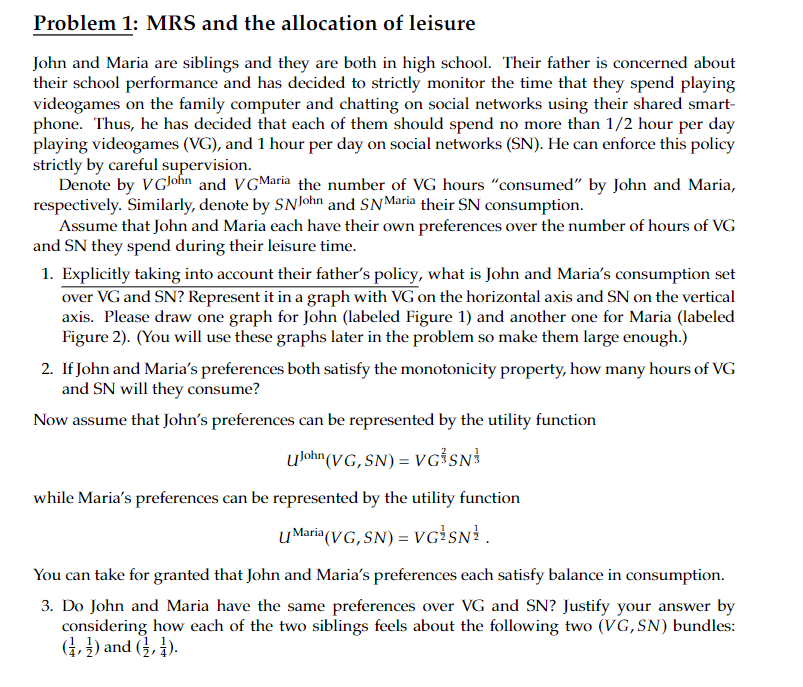
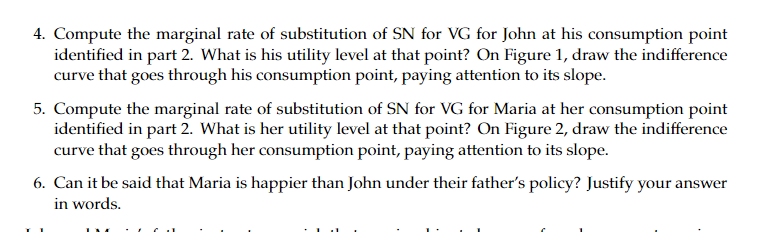
Problem 1: MRS and the allocation of leisure John and Maria are siblings and they are both in high school. Their father is concerned about their school performance and has decided to strictly monitor the time that they spend playing videogames on the family computer and chatting on social networks using their shared smart- phone. Thus, he has decided that each of them should spend no more than 1/2 hour per day playing videogames (VG), and 1 hour per day on social networks (SN). He can enforce this policy strictly by careful supervision. Denote by VG and VGM* the number of VG hours \"consumed\" by John and Maria, respectively. Similarly, denote by SN and SN2 their SN consumption. Assume that John and Maria each have their own preferences over the number of hours of VG and SN they spend during their leisure time. 1. Explicitly taking into account their father's policy, what is John and Maria's consumption set over VG and SN? Represent it in a graph with VG on the horizontal axis and SN on the vertical axis. Please draw one graph for John (labeled Figure 1) and another one for Maria (labeled Figure 2). (You will use these graphs later in the problem so make them large enough.) 2. If John and Maria's preferences both satisfy the monotonicity property, how many hours of VG and SN will they consume? Now assume that John's preferences can be represented by the utility function 1 ey SNY = VGISNG while Maria's preferences can be represented by the utility function UMy G SN) = VGISNT . You can take for granted that John and Maria's preferences each satisfy balance in consumption. 3. Do John and Maria have the same preferences over VG and SN? Justify your answer by considering how each of the two siblings feels about the following two (V G, SN) bundles: (%,%]and(%,}l . 4. Compute the marginal rate of substitution of SN for VG for John at his consumption point identified in part 2. What is his utility level at that point? On Figure 1, draw the indifference curve that goes through his consumption point, paying attention to its slope. 5. Compute the marginal rate of substitution of SN for VG for Maria at her consumption point identified in part 2. What is her utility level at that point? On Figure 2, draw the indifference curve that goes through her consumption point, paying attention to its slope. 6. Can it be said that Maria is happier than John under their father's policy? Justify your answer in words
Step by Step Solution
There are 3 Steps involved in it

Get step-by-step solutions from verified subject matter experts
 Study Help