







Question: Please do PART D ONLY. Problem 1 Assume you have the option to buy one of three bonds. All have the same degree of default
Please do PART D ONLY.
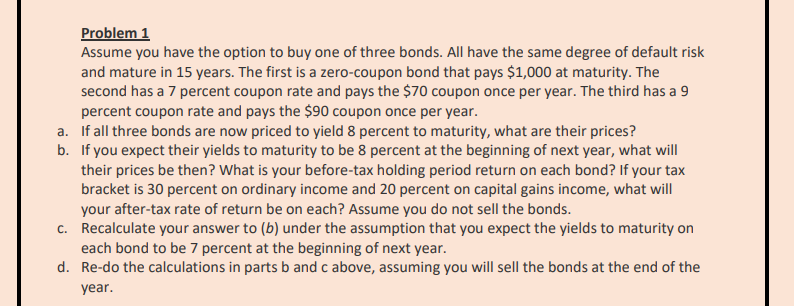
Problem 1 Assume you have the option to buy one of three bonds. All have the same degree of default risk and mature in 15 years. The first is a zero-coupon bond that pays $1,000 at maturity. The second has a 7 percent coupon rate and pays the $70 coupon once per year. The third has a 9 percent coupon rate and pays the $90 coupon once per year. a. If all three bonds are now priced to yield 8 percent to maturity, what are their prices? b. If you expect their yields to maturity to be 8 percent at the beginning of next year, what will their prices be then? What is your before-tax holding period return on each bond? If your tax bracket is 30 percent on ordinary income and 20 percent on capital gains income, what will your after-tax rate of return be on each? Assume you do not sell the bonds. C. Recalculate your answer to (b) under the assumption that you expect the yields to maturity on each bond to be 7 percent at the beginning of next year. d. Re-do the calculations in parts b and c above, assuming you will sell the bonds at the end of the year. Problem 1 Assume you have the option to buy one of three bonds. All have the same degree of default risk and mature in 15 years. The first is a zero-coupon bond that pays $1,000 at maturity. The second has a 7 percent coupon rate and pays the $70 coupon once per year. The third has a 9 percent coupon rate and pays the $90 coupon once per year. a. If all three bonds are now priced to yield 8 percent to maturity, what are their prices? b. If you expect their yields to maturity to be 8 percent at the beginning of next year, what will their prices be then? What is your before-tax holding period return on each bond? If your tax bracket is 30 percent on ordinary income and 20 percent on capital gains income, what will your after-tax rate of return be on each? Assume you do not sell the bonds. C. Recalculate your answer to (b) under the assumption that you expect the yields to maturity on each bond to be 7 percent at the beginning of next year. d. Re-do the calculations in parts b and c above, assuming you will sell the bonds at the end of the year
Step by Step Solution
There are 3 Steps involved in it

Get step-by-step solutions from verified subject matter experts
 Study Help