







Question: Please do question 2 in Python, thank you! - The following tutorials illustrate how to implement a fully connected neural network (also called multilayer perceptron
Please do question 2 in Python, thank you!
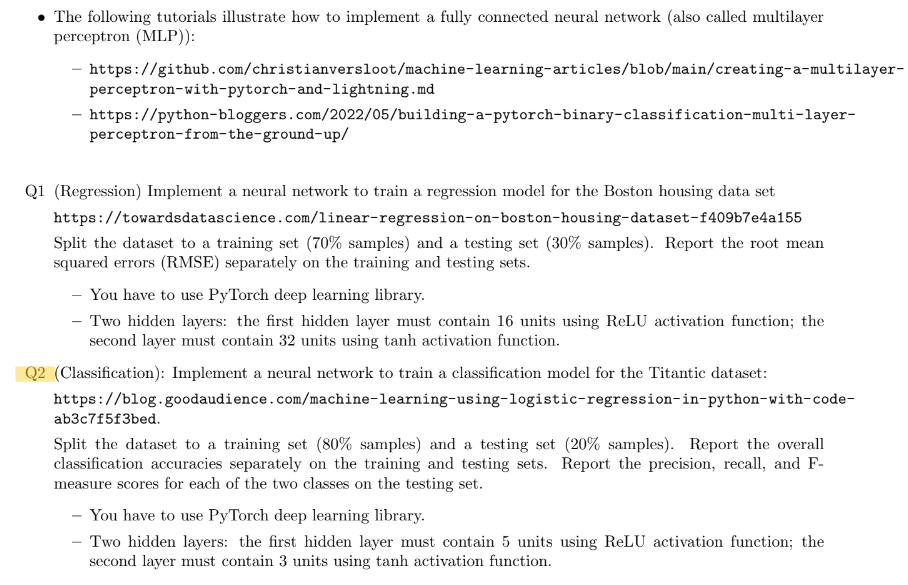
- The following tutorials illustrate how to implement a fully connected neural network (also called multilayer perceptron (MLP)): - https://github.com/christianversloot/machine-learning-articles/blob/main/creating-a-multilayer perceptron-with-pytorch-and-lightning.md - https://python-bloggers.com/2022/05/building-a-pytorch-binary-classification-multi-layer- perceptron-from-the-ground-up/ Q1 (Regression) Implement a neural network to train a regression model for the Boston housing data set https://towardsdatascience.com/linear-regression-on-boston-housing-dataset-f409b7e4a155 Split the dataset to a training set ( 70% samples) and a testing set ( 30% samples). Report the root mean squared errors (RMSE) separately on the training and testing sets. - You have to use PyTorch deep learning library. - Two hidden layers: the first hidden layer must contain 16 units using ReLU activation function; the second layer must contain 32 units using tanh activation function. Q2 (Classification): Implement a neural network to train a classification model for the Titantic dataset: https://blog.goodaudience.com/machine-learning-using-logistic-regression-in-python-with-codeab3c7f5f3bed. Split the dataset to a training set ( 80% samples) and a testing set (20\% samples). Report the overall classification accuracies separately on the training and testing sets. Report the precision, recall, and Fmeasure scores for each of the two classes on the testing set. - You have to use PyTorch deep learning library. - Two hidden layers: the first hidden layer must contain 5 units using ReLU activation function; the second layer must contain 3 units using tanh activation function
Step by Step Solution
There are 3 Steps involved in it

Get step-by-step solutions from verified subject matter experts
 Study Help