







Question: please do the first two questions Case 1: Cash Management Ms. Amanda Truly is the new CFO of Mind and Body, Inc., which produces popular
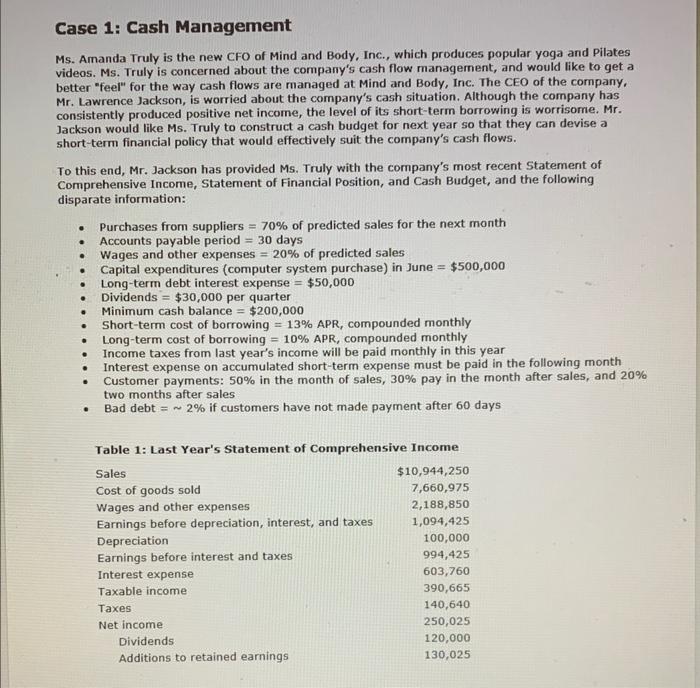
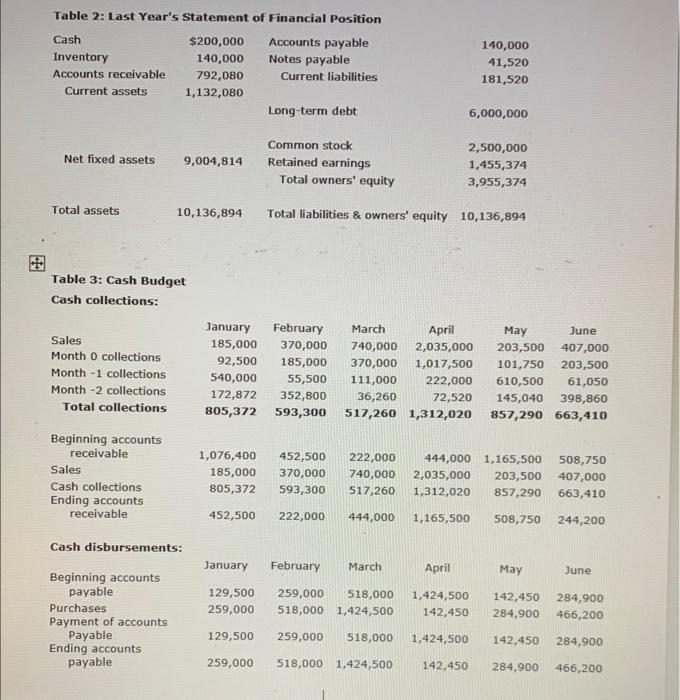
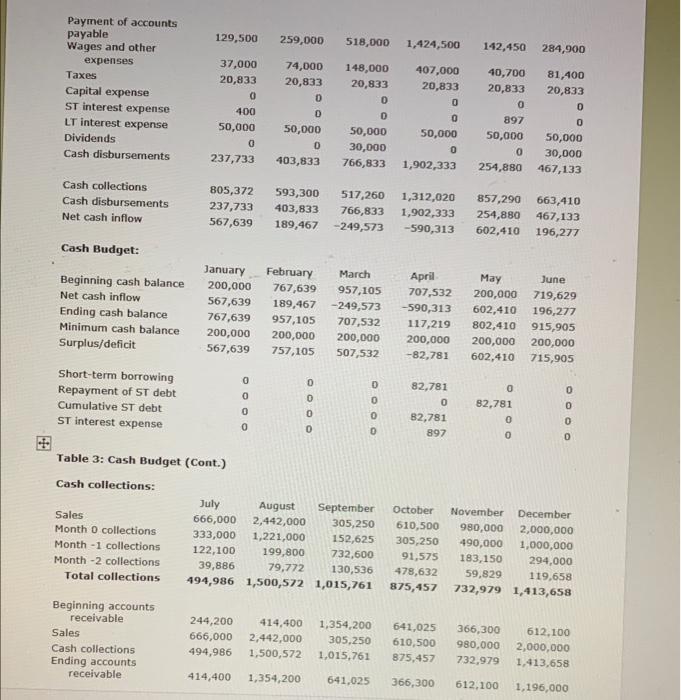
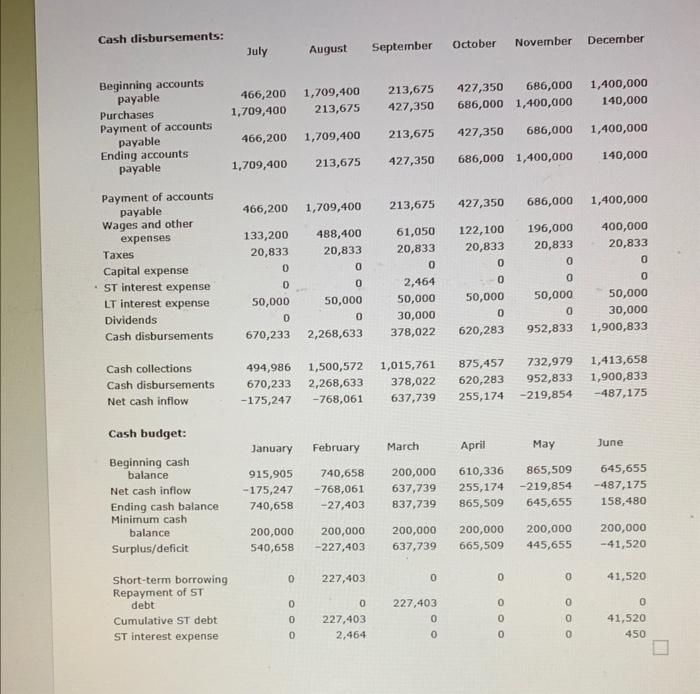
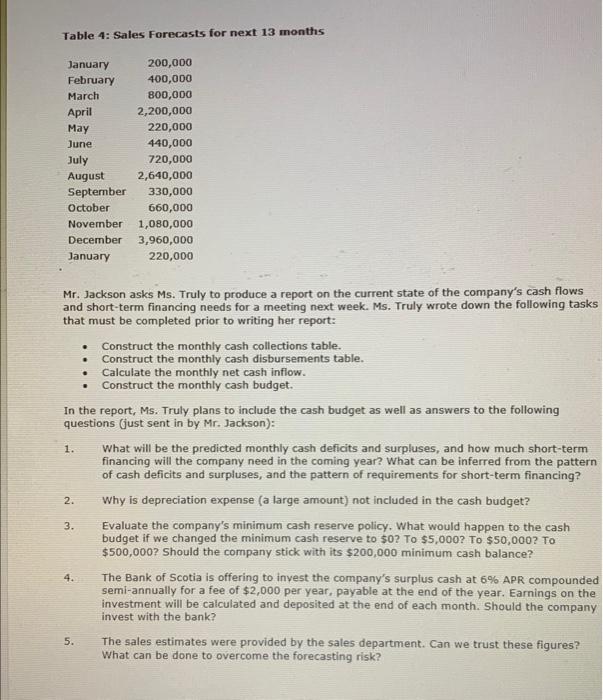
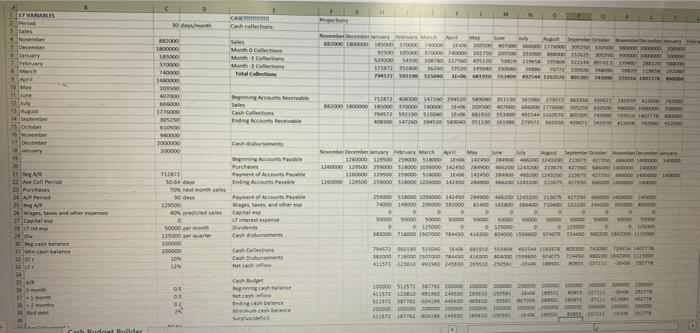
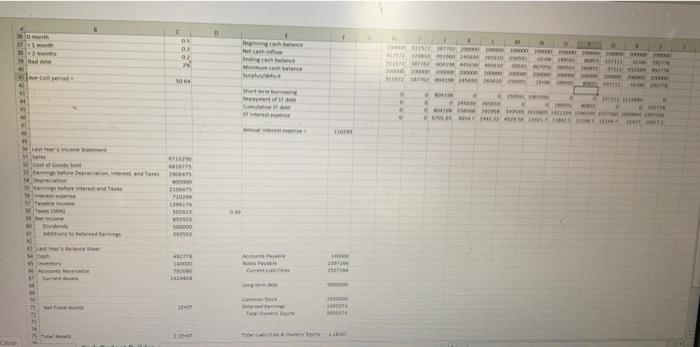
Case 1: Cash Management Ms. Amanda Truly is the new CFO of Mind and Body, Inc., which produces popular yoga and Pilates videos. Ms. Truly is concerned about the company's cash flow management, and would like to get a better "feel" for the way cash flows are managed at Mind and Body, Inc. The CEO of the company, Mr. Lawrence Jackson, is worried about the company's cash situation. Although the company has consistently produced positive net income, the level of its short-term borrowing is worrisome. Mr. Jackson would like Ms. Truly to construct a cash budget for next year so that they can devise a short-term financial policy that would effectively suit the company's cash flows. To this end, Mr. Jackson has provided Ms. Truly with the company's most recent Statement of Comprehensive Income, Statement of Financial Position, and Cash Budget, and the following disparate information: - Purchases from suppliers =70% of predicted sales for the next month - Accounts payable period =30 days - Wages and other expenses =20% of predicted sales - Capital expenditures (computer system purchase) in June =$500,000 - Long-term debt interest expense =$50,000 - Dividends =$30,000 per quarter - Minimum cash balance =$200,000 - Short-term cost of borrowing =13% APR, compounded monthly - Long-term cost of borrowing =10% APR, compounded monthly - Income taxes from last year's income will be paid monthly in this year - Interest expense on accumulated short-term expense must be paid in the following month - Customer payments: 50% in the month of sales, 30% pay in the month after sales, and 20% two months after sales - Bad debt =2% if customers have not made payment after 60 days Table 1: Last Year's Statement of Comprehensive Income Table 3: Cash Budget Cash collections: Payment of accounts Cash Budget: BeginningcashbalanceNetcashinflowEndingcashbalanceMinimumcashbalanceSurplus/deficitShort-termborrowingRepaymentofSTdebtCumulativeSTdebtSTinterestexpenseTable3:CashBudget(Cont.)January567,639767,639200,000567,639 Cash collections: Cash disbursernents: July August September October November December Beginning accounts payable Purchases Payment of accounts 466,2001,709,400466,2001,709,4001,709,400213,6751,709,400213,675213,675427,350213,675427,350427,350686,000427,350686,000686,0001,400,000686,0001,400,0001,400,000140,0001,400,000140,000 Payment of accounts payable Wages and other expenses Taxes Capital expense ST interest expens LT interest expensidends Divid disbursemen Cash collections Cash disbursemen Net cash inflow Cash budget: \begin{tabular}{lrrrrrrr} & January & February & March & April & May & June \\ Beginning cash & 915,905 & 740,658 & 200,000 & 610,336 & 865,509 & 645,655 \\ balance & 175,247 & 768,061 & 637,739 & 255,174 & 219,854 & 487,175 \\ Net cash inflow & 740,658 & 27,403 & 837,739 & 865,509 & 645,655 & 158,480 \\ Ending cash balance & 200,000 & 200,000 & 200,000 & 200,000 & 200,000 & 200,000 \\ Minimum cash balance & 540,658 & 227,403 & 637,739 & 665,509 & 445,655 & 41,520 \\ Surplus/deficit & 0 & 227,403 & 0 & 0 & 0 & 41,520 \\ Short-term borrowing Repayment of ST & 0 & 0 & 227,403 & 0 & 0 & 0 \\ debt & 0 & 227,403 & 0 & 0 & 0 & 41,520 \\ Cumulative ST debt & 0 & 2,464 & 0 & 0 & 0 & 450 \\ ST interest expense & 0 & & & & 0 \\ \hline \end{tabular} Table 4: Sales Forecasts for next 13 months Mr. Jackson asks Ms. Truly to produce a report on the current state of the company's cash flows and short-term financing needs for a meeting next week. Ms. Truly wrote down the following tasks that must be completed prior to writing her report: - Construct the monthly cash collections table. - Construct the monthly cash disbursements table. - Calculate the monthly net cash inflow. - Construct the monthly cash budget. In the report, Ms. Truly plans to include the cash budget as well as answers to the following questions (just sent in by Mr. Jackson): 1. What will be the predicted monthly cash deficits and surpluses, and how much short-term financing will the company need in the coming year? What can be inferred from the pattern of cash deficits and surpluses, and the pattern of requirements for short-term financing? 2. Why is depreciation expense (a large amount) not included in the cash budget? 3. Evaluate the company's minimum cash reserve policy. What would happen to the cash budget if we changed the minimum cash reserve to $0 ? To $5,000 ? To $50,000 ? To $500,000? Should the company stick with its $200,000 minimum cash balance? 4. The Bank of Scotia is offering to invest the company's surplus cash at 6% APR compounded semi-annually for a fee of $2,000 per year, payable at the end of the year. Earnings on the investment will be calculated and deposited at the end of each month. Should the company invest with the bank? 5. The sales estimates were provided by the sales department. Can we trust these figures? What can be done to overcome the forecasting risk? Case 1: Cash Management Ms. Amanda Truly is the new CFO of Mind and Body, Inc., which produces popular yoga and Pilates videos. Ms. Truly is concerned about the company's cash flow management, and would like to get a better "feel" for the way cash flows are managed at Mind and Body, Inc. The CEO of the company, Mr. Lawrence Jackson, is worried about the company's cash situation. Although the company has consistently produced positive net income, the level of its short-term borrowing is worrisome. Mr. Jackson would like Ms. Truly to construct a cash budget for next year so that they can devise a short-term financial policy that would effectively suit the company's cash flows. To this end, Mr. Jackson has provided Ms. Truly with the company's most recent Statement of Comprehensive Income, Statement of Financial Position, and Cash Budget, and the following disparate information: - Purchases from suppliers =70% of predicted sales for the next month - Accounts payable period =30 days - Wages and other expenses =20% of predicted sales - Capital expenditures (computer system purchase) in June =$500,000 - Long-term debt interest expense =$50,000 - Dividends =$30,000 per quarter - Minimum cash balance =$200,000 - Short-term cost of borrowing =13% APR, compounded monthly - Long-term cost of borrowing =10% APR, compounded monthly - Income taxes from last year's income will be paid monthly in this year - Interest expense on accumulated short-term expense must be paid in the following month - Customer payments: 50% in the month of sales, 30% pay in the month after sales, and 20% two months after sales - Bad debt =2% if customers have not made payment after 60 days Table 1: Last Year's Statement of Comprehensive Income Table 3: Cash Budget Cash collections: Payment of accounts Cash Budget: BeginningcashbalanceNetcashinflowEndingcashbalanceMinimumcashbalanceSurplus/deficitShort-termborrowingRepaymentofSTdebtCumulativeSTdebtSTinterestexpenseTable3:CashBudget(Cont.)January567,639767,639200,000567,639 Cash collections: Cash disbursernents: July August September October November December Beginning accounts payable Purchases Payment of accounts 466,2001,709,400466,2001,709,4001,709,400213,6751,709,400213,675213,675427,350213,675427,350427,350686,000427,350686,000686,0001,400,000686,0001,400,0001,400,000140,0001,400,000140,000 Payment of accounts payable Wages and other expenses Taxes Capital expense ST interest expens LT interest expensidends Divid disbursemen Cash collections Cash disbursemen Net cash inflow Cash budget: \begin{tabular}{lrrrrrrr} & January & February & March & April & May & June \\ Beginning cash & 915,905 & 740,658 & 200,000 & 610,336 & 865,509 & 645,655 \\ balance & 175,247 & 768,061 & 637,739 & 255,174 & 219,854 & 487,175 \\ Net cash inflow & 740,658 & 27,403 & 837,739 & 865,509 & 645,655 & 158,480 \\ Ending cash balance & 200,000 & 200,000 & 200,000 & 200,000 & 200,000 & 200,000 \\ Minimum cash balance & 540,658 & 227,403 & 637,739 & 665,509 & 445,655 & 41,520 \\ Surplus/deficit & 0 & 227,403 & 0 & 0 & 0 & 41,520 \\ Short-term borrowing Repayment of ST & 0 & 0 & 227,403 & 0 & 0 & 0 \\ debt & 0 & 227,403 & 0 & 0 & 0 & 41,520 \\ Cumulative ST debt & 0 & 2,464 & 0 & 0 & 0 & 450 \\ ST interest expense & 0 & & & & 0 \\ \hline \end{tabular} Table 4: Sales Forecasts for next 13 months Mr. Jackson asks Ms. Truly to produce a report on the current state of the company's cash flows and short-term financing needs for a meeting next week. Ms. Truly wrote down the following tasks that must be completed prior to writing her report: - Construct the monthly cash collections table. - Construct the monthly cash disbursements table. - Calculate the monthly net cash inflow. - Construct the monthly cash budget. In the report, Ms. Truly plans to include the cash budget as well as answers to the following questions (just sent in by Mr. Jackson): 1. What will be the predicted monthly cash deficits and surpluses, and how much short-term financing will the company need in the coming year? What can be inferred from the pattern of cash deficits and surpluses, and the pattern of requirements for short-term financing? 2. Why is depreciation expense (a large amount) not included in the cash budget? 3. Evaluate the company's minimum cash reserve policy. What would happen to the cash budget if we changed the minimum cash reserve to $0 ? To $5,000 ? To $50,000 ? To $500,000? Should the company stick with its $200,000 minimum cash balance? 4. The Bank of Scotia is offering to invest the company's surplus cash at 6% APR compounded semi-annually for a fee of $2,000 per year, payable at the end of the year. Earnings on the investment will be calculated and deposited at the end of each month. Should the company invest with the bank? 5. The sales estimates were provided by the sales department. Can we trust these figures? What can be done to overcome the forecasting risk
Step by Step Solution
There are 3 Steps involved in it

Get step-by-step solutions from verified subject matter experts
 Study Help