







Question: please do the following problems and show the work Differential Calculus is the study of instantaneous rates of change. We begin by investi- gating average
please do the following problems and show the work
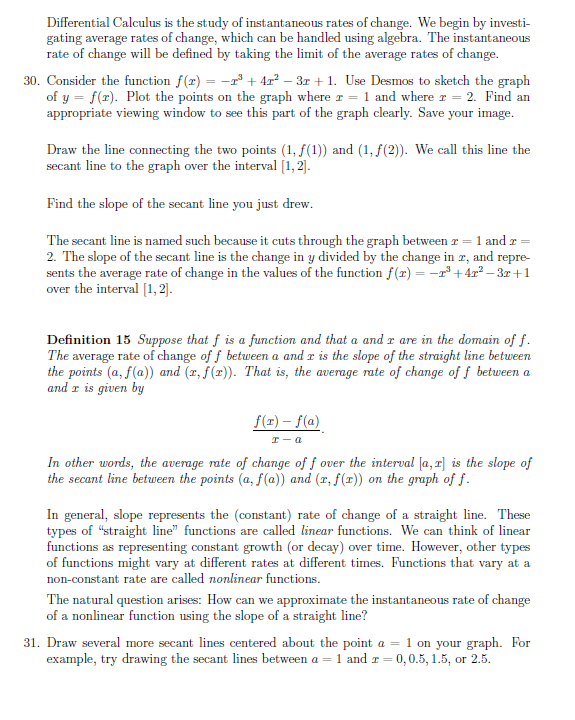
Differential Calculus is the study of instantaneous rates of change. We begin by investi- gating average rates of change, which can be handled using algebra. The instantaneous rate of change will be defined by taking the limit of the average rates of change. 30. Consider the function f(x) = -r + 4r' -3r + 1. Use Desmos to sketch the graph of y = f(x). Plot the points on the graph where r = 1 and where r = 2. Find an appropriate viewing window to see this part of the graph clearly. Save your image. Draw the line connecting the two points (1, f(1)) and (1, f(2)). We call this line the secant line to the graph over the interval [1, 2]. Find the slope of the secant line you just drew. The secant line is named such because it cuts through the graph between r = 1 and r = 2. The slope of the secant line is the change in y divided by the change in c, and repre- sents the average rate of change in the values of the function f(x) = -r' +4r? -3x+1 over the interval [1, 2]- Definition 15 Suppose that f is a function and that a and x are in the domain of f. The average rate of change of f between a and x is the slope of the straight line between the points (a, f(a)) and (r, f(x)). That is, the average rate of change of f between a and r is given by f(r) - f(a) In other words, the average rate of change of f over the interval [a, I] is the slope of the secant line between the points (a, f(a) ) and (r, f(x)) on the graph of f. In general, slope represents the (constant) rate of change of a straight line. These types of "straight line" functions are called linear functions. We can think of linear functions as representing constant growth (or decay) over time. However, other types of functions might vary at different rates at different times. Functions that vary at a non-constant rate are called nonlinear functions. The natural question arises: How can we approximate the instantaneous rate of change of a nonlinear function using the slope of a straight line? 31. Draw several more secant lines centered about the point a = 1 on your graph. For example, try drawing the secant lines between a = 1 and r = 0, 0.5, 1.5, or 2.5
Step by Step Solution
There are 3 Steps involved in it

Get step-by-step solutions from verified subject matter experts
 Study Help