







Question: please do the postlab question #1 and 2 based on the first page of lab. thank you Lab - Titration Titration involves the addition of
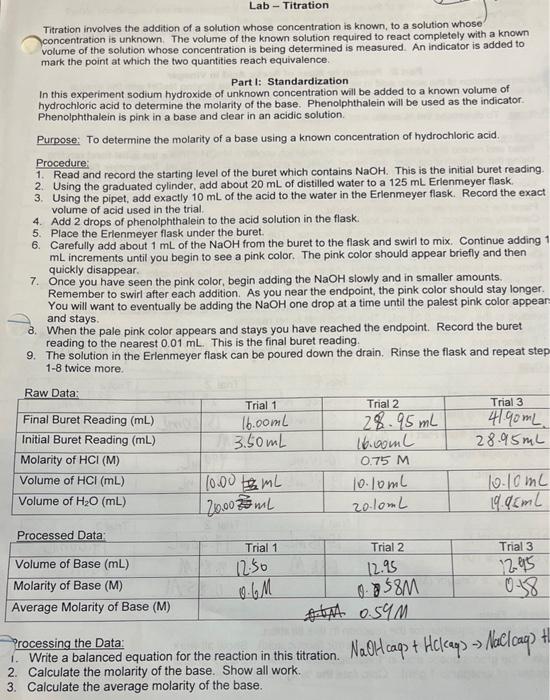

Lab - Titration Titration involves the addition of a solution whose concentration is known, to a solution whose concentration is unknown The volume of the known solution required to react completely with a known volume of the solution whose concentration is being determined is measured. An indicator is added to mark the point at which the two quantities reach equivalence. Part I: Standardization In this experiment sodium hydroxide of unknown concentration will be added to a known volume of hydrochloric acid to determine the molarity of the base. Phenolphthalein will be used as the indicator Phenolphthalein is pink in a base and clear in an acidic solution Purpose: To determine the molarity of a base using a known concentration of hydrochloric acid. Procedure 1. Read and record the starting level of the buret which contains NaOH. This is the initial buret reading. 2. Using the graduated cylinder, add about 20 mL of distilled water to a 125 mL Erlenmeyer flask 3. Using the pipet, add exactly 10 mL of the acid to the water in the Erlenmeyer flask. Record the exact volume of acid used in the trial 4. Add 2 drops of phenolphthalein to the acid solution in the flask. 5. Place the Erlenmeyer flask under the buret. 6. Carefully add about 1 mL of the NaOH from the buret to the flask and swirl to mix. Continue adding 1 ml. increments until you begin to see a pink color. The pink color should appear briefly and then quickly disappear 7. Once you have seen the pink color, begin adding the NaOH slowly and in smaller amounts. Remember to swirl after each addition. As you near the endpoint, the pink color should stay longer, You will want to eventually be adding the NaOH one drop at a time until the palest pink color appear and stays 3. When the pale pink color appears and stays you have reached the endpoint. Record the buret reading to the nearest 0.01 mL. This is the final buret reading 9. The solution in the Erlenmeyer flask can be poured down the drain. Rinse the flask and repeat step 1-8 twice more Raw Data: Trial 1 16.00ml 3.50mL Trial 3 41.90mL. 28.95mL Final Buret Reading (mL) Initial Buret Reading (mL) Molarity of HCI (M) Volume of HCI (mL) Volume of H20 (ml) Trial 2 28.95 ml 16.00ml 0.75 M 10.loml 2o-lomL 10.00 ML 10.10mL 19.95mL 120,00 Boml Processed Data: Trial 2 Trial 3 Volume of Base (mL) Molarity of Base (M) Average Molarity of Base (M) Trial 1 12.50 0.6M 12.95 12.95 0.858M att os9M Nallt cap + Hcleays-> Mallcamp t- Processing the Data: 1. Write a balanced equation for the reaction in this titration. 2. Calculate the molarity of the base. Show all work. 3. Calculate the average molarity of the base. Postlab Questions: 1. We did not use the volume of the water initially added to the Erlenmeyer in our calculations. Why? What was the purpose of recording the volume of water used? 2. Describe the apparent relationship between (H') and (OH) when the endpoint is reached in an acid- base titration
Step by Step Solution
There are 3 Steps involved in it

Get step-by-step solutions from verified subject matter experts
 Study Help