







Question: please do this for group #1, include all tables filled out please. This was everything that was given, there is no more info to be
 please do this for group #1, include all tables filled out please.
This was everything that was given, there is no more info to be given
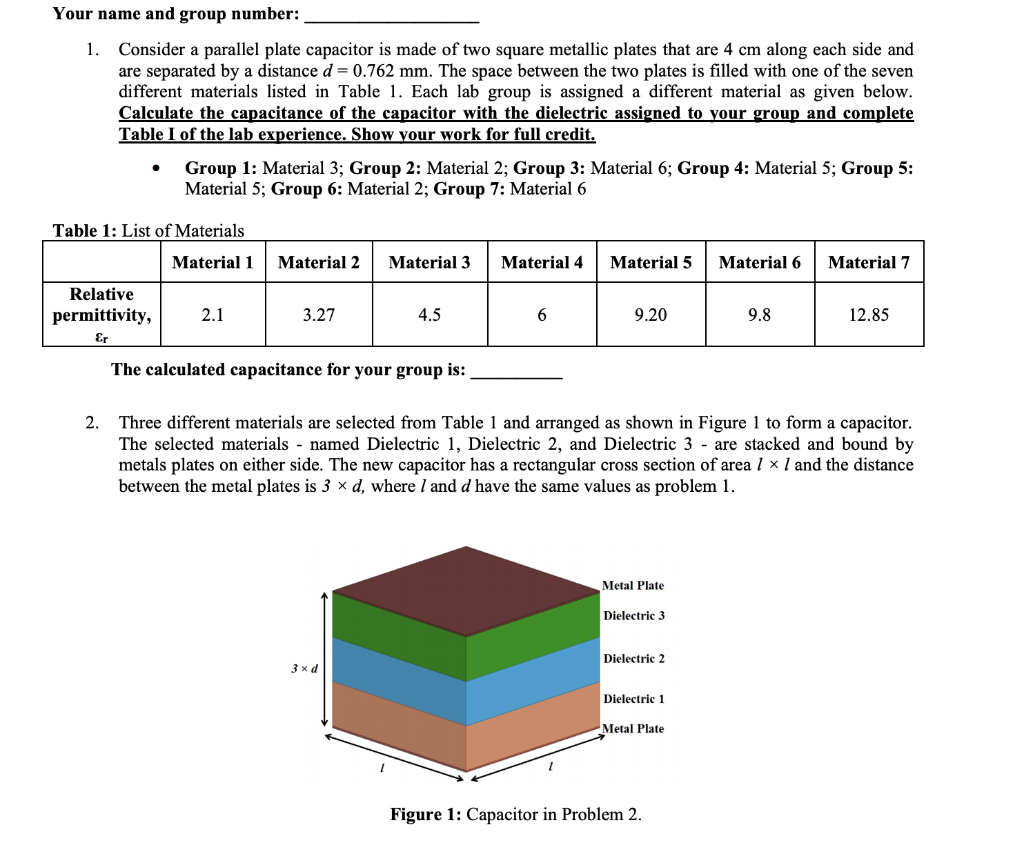
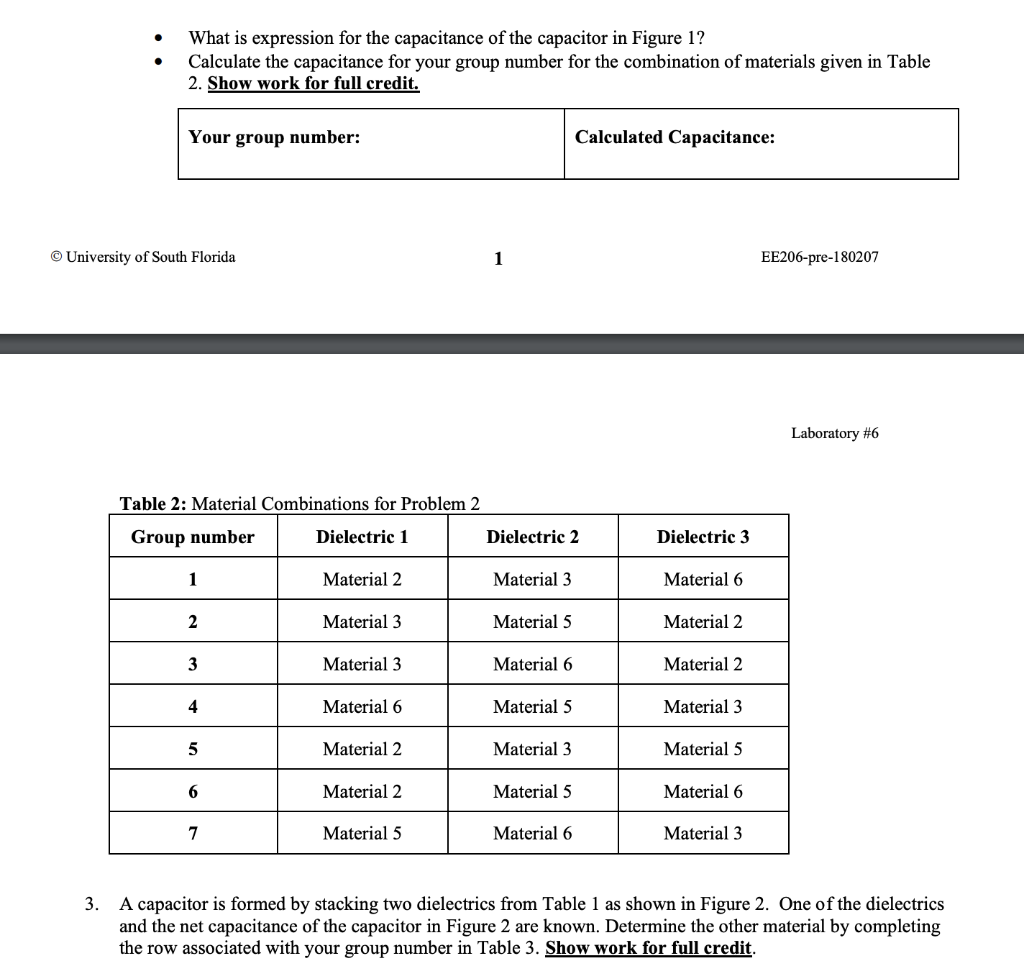
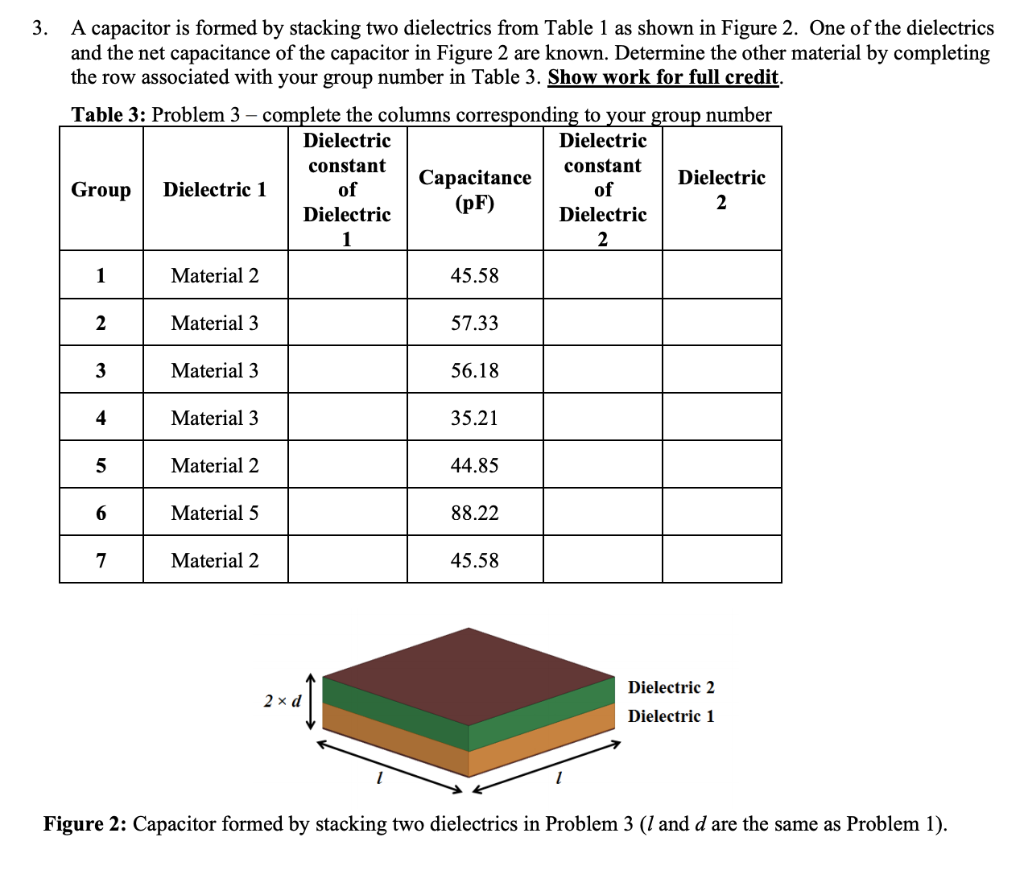
Your name and group number: 1. Consider a parallel plate capacitor is made of two square metallic plates that are 4 cm along each side and are separated by a distance d = 0.762 mm. The space between the two plates is filled with one of the seven different materials listed in Table 1. Each lab group is assigned a different material as given below. Calculate the capacitance of the capacitor with the dielectric assigned to your group and complete Table I of the lab experience. Show your work for full credit. Group 1: Material 3; Group 2: Material 2; Group 3: Material 6; Group 4: Material 5; Group 5: Material 5; Group 6: Material 2, Group 7: Material 6 Table 1: List of Materials Material 1 Material 2 Material 3 Material 4 Material 5 Material 6 Material 7 Relative permittivity, Er 2.1 3.27 4.5 6 9.20 9.8 12.85 The calculated capacitance for your group is: 2. Three different materials are selected from Table 1 and arranged as shown in Figure 1 to form a capacitor. The selected materials - named Dielectric 1, Dielectric 2, and Dielectric 3 - are stacked and bound by metals plates on either side. The new capacitor has a rectangular cross section of area 1 x 1 and the distance between the metal plates is 3 x d, where I and d have the same values as problem 1. Metal Plate Dielectric 3 Dielectric 2 3 xd Dielectric 1 Metal Plate Figure 1: Capacitor in Problem 2. . . What is expression for the capacitance of the capacitor in Figure 1? Calculate the capacitance for your group number for the combination of materials given in Table 2. Show work for full credit. Your group number: Calculated Capacitance: University of South Florida 1 EE206-pre-180207 Laboratory #6 Table 2: Material Combinations for Problem 2 Group number Dielectric 1 Dielectric 2 Dielectric 3 1 Material 2 Material 3 Material 6 2 Material 3 Material 5 Material 2 3 Material 3 Material 6 Material 2 4 Material 6 Material 5 Material 3 5 Material 2 Material 3 Material 5 6 Material 2 Material 5 Material 6 7 Material 5 Material 6 Material 3 3. A capacitor is formed by stacking two dielectrics from Table 1 as shown in Figure 2. One of the dielectrics and the net capacitance of the capacitor in Figure 2 are known. Determine the other material by completing the row associated with your group number in Table 3. Show work for full credit. 3. A capacitor is formed by stacking two dielectrics from Table 1 as shown in Figure 2. One of the dielectrics and the net capacitance of the capacitor in Figure 2 are known. Determine the other material by completing the row associated with your group number in Table 3. Show work for full credit. Table 3: Problem 3 - complete the columns corresponding to your group number Dielectric Dielectric constant constant Capacitance Dielectric Group Dielectric 1 of of Dielectric (pF) 2 Dielectric 2 1 Material 2 45.58 2 Material 3 57.33 3 Material 3 56.18 4 Material 3 35.21 5 Material 2 44.85 6 Material 5 88.22 7 Material 2 45.58 Dielectric 2 2 x d Dielectric 1 Figure 2: Capacitor formed by stacking two dielectrics in Problem 3 (l and d are the same as Problem 1). Your name and group number: 1. Consider a parallel plate capacitor is made of two square metallic plates that are 4 cm along each side and are separated by a distance d = 0.762 mm. The space between the two plates is filled with one of the seven different materials listed in Table 1. Each lab group is assigned a different material as given below. Calculate the capacitance of the capacitor with the dielectric assigned to your group and complete Table I of the lab experience. Show your work for full credit. Group 1: Material 3; Group 2: Material 2; Group 3: Material 6; Group 4: Material 5; Group 5: Material 5; Group 6: Material 2, Group 7: Material 6 Table 1: List of Materials Material 1 Material 2 Material 3 Material 4 Material 5 Material 6 Material 7 Relative permittivity, Er 2.1 3.27 4.5 6 9.20 9.8 12.85 The calculated capacitance for your group is: 2. Three different materials are selected from Table 1 and arranged as shown in Figure 1 to form a capacitor. The selected materials - named Dielectric 1, Dielectric 2, and Dielectric 3 - are stacked and bound by metals plates on either side. The new capacitor has a rectangular cross section of area 1 x 1 and the distance between the metal plates is 3 x d, where I and d have the same values as problem 1. Metal Plate Dielectric 3 Dielectric 2 3 xd Dielectric 1 Metal Plate Figure 1: Capacitor in Problem 2. . . What is expression for the capacitance of the capacitor in Figure 1? Calculate the capacitance for your group number for the combination of materials given in Table 2. Show work for full credit. Your group number: Calculated Capacitance: University of South Florida 1 EE206-pre-180207 Laboratory #6 Table 2: Material Combinations for Problem 2 Group number Dielectric 1 Dielectric 2 Dielectric 3 1 Material 2 Material 3 Material 6 2 Material 3 Material 5 Material 2 3 Material 3 Material 6 Material 2 4 Material 6 Material 5 Material 3 5 Material 2 Material 3 Material 5 6 Material 2 Material 5 Material 6 7 Material 5 Material 6 Material 3 3. A capacitor is formed by stacking two dielectrics from Table 1 as shown in Figure 2. One of the dielectrics and the net capacitance of the capacitor in Figure 2 are known. Determine the other material by completing the row associated with your group number in Table 3. Show work for full credit. 3. A capacitor is formed by stacking two dielectrics from Table 1 as shown in Figure 2. One of the dielectrics and the net capacitance of the capacitor in Figure 2 are known. Determine the other material by completing the row associated with your group number in Table 3. Show work for full credit. Table 3: Problem 3 - complete the columns corresponding to your group number Dielectric Dielectric constant constant Capacitance Dielectric Group Dielectric 1 of of Dielectric (pF) 2 Dielectric 2 1 Material 2 45.58 2 Material 3 57.33 3 Material 3 56.18 4 Material 3 35.21 5 Material 2 44.85 6 Material 5 88.22 7 Material 2 45.58 Dielectric 2 2 x d Dielectric 1 Figure 2: Capacitor formed by stacking two dielectrics in Problem 3 (l and d are the same as Problem 1)
Step by Step Solution
There are 3 Steps involved in it

Get step-by-step solutions from verified subject matter experts
 Study Help