







Question: Please do this in R Dataset:: Channel Views A 54 A 171 A 20 A 403 A 38 B 38 B 43 B 21 B
Please do this in R
Dataset::
"Channel" "Views" A 54 A 171 A 20 A 403 A 38 B 38 B 43 B 21 B 8 B 41 C 935 C 15 C 4 C 7 C 5 D 130 D 96 D 867 D 1955 D 310 E 472 E 25 E 87 E 213 E 26 F 98 F 10 F 56 F 34 F 18
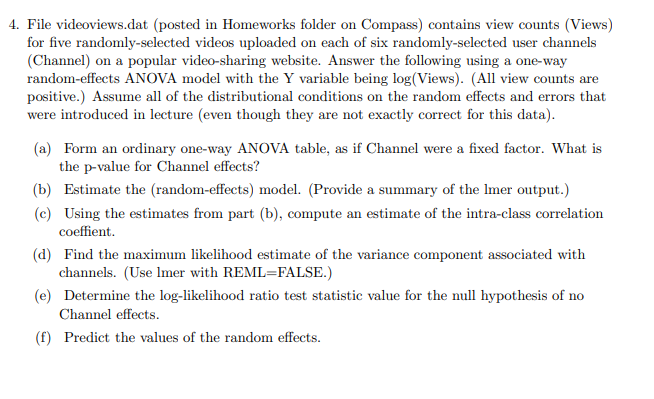
4. File videoviews.dat (posted in Homeworks folder on Compass) contains view counts (Views) for five randomly-selected videos uploaded on each of six randomly selected user channels (Channel) on a popular video-sharing website. Answer the following using a one-way random-effects ANOVA model with the Y variable being log(Views). (All view counts are positive.) Assume all of the distributional conditions on the random effects and errors that were introduced in lecture (even though they are not exactly correct for this data). (a) Form an ordinary one-way ANOVA table, as if Channel were a fixed factor. What is the p-value for Channel effects? (b) Estimate the (random-effects) model. (Provide a summary of the Imer output.) (c) Using the estimates from part (b), compute an estimate of the intra-class correlation coeffient. (d) Find the maximum likelihood estimate of the variance component associated with channels. (Use Imer with REML=FALSE.) (e) Determine the log-likelihood ratio test statistic value for the null hypothesis of no Channel effects. (f) Predict the values of the random effects. 4. File videoviews.dat (posted in Homeworks folder on Compass) contains view counts (Views) for five randomly-selected videos uploaded on each of six randomly selected user channels (Channel) on a popular video-sharing website. Answer the following using a one-way random-effects ANOVA model with the Y variable being log(Views). (All view counts are positive.) Assume all of the distributional conditions on the random effects and errors that were introduced in lecture (even though they are not exactly correct for this data). (a) Form an ordinary one-way ANOVA table, as if Channel were a fixed factor. What is the p-value for Channel effects? (b) Estimate the (random-effects) model. (Provide a summary of the Imer output.) (c) Using the estimates from part (b), compute an estimate of the intra-class correlation coeffient. (d) Find the maximum likelihood estimate of the variance component associated with channels. (Use Imer with REML=FALSE.) (e) Determine the log-likelihood ratio test statistic value for the null hypothesis of no Channel effects. (f) Predict the values of the random effectsStep by Step Solution
There are 3 Steps involved in it
1 Expert Approved Answer
Step: 1 Unlock

Question Has Been Solved by an Expert!
Get step-by-step solutions from verified subject matter experts
Step: 2 Unlock
Step: 3 Unlock
 Study Help