







Question: please do through excel Enterprises is considering buying a vacant lot that sells for $1.1 million. If the property is purchased, the company's plan is
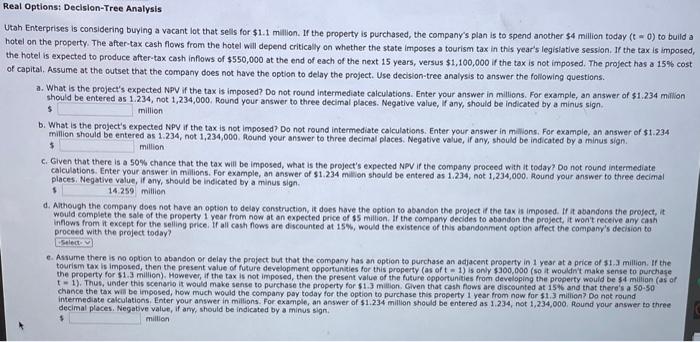
Enterprises is considering buying a vacant lot that sells for $1.1 million. If the property is purchased, the company's plan is to spend another $4 million today (t =0 ) to build I on the property. The after-tax cash flows from the hotel will depend critically on whether the state imposes a tourism tax in this year's legislative session. If the tax is impose hotel is expected to produce after-tax cash inflows of $550,000 at the end of each of the next 15 years, versus $1,100,000 if the tax is not imposed. The project has a 15% con apital. Assume at the outset that the company does not have the option to delay the project. Use decision-tree analysis to answer the following questions. a. What is the project's expected NPV if the tax is imposed? Do not round intermediste calculations. Enter your answer in millions. For example, an answer of s1.234 million should be entered as 1,234 , not 1,234,000. Round your answer to three decimal places. Negative value, If any, should be indicated by a minus sign. 5 million b. What is the project's expected NPV if the tax is not impesed? Do not round intermediate calculations. Enter your answer in millions. For example, an answer of $1.234 milion shauld be antered as 1.234, not 1,234,000. Round your answer to three decimal places. Negative value, if any, should be indicated by a minus sign. 5 million c. Given that there is a 50% chance that the tax will be imposed, what is the project's expected NPV if the company proceed with it todar? Do not round intermediate calculations. Enter your answer in millions. For example, an answer of 51.234 million should be entered as 1.234, not 1,234,000. Round your answer to three decimal places. Negative value. If any, should be indicated by a minus sign. 1 mililion d. Athough the company does not have an optign to delay constraction, it does have the option to abandon the project if the tax is imposed. If it abandons the project, it would complete the sale of the property 1 year from now at an expected price of 15 milion. If the compary decides to abandon the project, it wont receive any cash infhows from it except for the selling price. If all cash flows are discounted at 15%, would the existence of this abandonment option affect the company's decision to broceed with the project today? e. Assume there is no option to abandon or delay the project but that the company has an option to purchase an adjacent property in 1 yesr at a grice of 31.3 million. If the tourism tax is imposed, then the present value of future developenent oppertunmies for this property (as of t=1 ) is only s300,00o (so it wouldint make sense to purchase the property for s1.3 millico). However, if the tax is not imposed, then the present value of the future coportunities from developing the property would be $4 mulition (as of t=1 ). Thuo, under this scenario is would make sense to purchase the property for 51.3m mion. Given that cash faws are discounted at is\% and that theres a 5050 ( chance the tax will be imposed, how much would the company pay today for the option to purchase this property 1 year from now for 51.3 mition? Do not round intermediate calculations. Enter your answer in millions. For example, an answer of $1.234 million should be entered as 1.234 , not 1,234,000. Pound your answer to three decimal olaces. Neoative value, if amy, should be indicated by a minus sign. is mition d. Although the would complet inflows from it proceed with -Select- Yes e No re Enterprises is considering buying a vacant lot that sells for $1.1 million. If the property is purchased, the company's plan is to spend another $4 million today (t =0 ) to build I on the property. The after-tax cash flows from the hotel will depend critically on whether the state imposes a tourism tax in this year's legislative session. If the tax is impose hotel is expected to produce after-tax cash inflows of $550,000 at the end of each of the next 15 years, versus $1,100,000 if the tax is not imposed. The project has a 15% con apital. Assume at the outset that the company does not have the option to delay the project. Use decision-tree analysis to answer the following questions. a. What is the project's expected NPV if the tax is imposed? Do not round intermediste calculations. Enter your answer in millions. For example, an answer of s1.234 million should be entered as 1,234 , not 1,234,000. Round your answer to three decimal places. Negative value, If any, should be indicated by a minus sign. 5 million b. What is the project's expected NPV if the tax is not impesed? Do not round intermediate calculations. Enter your answer in millions. For example, an answer of $1.234 milion shauld be antered as 1.234, not 1,234,000. Round your answer to three decimal places. Negative value, if any, should be indicated by a minus sign. 5 million c. Given that there is a 50% chance that the tax will be imposed, what is the project's expected NPV if the company proceed with it todar? Do not round intermediate calculations. Enter your answer in millions. For example, an answer of 51.234 million should be entered as 1.234, not 1,234,000. Round your answer to three decimal places. Negative value. If any, should be indicated by a minus sign. 1 mililion d. Athough the company does not have an optign to delay constraction, it does have the option to abandon the project if the tax is imposed. If it abandons the project, it would complete the sale of the property 1 year from now at an expected price of 15 milion. If the compary decides to abandon the project, it wont receive any cash infhows from it except for the selling price. If all cash flows are discounted at 15%, would the existence of this abandonment option affect the company's decision to broceed with the project today? e. Assume there is no option to abandon or delay the project but that the company has an option to purchase an adjacent property in 1 yesr at a grice of 31.3 million. If the tourism tax is imposed, then the present value of future developenent oppertunmies for this property (as of t=1 ) is only s300,00o (so it wouldint make sense to purchase the property for s1.3 millico). However, if the tax is not imposed, then the present value of the future coportunities from developing the property would be $4 mulition (as of t=1 ). Thuo, under this scenario is would make sense to purchase the property for 51.3m mion. Given that cash faws are discounted at is\% and that theres a 5050 ( chance the tax will be imposed, how much would the company pay today for the option to purchase this property 1 year from now for 51.3 mition? Do not round intermediate calculations. Enter your answer in millions. For example, an answer of $1.234 million should be entered as 1.234 , not 1,234,000. Pound your answer to three decimal olaces. Neoative value, if amy, should be indicated by a minus sign. is mition d. Although the would complet inflows from it proceed with -Select- Yes e No re
Step by Step Solution
There are 3 Steps involved in it

Get step-by-step solutions from verified subject matter experts
 Study Help